






The community saw a win for justice a few weeks ago when two students from BC Law’s Civil Rights Clinic won their bond arguments for two immigrant clients, allowing them to be freed and go home to their families.
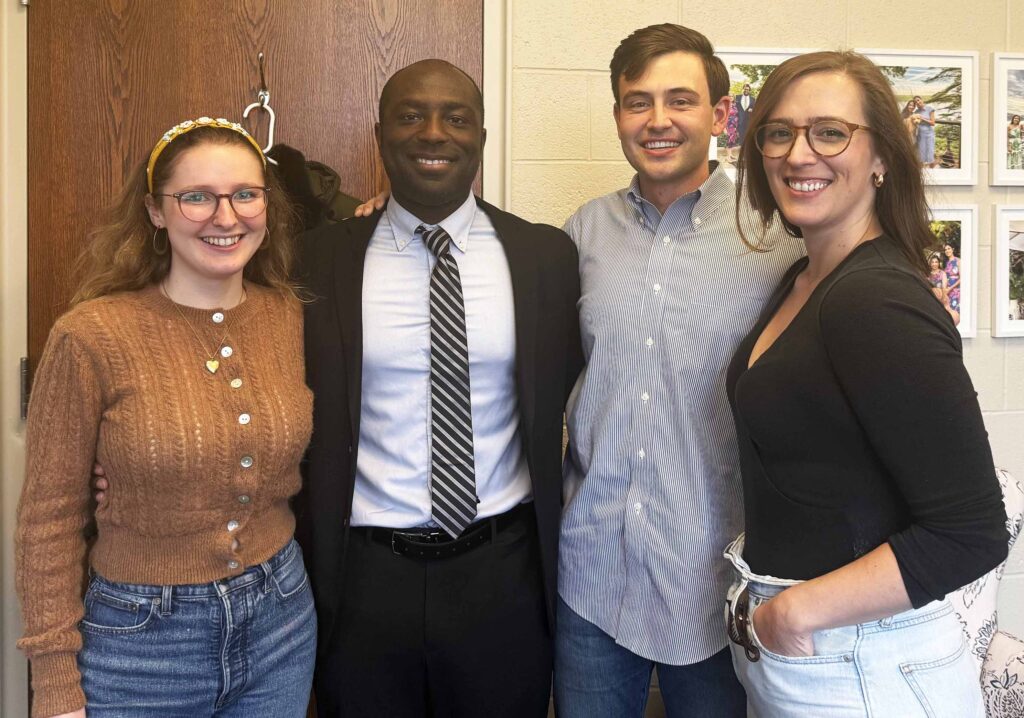
Directed by Reena Parikh, the Civil Rights Clinic allows students to engage in different modes of lawyering, assigning each student at least one litigation matter and one community or policy advocacy matter. Litigation matters may include civil rights cases on behalf of low-wage workers, prisoners, or immigrants, as was the case for 2Ls Mitchord Cope-Hobbs, Max German, Portia Caruso, and Catelyn Devlin.
Cope-Hobbs and German each represented an immigrant who was referred to the clinic by the PAIR Project, a nonprofit legal services organization that represents detained immigrants. With the help of PAIR, each client had previously won a habeas petition after months of being imprisoned by ICE. The petition orders an immigration judge to give the clients due process with a bond hearing that would ultimately determine if they would be released from detention. At that point, the Civil Rights Clinic took over, with only a few weeks for Cope-Hobbs and German to prepare for the bond hearings.
“They were the embodiment of zealous advocates,” Parikh said. Both students won their bond motions with the help of the clients’ families who put together letters of support from the community, and the strong support of their teammates, Caruso and Catelyn, who are currently preparing a brief for the Board of Immigration Appeals to keep a third client free from detention.
“We are so lucky to be part of a legal community in Massachusetts that is so justice-oriented and collaborative,” Parikh said, expressing gratitude for Professor Mary Holper whose Immigration Clinic provided helpful bond materials for the Civil Rights Clinic, which doesn’t typically handle immigration cases.
Cope-Hobbs highlighted the teamwork this process took. “Since the beginning this was a collaborative effort, from my clinical professor and my classmates who provided so much support along the way, to the friends and family of my client who spoke up to let it be known how much he meant to the community,” he said. “This whole experience has shown me how powerful a community can be when it comes together to support one of their own and I am proud to have played my part as a representative.”
For German, the experience affirmed his decision to be an attorney. “I came to law school because I wanted to help people and now I understand better than ever what that truly means,” he said. “To help give somebody a voice who otherwise wouldn’t have one, is an incredible, yet empowering, responsibility. The entire process, from the help of my team to working with the client and his family, solidified the idea that we, as law students and attorneys, are in a special position to make this world a better place.”
Fighting immigration battles is both ongoing and of the essence. “The treatment of immigrants is a key civil rights and human rights issue of our time. It’s a privilege to create opportunities in the Civil Rights Clinic for our students to join BC’s strong legacy of elevating immigrant voices,” Parikh said.