







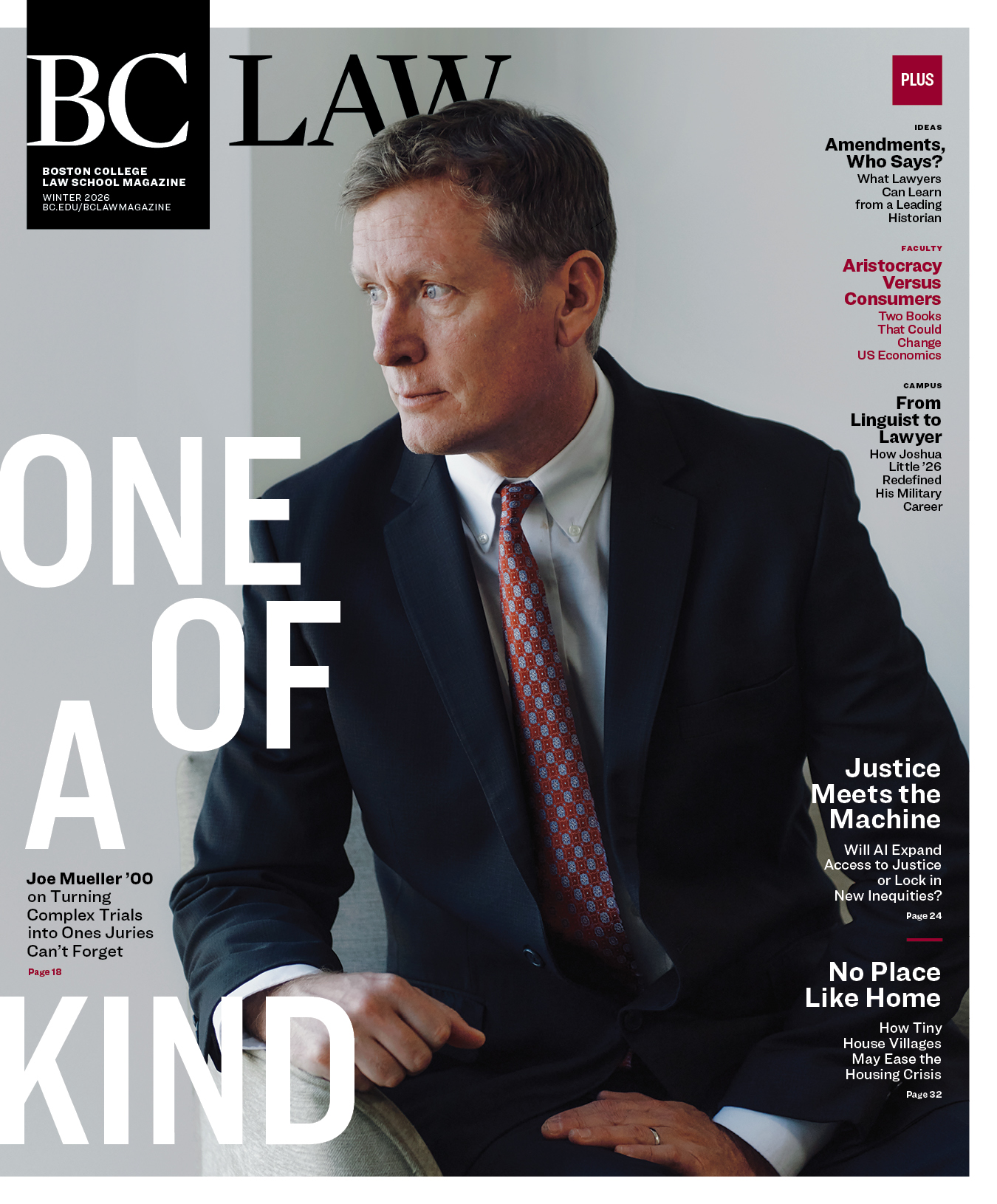
Boston College Law School will never run out of stories to tell. And within them are all manner of character-defining behaviors, ideas, achievements, challenges, surprises. BC Law Magazine, online and in print, annually publishes hundreds of such tales, and they have grown into an archive to treasure.
The Winter 2026 issue adds to the compilation of what distinguishes a community determined to cut through propaganda, criminal behavior, immorality, and the like, in order to preserve the standards that it holds sacred: integrity and equity. The standards become legal tools used in members’ courtrooms, scholarship, and classrooms. What follows are three examples of how BC Law colleagues exemplify or apply those measures for the greater good.
Litigation. It’s the profession’s foundational mechanism for enforcing rights and resolving disputes. Joseph Mueller ’00 is a one-of-a-kind achiever in the field. His victories involve millions—sometimes billions—of dollars, his cases run the intellectual property gamut, his quantity of trials is way up there. But it’s his ingenious use of “demonstratives” and his teacherly demeanor, among other personal qualities, that elevate his story to another level of community understanding. He finds “the different pieces of what he sees out there that he thinks work well and meshes them with his own personality to come up with a style that is uniquely his,” says one of his WilmerHale colleagues. That style, it turns out, has BC Law written all over it.
In a similar way, so does the work of James Sturdevant ’72. As a young legal-service attorney representing vulnerable individuals, he came to see how class action litigation might have a greater impact not only on clients like his but also on the legal system as a whole. He has spent the last 50 years proving that to be true, a sincere act of BC Law kindness.
Housing. In her scholarship, Professor Lisa Alexander has taken on what has become an enormous challenge in America: homelessness. She is helping to solve it with tiny homes. The concept is not only to provide a variety of people with safe dwellings, it is also to give residents a sense of responsibility for maintaining and improving the entire village in which they live. Alexander believes that the right to housing is just as vital as the rights to free speech, assembly, and religion, even though it is not yet legally recognized. She’s teaching that lesson to her BC Law students.
Vicki Sanders, Editor
vicki.sanders@bc.edu