






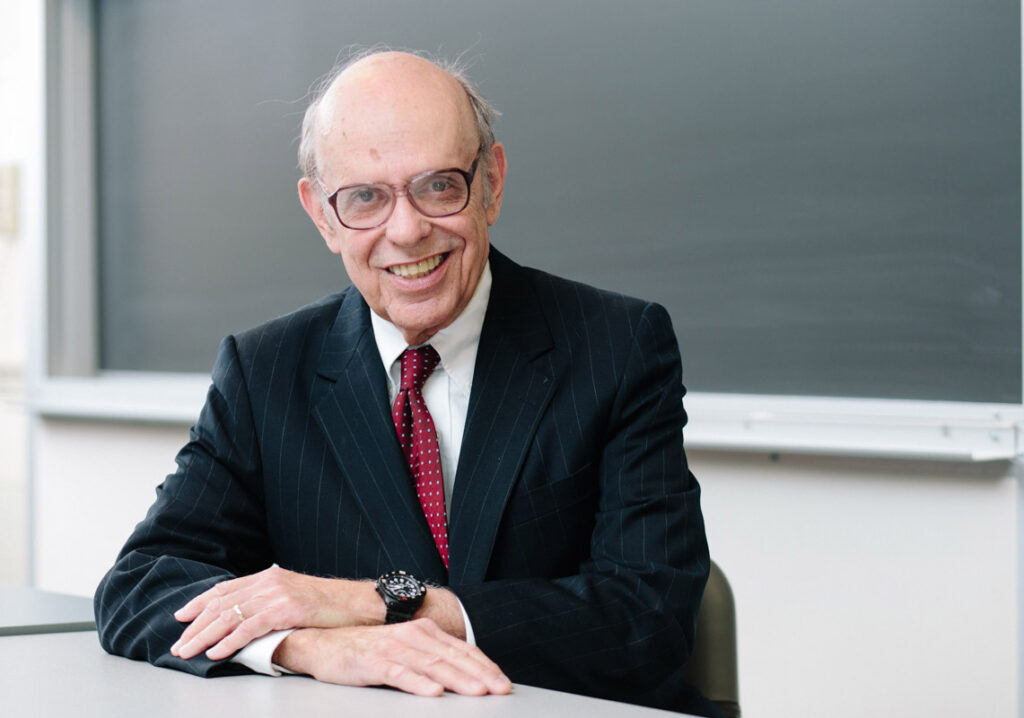
Boston College Law School’s George Brown, an influential scholar, teacher, and admired legal authority, passed away on March 12. As colleague Mary Bilder put it upon learning of his death, “He was the model of intellectual humility, brilliance, responsibility, and integrity. And he had an incredible work ethic.”
Admitting to workaholic tendencies at the time of his retirement—Brown retired in 2021 after nearly five decades at BC Law—he continued researching and publishing in law reviews as the Emeritus Robert Drinan, SJ, Professor of Law. He worked on an article about court packing, and followed a slew of blogs, both liberal and conservative. Until recently, he was often spotted in an emeritus office or greeting students and fellow professors in the hallways with his collegial smile.
The Law School meant a lot to Brown from beginning to end. “There is a certain symmetry to it all,” he said about teaching his final class in November of 2020: “Fifty years earlier—almost to the day—I drove out Commonwealth Avenue for my interview with [then-acting] Dean Richard Huber and the Boston College Law School community. What I found astonished me. The school was vibrant at every level. There was an exciting junior and mid-level faculty. There was a distinguished senior faculty. They were integral members of the community, still productive, respected by all. The students were impressive.
“I spent a lot of time with [Dean Huber],” Brown said of that first visit. “Our conversation changed my mind about teaching. I had been leaning toward going back into state government. The whole visit convinced me to throw my hat in the ring.”
Huber continued to play a helpful role in Brown’s decision-making over the years, a characteristic of BC Law’s leadership style. “I remember having a severe case of writer’s block, and how patiently he talked me through it.” Brown said. “I sometimes thought of leaving. The school indulged me with leaves, and I always came back.”
Brown was long recognized for his influential scholarship in government ethics, public corruption, and federal-state relations. The two final courses he taught as a full-time professor were Political Corruption and Election Law, which were supercharged with material drawn straight from current events, from the “Bridgegate” controversy in New Jersey involving former Governor Chris Christie’s staff to battles over election law in the run-up to November 2020’s general election.
“He’s brilliant and self-effacing, so that most people would not know that he was a Sears Prize winner at Harvard Law School,” Brown’s longtime friend and colleague, Professor Zygmunt Plater, told BC Law Magazine in 2022. “When he writes an article, it’s to make a difference in the jurisprudence of the United States.” The claim was supported by the fact that Brown published some 45 scholarly articles and his work was cited more than 500 times in court opinions and law review articles, including by Supreme Court Justice Antonin Scalia in an influential dissent from a denial of certiorari in Sorich v. US (2009.)
A few years ago, Brown shared a couple of anecdotes about his BC Law experiences.
The first was his good-natured recollection of the annual student skit, Boston College Law Revue, that was merciless in poking fun at the school, mainly the faculty. “One year I was played by a student who was more like me than I was,” Brown said. “He had my every gesture down pat, and even wore a hair piece which mimicked perfectly my balding countenance. My date—later my wife—loved it, although I was a bit miffed, for a while.”
The second story referred to the Supreme Court citation mentioned above. “I taught a course on Political Corruption to an outstanding group of second- and third-year students. The classes helped me formulate an article which ended up being cited in the body of an opinion by Justice Scalia,” Brown recalled.
“What both stories have in common is the breadth of interactions between me and the students,” Brown said. “In particular, my research assistants have made invaluable contributions over the years. They are part of an extraordinary bunch; I hope all of them gained as much from me as I did from them.”
Friend and colleague Professor James Repetti emphasized Brown’s career as a public servant. Prior to joining BC Law, Brown served as an assistant attorney general under Elliot Richardson and as his legislative assistant. He also was a legislative counsel to US Senator Charles Matthias, an early supporter of Civil Rights and environmental protections.
George’s service included being the legislative assistant to Governor Frank Sargent, Repetti said, citing Sargent’s environmental activism, creation of the Massachusetts Appeals Court, and adoption of the state’s first corporate income tax, all of which influenced Brown’s early career. Brown also chaired the state’s ethics commission, which Repetti described as no easy task. “I would often tease George that that the title, ‘Massachusetts State Ethics Commission,’ had to be the ultimate oxymoron. He would always chuckle and respond in his understated manner and dry sense of humor, ‘It’s a tough job, but someone has to do it.’”
Outside of the academy, Brown explored the history of his hometown of Newburyport, Massachusetts. He and his wife Patricia, a retired teacher, were members of the town’s historical society, and Brown was a regular at its weekly Zoom trivia quiz. “I’ve only won it once, but it’s a lot of fun,” he once said. As Zyg Plater noted: Very quickly people realized, you couldn’t underestimate George Brown.
A number of other colleagues responded to Brown’s passing.
Professor Kent Greenfield called him a paragon of integrity: “He took things seriously, but he did not take disagreements personally. He had a quiet authority and a biting wit that made him a wonderful colleague. His intelligence and knowledge were surpassed only by his wisdom and strength of character. I will miss his good sense and his friendship even more.”
Mary Holper ’03, a professor and former student, recalled: “My husband and I took his fed courts class together in the early 2000s, and we still have so many fond memories of George with his hard candies studying passages from the casebook as he engaged our class in conversations around fascinating issues like federal courts’ jurisdiction.”
Professor Mark Brodin described Brown as “a one-of-a-kind—a consummate and incredibly productive scholar, a brilliant and beloved teacher, a wonderful colleague with great stories of his time in state government (the colorful characters all larger than life, from another time), and a dear, dear friend.”
Professor Paulo Barrozo said Brown’s contributions to BC Law were many and that “a particular mark distinguished and united all of them: the civility and modesty at the personal level and the integrity of his leadership in several positions, including that of interim dean, at the institutional level. Great institutions never become so unless they have the hands of people like George helping shape them. That was the good fortune of Boston College Law School.”
J. Donald Monan, SJ, University Professor Emeritus Daniel Coquillette made these observations: “All good institutions have people who are like glue, who hold the place together in good times and bad. I very clearly remember turning to George in hard times, when what the school needed was standards and respect for each other and our educational mission. George never failed to be the person who could do that. I often think, in my occasional trips to Washington, how much these values are needed, not just in legal education, but throughout America.”
Professor Robert Bloom recalled his friendship with Brown in this manner: “George would often brag about being the only Republican on the faculty. The type of republican George was one who was impeccably honest, caring for the environment, and always striving to make the world a better place. We would often tease each other as I was a Massachusetts Democrat and the [state] Legislature was always very democratic, but the voters would often elect a Republican Governor to keep an eye on things. One year we both taught Civil Procedure and our students dedicated their yearbook to us, and George would comment what strange bed-fellows we were. He was a great teacher who had a very wry sense of humor. He was such a great role model and cared greatly for our students.”
Samantha Ghelli, administrative assistant for the Law School’s Initiative on Land, Housing & Property Rights, had the pleasure of being in an office across from Brown’s emeritus workspace for nearly three years. Her desk was near her door so she could see everyone coming down the hall. “George was a bright light twice a week, every week. He would come to my office door and always ask how I was doing and what I was working on, despite it never really being anything interesting (you’d think he would stop caring by the fifth time I said ‘data entry’),” she said. “When I started working as an international election observer, George, of course, was someone I could speak to candidly and in depth about democratic integrity and the fate of tomorrow. He was always sweet, soft-spoken, and always had something new for me to read. I will always cherish how he cared about my small task and life, despite the big impact he made on the world around us.”
Northwestern Law Professor James Pfander, a scholarly colleague, wrote: “I knew Professor George Brown through his lucid scholarship on the law of federal jurisdiction. He made important contributions to a broad array of jurisdictional puzzles: the proper reading of the Eleventh Amendment, the application of state sovereign immunity, the incredibly disappearing Bivens doctrine, and a range of judge-made abstention doctrines that connect to his ongoing interest in federal-state relations. He was, needless to say, quite active in other fields of inquiry, compiling an enviable record of scholarly accomplishment that cut across a range of disciplines. The work I know best, on the law of federal jurisdiction, was always well informed and thoughtful and it remains vibrantly alive—essential reading for scholars working today in the fields to which he contributed so much.”
Photograph by Adam DeTour
Read more in the Boston Globe and from the State Ethics Commission.