






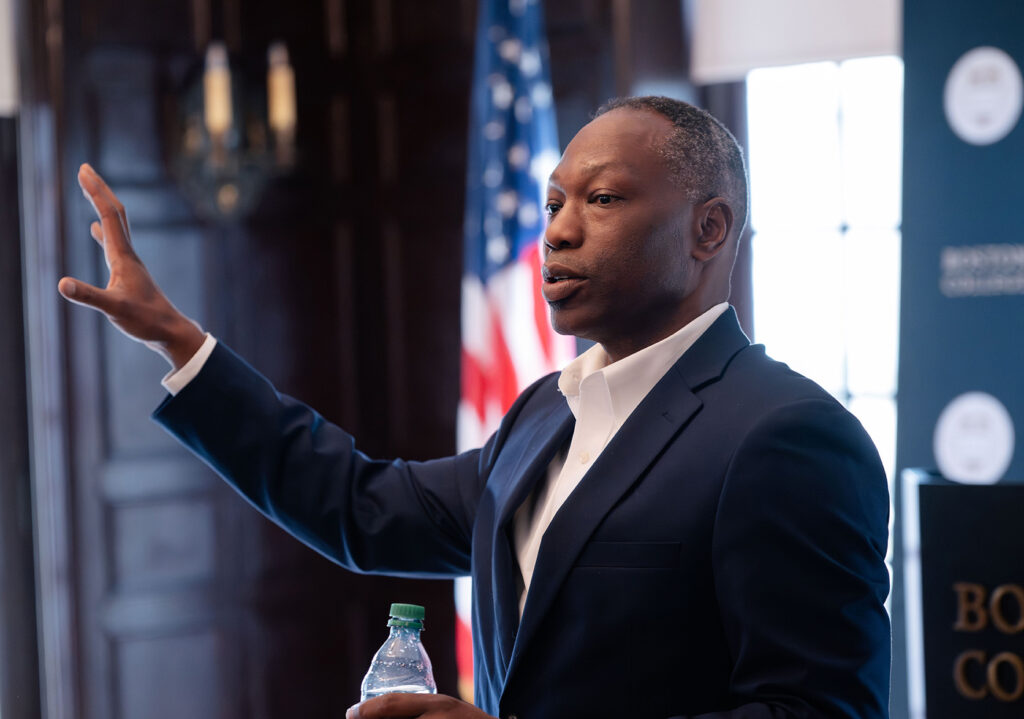
Boston College Law School hosted the annual Catharine Wells Memorial Lecture in Jurisprudence, a series established to honor the late professor’s lasting influence on legal philosophy and the intellectual life of the law school. The lecture invites prominent scholars to engage questions at the intersection of law, democracy, and political thought. This year, speaker Professor Guy-Uriel E. Charles examined one of the most enduring questions in American political life: Who belongs to the American polity and who has the authority to rule?
Charles is the Charles J. Ogletree Jr. Professor of Law at Harvard Law School and the faculty director of the Charles Hamilton Houston Institute for Race and Justice. His scholarship focuses on the ways law mediates political power and addresses racial subordination, particularly in the context of election law and democratic governance. In his talk on March 16, Charles turned his attention to America’s “identity crisis.” To understand the present moment in American society, he argued, the country must grapple with a set of fundamental questions. “Who are we? Who do we want to become? And who is invited to participate in American political life?”
As a scholar of voting rights, Charles approaches these questions through the structure of political participation. The issue, he explained, reaches beyond the mechanics of elections. Debates about voting and citizenship ultimately concern who is entitled to rule within the American constitutional system and how law distributes political authority.
Charles began his historical exploration with the Naturalization Act of 1790, signed by President George Washington. This statute set out several qualifications for citizenship, including two years of residency in the United States and evidence of good character. The law also contained a racial restriction in which citizenship was limited to “free white persons.”
The law reflected the assumptions of many early lawmakers about the character of the new nation: Immigration was essential to the country’s growth, yet lawmakers sought to manage perceived risks associated with new arrivals. While the ability to purchase and hold land offered immigrants a stake in the success of the republic and encouraged assimilation into American society, citizenship did not automatically guarantee the right to vote. Many leaders believed that suffrage should remain limited even as new residents gained property rights. This arrangement reflected a political system that sorted access to power according to race and social class.
Charles emphasized that the Naturalization Act did not represent a single, uncontested statement of American identity. Under the Articles of Confederation, states exercised authority over naturalization and followed a variety of practices. He contrasted the Naturalization Act with another foundational document, the Northwest Ordinance of 1787; section nine of the ordinance granted voting rights to free male residents who met certain age requirements. For Charles, the contrast between these two early laws reveals a central feature of American history From the nation’s founding, multiple visions of American identity have existed side by side.
The Constitution itself reflects this ambiguity. Its opening words, “We the People,” identify the source of political authority without defining who the people are. Charles described democratization as a continuing struggle over people-making. Conflicts over citizenship, suffrage, and representation represent attempts to define the boundaries of the political community. Race has played a central role in those conflicts. Legal institutions have often determined who is included within the American polity and who remains outside it.
To understand the present moment, Charles outlined four traditions that have shaped American debates about identity and political power.
The first tradition is ethnic nationalism, which defines the nation through ancestry and cultural identity. Charles pointed to the Supreme Court’s decision in Dred Scott v. Sandford as a powerful articulation of this view. Chief Justice Roger Taney argued that Black Americans could not be members of the political community under the Constitution.
Another tradition, civic nationalism, describes the United States as a nation grounded in universal political ideals. Advocates of this perspective emphasize commitments to liberty, equality, and democratic participation. Senator Charles Sumner and other Reconstruction era figures described the nation as a political community organized around shared principles rather than ethnic identity. Charles noted that the universalist vision has always existed alongside the reality of racial exclusion. Marginalized communities have often invoked the nation’s professed ideals to demand greater inclusion within the political system.
A third perspective, which Charles described as critical racial realism, centers the experiences of marginalized groups in understanding American identity. Thinkers such as Frederick Douglass and Thurgood Marshall highlighted the distance between the nation’s democratic ideals and its historical practices. Marshall once observed that the meaning of the Constitution did not remain fixed in 1787 and that later generations reshaped its principles through political struggle. Legal scholar Derrick Bell offered a darker interpretation of the nation’s trajectory. Bell argued that racism operates as a persistent structural force in American life. Even so, Charles explained that this perspective also recognizes the central role marginalized communities have played in sustaining the country’s democratic ideals.
The fourth tradition, colorblind nationalism, argues that American identity should exist apart from racial categories. Justice Antonin Scalia articulated this perspective in judicial opinions that described Americans as members of a single national race. Senator Barack Obama expressed a similar sentiment during his early political career when he declared that the United States contains neither a Black America nor a white America.
According to Charles, each of these traditions offers a distinct explanation of the relationship between race and American identity. Contemporary conflicts over voting rights and political participation reflect the ongoing competition among these visions. He pointed to modern debates over birthright citizenship and proposals that would require proof of citizenship for voting as examples of this struggle. For Charles, these conflicts ultimately revolve around political power. They determine who has the authority to participate in governance and whose interests shape the nation’s future.
So, why are Americans still fighting about identity? The answer, Charles suggested, lies in the stakes of the debate: Disputes about an American identity determine who belongs to the American polity and who has the right to rule within it.
Photograph: Andres Leiva ’26