






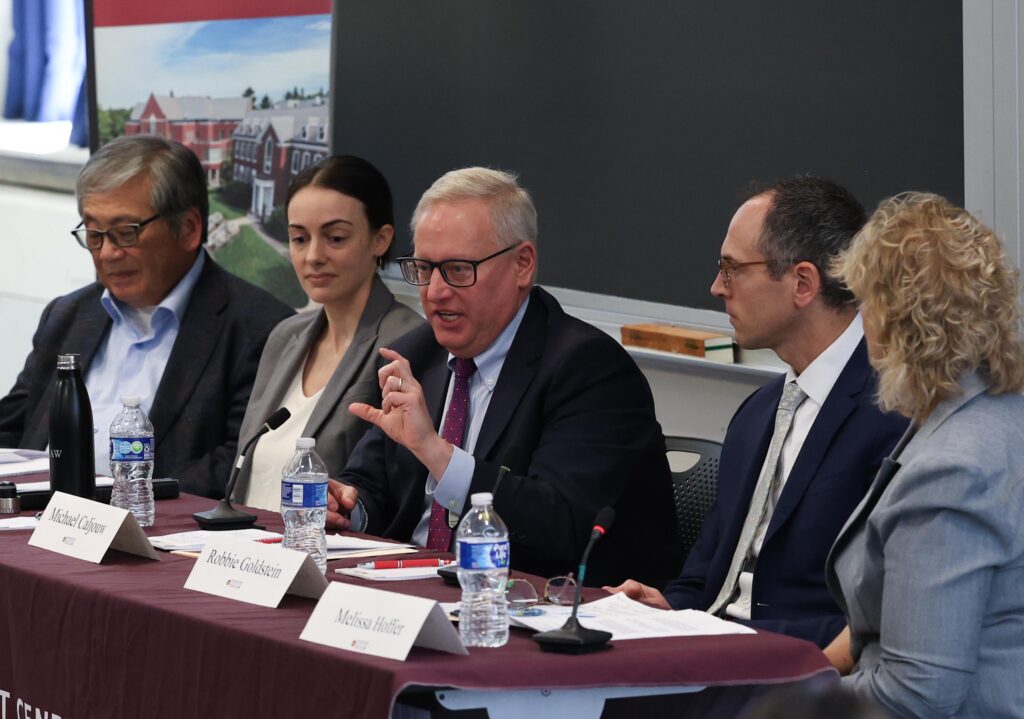
President Trump’s second inauguration set in motion significant changes to the regulation of public health and climate policy. To address the gaps created by federal officials, Massachusetts policymakers have developed state and regional initiatives to offset the impact of the national overhauls. On March 11, state leaders convened at Boston College Law School to discuss that work.
For Commissioner Robbie Goldstein of the Massachusetts Department of Public Health, responding to federal changes in vaccine regulation has been akin to “untangling a very complicated knot.” Early in the Trump administration, Goldstein observed the dismantling of long-standing vaccine regulatory practice and the replacement of public health officials with those “using ideology to drive decisions.” In response, the health department issued its own evidence-based vaccine recommendations and created a collaborative with states across the Northeast to standardize practices and recommendations in the region.
Massachusetts Climate Chief Melissa Hoffer—the first in her role—coordinates climate policy across all 11 state secretariats. Recognizing that climate change affects every sector, she emphasized that “we need to be thinking about climate change when we’re thinking about the policies emerging from every part of state government.”
Amid federal inaction, panelist Michael T. Caljouw, commissioner of the Division of Insurance, has focused on the growing affordability challenges facing Massachusetts policyholders. Some of the measures Caljouw is considering include changing the payment structure for primary care to make it more accessible for consumers, capping percentage increases allowed for deductibles, and eliminating prior authorization requirements in a number of areas.
Figuring out how to finance state initiatives is front of mind for the panelists. Caljouw disputed “the myth” that defunding programs necessarily saves money, noting that there are costs to bear when emergency care is the first point of relief.
Financing is of equal concern to Hoffer, who has been working on funding the state’s transition from fossil fuels to renewable energy. The Massachusetts Community Climate Bank, instituted in 2023, has been critical in hosting revolving loans that help fund decarbonization policies for Massachusetts homeowners.
The discussion titled “When the Feds Drop the Ball: State Innovations in Health and Climate Policy” was sponsored by the Rappaport Center for Law and Public Policy and moderated by BC Law professors Dean Hashimoto and Caroline Cox.
Photograph by Reba Saldanha