






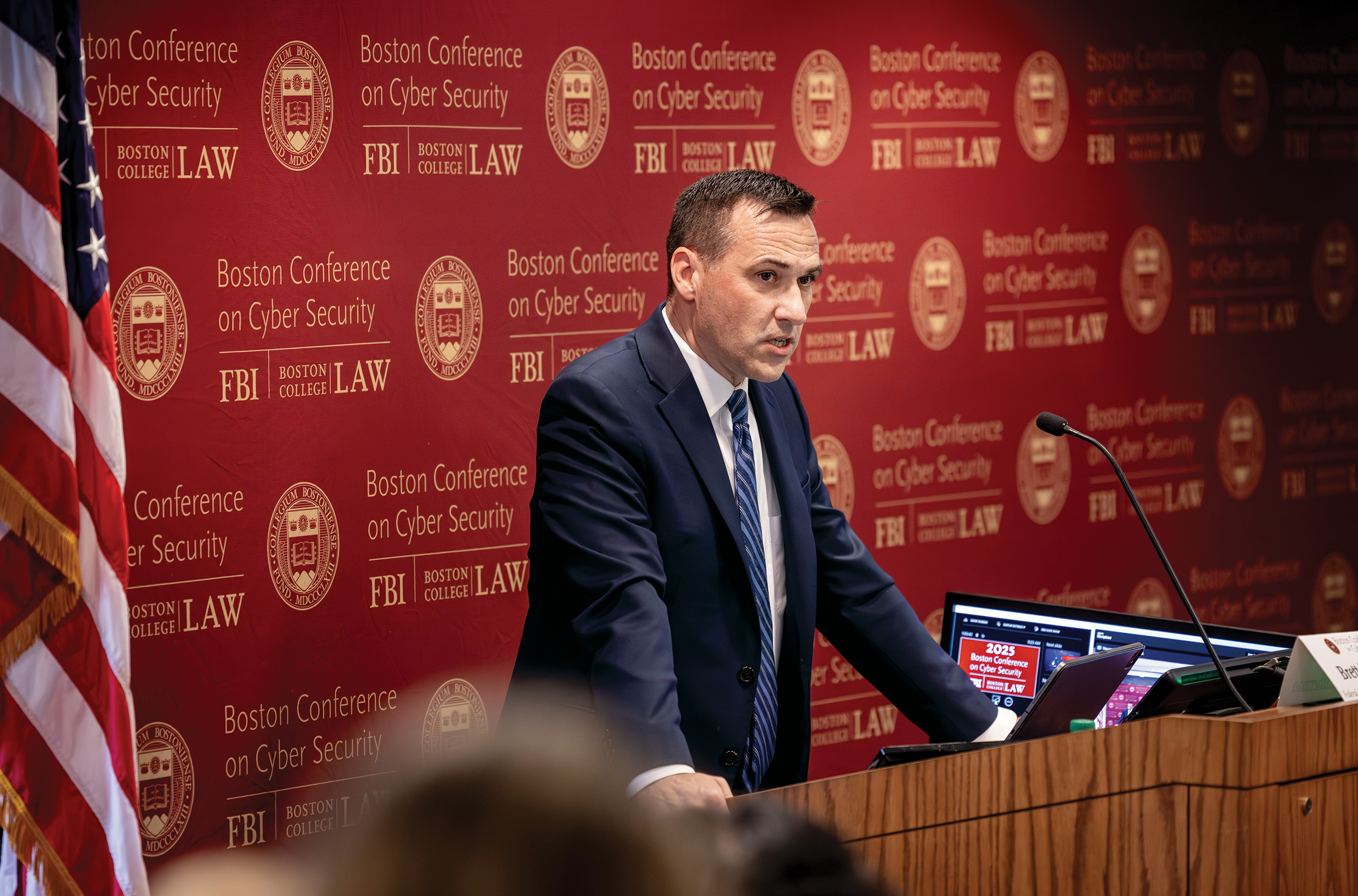

Last fall marked a new chapter in the Boston Conference on Cyber Security’s nine-year history at the University. In continued partnership with the Federal Bureau of Investigation, the conference is now being held at Boston College Law School, where the Master of Legal Studies in Cybersecurity, Risk, and Governance program was recently established under the direction of Kevin R. Powers.
Panel discussions ranged from topics on emerging technologies, operations, and enforcement to cyber and national security concerns. Among the featured speakers were experts from the FBI, Department of Justice, Kraft Group & Affiliates, Boston Bruins, Boston Celtics, Boston Red Sox, Bain Capital Ventures, Guidehouse, Hinckley Allen, & FINRA.
Brett Leatherman, assistant director of the FBI’s Cyber Division, delivered the keynote address, in which he recognized “the incredibly strong partnerships” that Boston College and the FBI field office in Boston have generated and maintained over the years. He also provided an overview of the impact of cyber threats at local, state, and international levels, stating that in 2024 alone, Americans reported $1.5 billion in cyber crime losses to the FBI’s internet crime complaint center.
As the lead government agency for cyber threat response, the FBI has four key pillars of its cyber mission. First, is to take players off the battlefield, identify, and arrest them. “We excel at removing the cloak of anonymity many cyber actors hide behind,” Leatherman said. He also spoke of recent international FBI operations that have led to the arrest of cyber criminals, such as those belonging to the cyber criminal group Scattered Spider. The remaining pillars include pressuring the threat, leveraging domestic authorities to inform intelligence communities and citizens on how to better defend their networks, and keeping the work victim-centered.
Leatherman stressed the importance of organizations having an existing relationship with the FBI. “The best time to meet us is before you need us,” he said. Information-sharing with the FBI is key to their efficiency and effectiveness. Another crucial way to protect yourself and to prevent further harm from cyber attacks is to have an incident response plan in place that is up to date and rehearsed. Finally, report the compromise. “The FBI is focused on helping you,” Leatherman said.
In her remarks, BC Law Dean Odette Lienau noted how the Law School’s mission reflects the increasing need for a holistic approach to the challenges that cyber security poses. “We believe in the power of law and law-informed processes to advance the greater good, and we challenge our community to be thoughtful stewards of these goals in every sector in which they serve,” she said.
“Our MLS program is a natural extension of that mission, designed for the times we live in,” Lienau continued. “So, the collaborative approach of this conference, which emphasizes how different sectors must work together to ensure a secure cyber environment, really reflects the hallmark of our program.”