









The tiny home era has arrived. It’s a testament to tiny homes’ protean, shape-shifting nature that they are creating new forms of housing, not only for the eco-conscious first-time homeowner or affluent vacation-home buyer, but also by filling the gaps between renting a home and owning one, between homeless shelters and mobile homes, between the homeless and the housed. In a world where housing costs have escalated beyond many buyers’ reach, and where homelessness is a humanitarian crisis, tiny homes offer a promising alternative.
In tiny home villages constructed for homeless people, residents may pay part or all of their rent obligation with physical labor, known as “sweat equity,” contributing to their community by cooking, cleaning, or tending gardens and acting as stewards of their surroundings. In return, they share the villages’ resources, which may include communal kitchens, gardens, and bathrooms, woodworking and car repair shops, libraries, and medical clinics.
Homeless people may struggle with substance abuse or mental illness, they may be traumatized veterans, unhoused youth, or members of whole families or mothers with children who simply can’t afford rent. Without residences, they’ve lost connections to welcoming communities. Tiny home villages offer them community and a chance to live with dignity, agency, and self-determination. At the same time, the villages enable cities to respond to the needs of the homeless in a cost-effective way.
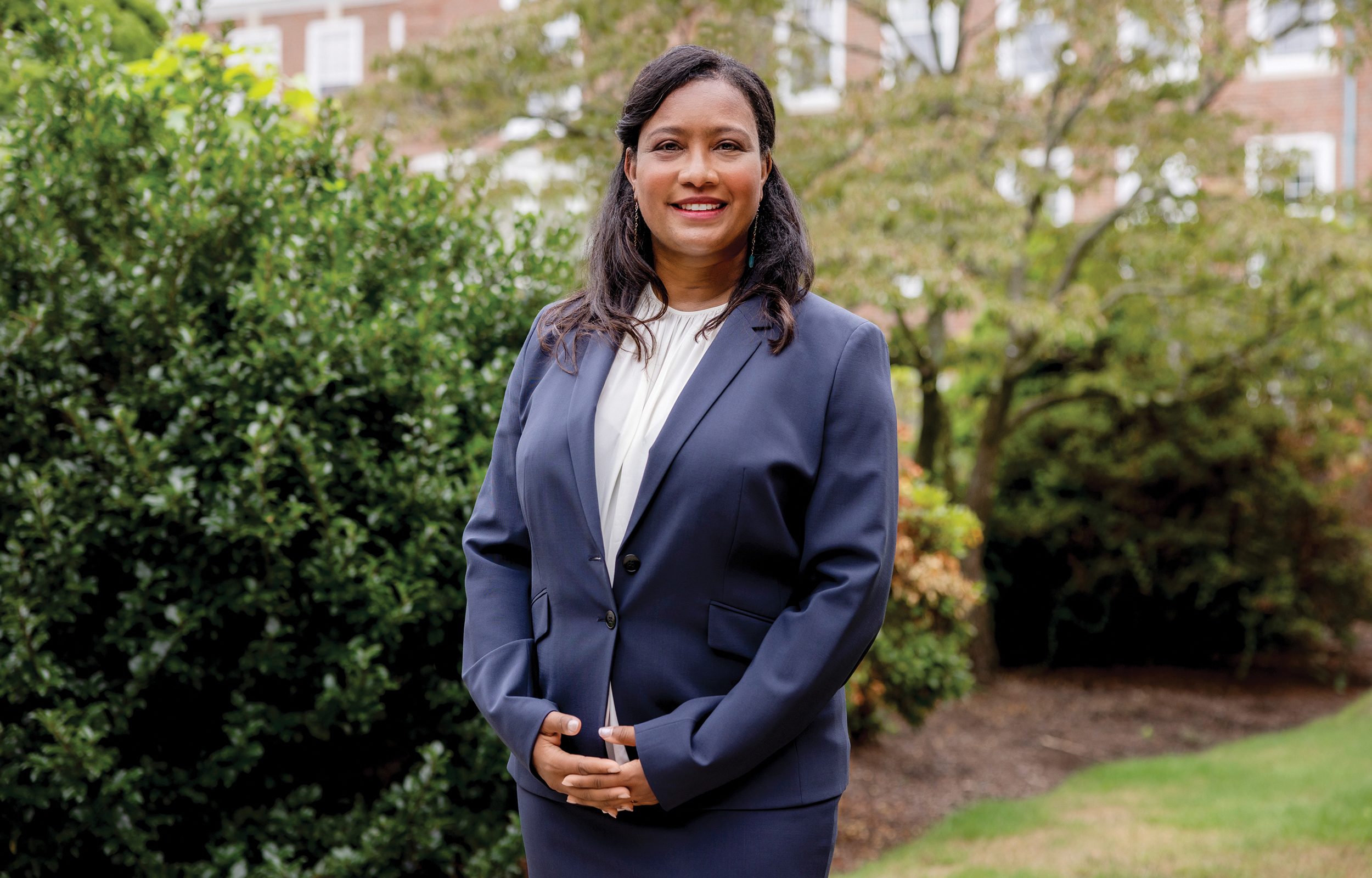
Lisa Alexander, a Boston College Law professor whose career has focused on advancing property rights policies that make housing markets more equitable and support disadvantaged people, was one of the first legal scholars to research tiny home villages, beginning in 2014. Now 53, she grew up in a publicly subsidized Manhattan apartment building on the border of Morningside Heights and the Upper West Side.
“I lived in Mitchell-Lama housing, a state program started in 1955 to create affordable homes for working-class families: teachers, firefighters, people like my parents,” she said. Though her building was close to traditional public housing, it was privately owned but publicly subsidized, which kept rents affordable. “I noticed from a young age how my building was nicer than public housing, but still worlds away from the homes of classmates I met at a private school on the East Side, children whose families owned large co-ops or townhouses,” she recalled. “It made me wonder: ‘Why do some people live in buildings like mine, some in public housing, and some in wealthy homes?’”
Affordable housing like hers was often portrayed as a repository of crime, drugs, and social dysfunction, but Alexander found in hers a rich, diverse, vital community. For the majority of her elementary and secondary education, she was the only Black student attending the Upper East Side’s exclusive all-female Nightingale-Bamford prep school. Each school day she crossed from her humble apartment building into a zone of opulence, where fellow students lived in buildings with doormen and posh stores predominated. Though she enjoyed her classmates, the contrast fed her sense of injustice, and led her to study—and as a middle-school student give a talk at an assembly about—Martin Luther King, Jr. and the 1960s civil rights movement. It also sensitized her to the outsized importance of housing.

A common definition of tiny homes is that they occupy no more than 400 square feet—enough for only a few amenities, if any, but still a refuge, with a door that residents can close to the outside world, a crucial feature for people used to feeling anxious about their lack of safety and privacy in homeless shelters and outdoor camps. Without such refuges, it can be difficult for residents to reach vital goals such as acquiring jobs or medical insurance or establishing fulfilling social connections. “Without a home,” wrote scholars Krista Evans and Yetimoni Kpeebi in a 2025 paper about tiny home villages, “it is nearly impossible for a person to reach their potential.”
Tiny home villages began to form in the 1990s, and multiplied rapidly in the wake of the 2007-2009 Great Recession. A 2024 count across the US established their number at 123, up from 34 four years earlier, and many more are expected to form. Minneapolis, Seattle, Sacramento, and Denver are among the cities now promoting municipally-owned tiny home villages.
A village may consist of as few as three or four residents or as many as 420, the number in the nation’s largest tiny home village, Community First! Village, outside Austin, Texas. The total number of tiny home village residents is probably no more than a few thousand, barely enough to put a small dent in the national homeless population of 770,000. But the potential for continued growth of tiny home villages is high, and advocates believe they can be a useful option in urban planners’ toolkits.
The potential for continued growth of tiny home villages is high, and advocates believe they can be a useful option in urban planners’ toolkits.
Their emergence is particularly significant because it offsets a countervailing trend, the increasing tendency of municipalities to treat homeless people as criminals. A 2024 Supreme Court decision effectively endorsed this behavior when it ruled in Grants Pass, OR v. Johnson that municipalities may impose sanctions on homeless people who sleep in public spaces. Adding criminalization to the formidable obstacles homeless people face in finding housing only exacerbates their predicament.
Alexander’s childhood experience in subsidized housing caused her to wonder why some people lived in public housing and others in fashionable homes. “That curiosity turned into a lifelong question about how housing determines life outcomes,” she said in an interview. “I wanted to understand why certain groups had access to ownership, and others did not, and how the law structured those inequities.” After a three-year stint doing some litigation, which showed her the limitations of lawsuits in achieving just outcomes, she immersed herself in real estate and transactional law.
She paid particular attention to the community development movement, which originated in the late 1970s and early 1980s as bankruptcies spread among homeowners and cities, when “people started coming together individually to figure out how to solve housing problems that nobody else was solving,” she said. “The cities weren’t really solving them, the states weren’t solving them, the federal government wasn’t doing anything, and people needed more and better housing…. I was really interested in the ways in which people started working together to make a difference when governments and markets were failing.”
In Madison, Wisconsin, where Alexander was a professor at the University of Wisconsin Law School from 2006 to 2016, she got a close-up view of the role that tiny home villages could play in meeting the movement’s goals. Occupy Madison, a nonprofit spinoff of the international Occupy movement, led a group of homeless people, lawyers, university professors, and other NGOs who were trying to figure out how to provide habitable dwellings for homeless people during the city’s frigid winters. After ad hoc tent cities they formed were cleared by the city, their solution was to begin building bare-bones, 99-square-foot houses on the site of an abandoned gas station and auto body shop.
Each house cost $3,500. The occupants, all previously homeless, couldn’t own the homes, but they could become the homes’ stewards—the village helped establish stewardship as a kind of middle ground between renting and ownership, with its own unique benefits. To become stewards, potential tiny home occupants had to amass about 500 hours of sweat equity, cooking, gardening, maintaining the site, or helping to build other structures. Since the tiny houses lacked most amenities, the old auto body shop was converted into a communal building with a store, bathroom, showers, and a workshop to facilitate more construction. Having a stake in the village’s well-being helped residents feel pride in their contributions.
“A lot of my work has been looking for ways in which individuals’ relationship to property can be reframed, so that things considered negative are actually positive.”
Professor Lisa Alexander
At first, the installation faced opposition from neighbors, 70 percent of whom signed a petition claiming it would lower property values, increase the cost of municipal services, and result in more police calls, but in the first year of the village’s existence, the police didn’t receive one call. The neighbors’ fears proved unfounded, and many who at first opposed the village became its supporters.
An even greater obstacle was that the village violated Madison building codes and zoning regulations, which required residences to be larger than 400 square feet. But as the village flourished, attracting students and other housed people to become volunteers, it won a zoning exception and was legalized. The village now contains nine tiny houses, and Occupy Madison has created another tiny home village a mile away. Impressed by the results, Madison city officials built a third village in 2021.
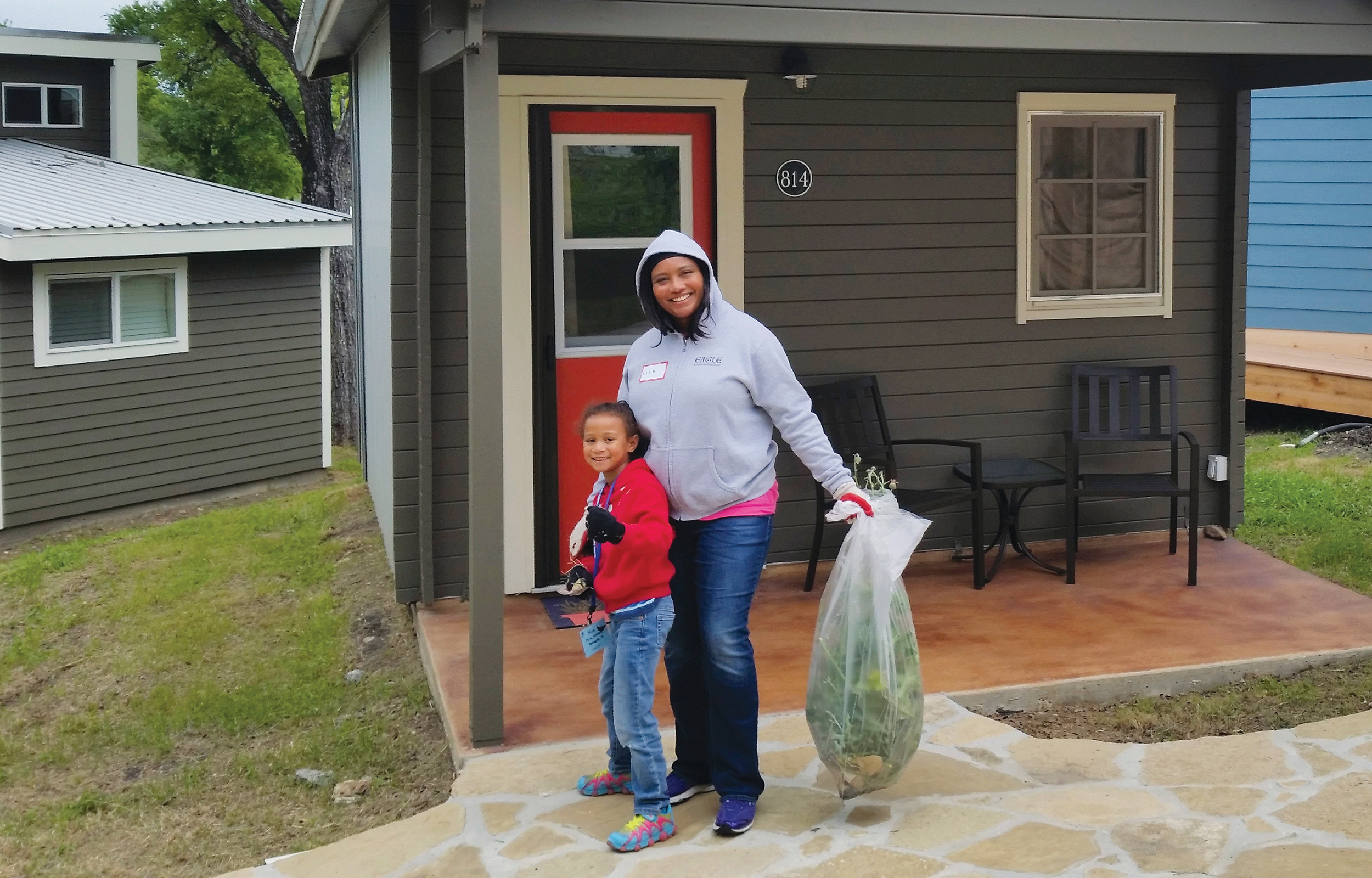
When Alexander moved on to a professorship at Texas A&M University in 2017, she discovered another tiny home village that further expanded her understanding of their potential. Its founder, Alan Graham, was a real estate developer and faith-centered philanthropist who told a Parade Magazine interviewer, “Housing will never solve homelessness in our country, but community will.” In response to a decision by the city of Austin that forbade living on city streets, he worked with a University of Texas architecture class to locate land for a tiny home outpost that was named Community First! Village. It had to be outside Austin’s city limits (to avoid zoning restrictions), have access to electricity and rich soil for a garden, and be close to water and sewage infrastructure and bus lines.
What emerged is now the nation’s largest tiny home village, with 420 occupants. Its residences include tiny houses that range from 121 to 300 square feet, recreational vehicles, and canvas cottages. The 51-acre planned community contains more attractions than a cruise ship: they include communal outdoor kitchens and private bathrooms; a community market; a dog park; laundries; libraries; medical, hospice, and addiction recovery centers; a hair salon; a worship area; an organic farm that provides residents with fruits, nuts, vegetables, honey, eggs, and goat milk; workshops that offer training in car repair, blacksmithing, and woodworking; an art house that sells residents’ works to outsiders; a bed-and-breakfast for visiting volunteers; and an outdoor movie theater where residents sell concessions to visiting patrons. Most facilities are manned by the residents themselves. After years of traumatic homelessness, members typically start out distrustful of the community and warm to it as they find valued roles.
Community First! Village residents, who are referred to as “neighbors,” pay modest rent, ranging from $225 to $430 a month, that covers roughly 40 percent of the village’s operating expenses; private donations cover the rest. Tenants who miss payments are asked to leave, but that doesn’t happen often: as of 2019, the village’s rate of retention of occupants was 86 percent. Because the cost of providing shelters, jail cells, and emergency room care to homeless people can range up to $40,000 a year per person, the community saved the city of Austin between $1.7 and $3 million per year, according to a 2017 Urban Land Institute study.
To Alexander, who was used to seeing homeless people portrayed as “down and out, problematic, sucking the city’s resources and providing nothing,” the model that Community First! Village represented offered an essential corrective. “A lot of my work has been looking for ways in which individuals’ relationship to property can be reframed, so that things considered negative are actually positive,” she said.
Alexander moved to BC Law in July 2022 and became faculty director of BC Law’s housing and property rights program a few months later. The program is part of the school’s Initiative on Land, Housing & Property Rights, founded and directed by BC Law professor Thomas Mitchell. Alexander was drawn to BC Law in part because of the school’s focus on advancing social justice, and in part because efforts by state and local governments to reduce Boston’s severe housing crisis have made the city an ideal place to study.
In her new position, Alexander has continued to explore housing models that challenge conventional legal and social conceptions of renters and homeowners. Her latest project involves long-term tenants—people who’ve lived in their apartments for a decade or longer. Informed by her experience as a child growing up in a building of long-term tenants who felt a powerful connection to their apartment-house community, she is writing a paper that will challenge the conventional wisdom that homeowners’ connections to their residences are deeper and more enduring than long-term tenants’ connections to theirs. She argues that long-term tenants, therefore, deserve some of the rights usually reserved for owners.
Behind all of Alexander’s work is the idea that the right to housing is just as vital as the rights to free speech, assembly, and religion, even though it is not yet legally recognized. “I want students to understand that housing law is central to justice, not peripheral,” she said. “It is often treated not as law, but as policy, as technical or secondary, but it shapes everything: opportunity, wealth, even democracy.”
Jacques Leslie is a Los Angeles Times contributing writer. He has won numerous awards for his work in books, magazines, and newspapers.