






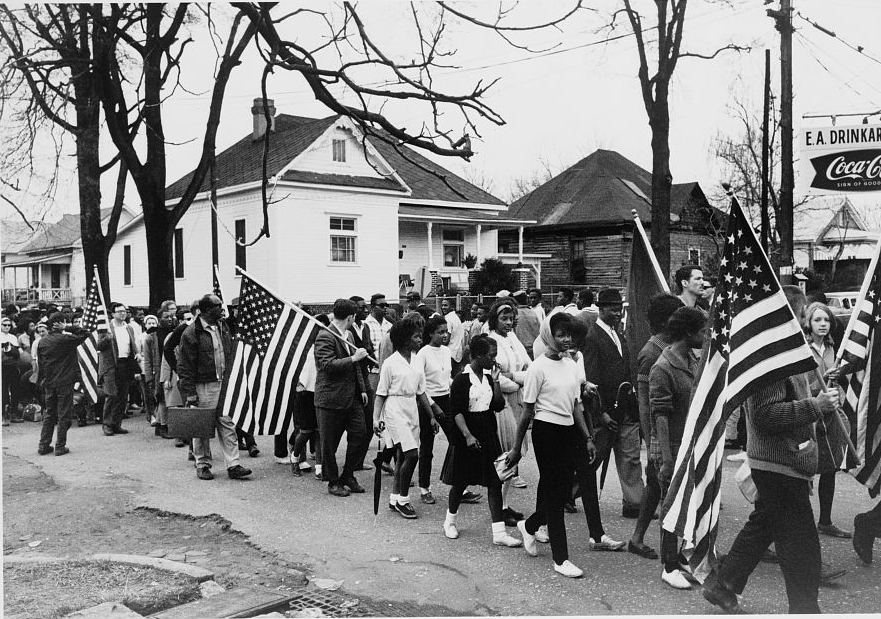
Instead of relaxing with Netflix over winter break, five BC Law students accepted the offer to spend a week touring through the heart of the American Civil Rights Movement in Georgia and Alabama. The experience included stops such as at the Edmund Pettus Bridge, the National Memorial for Peace and Justice, the birthplace of Dr. Martin Luther King Jr., and the Legacy Museum.
It was more than just sightseeing, however. Bret Jacob ’26 referred to the “meticulously curated itinerary” as one that exposed them all not just to major moments of the civil rights movement, but the intimate details learned only by those who have lived through it. As LLM student Humphrey Norman Mugoya reflected, “The tour didn’t just teach me history but it made me confront it. It exceeded my expectations because it transformed history from something I studied into something I carried in my chest.”
The tour was conceived by Angel Kelley, US District Court Judge for the District of Massachusetts. Alongside BC, other participating law schools included Boston University, Harvard, Northeastern, UMass, Roger Williams, Suffolk, and Western New England. According to Kelley, this is a journey that everyone needs to make, but most certainly future legal leaders.
The Hon. Geraldine Hines, retired justice of the Massachusetts Supreme Judicial Court and BC Law’s Huber Distinguished Visiting Professor, observed that the trip also took place at a moment when the politics of the day are undermining the vitality of and respect for the rule of law. “The students who were lucky enough to be selected for this journey came face to face with ordinary people and with lawyers who faced similar, if not more daunting challenges, in bending and shaping the law as an instrument of change in our society,” she said.
The experience began with an insightful pre-trip Zoom gathering with Stephen Bright, law professor at Yale and Georgetown universities and longtime director of the Southern Center for Human Rights. He was also a mentor to Bryan Stevenson, founder and executive director of the Equal Justice Initiative and author of Just Mercy: A Story of Justice and Redemption.
Once on the road, students traveled to Atlanta for a tour with guide Tom Houck, King’s driver and personal assistant. From there, the group headed to Alabama for the remainder of the week, where, in addition to touring museums, jails, and historic sites, the participants heard from civil rights leaders and activists like Joanne Bland, Sara Collins Rudolph, and Fred Gray, and historian J. Mills Thornton, author of Dividing Lines: Municipal Politics and the Struggle for Civil Rights in Montgomery, Birmingham, and Selma.
In Montgomery, the group visited the Franklin Johnson Institute where they met with Myron Thompson, US District Court Judge for the Middle District of Alabama, before traveling to Selma for a personal tour conducted by Bland, co-founder and former director of the National Voting Rights Museum. She not only dove deep into the struggle for voting rights in Selma, but also covered landmarks such as Brown Chapel, the New Live Oak Cemetery, and the site for Foot Soldiers Park and Education Center.
Justice Hines accompanied the students throughout the trip. “As a native of the South who came of age during the Jim Crow era, I was familiar with many of the people and places the students would encounter and the trip allowed me to reflect on my own path to a legal career devoted to civil rights and racial justice,” Hines explained. Her insight brought the movement to life for the students. “Hearing [Hines] speak about her ancestors who lived through the era, who felt the tremors of change firsthand, and had her lineage part of this story gave the tour a depth no textbook could offer,” Mugoya said.
Mugoya joined the tour with a deep personal connection. “As an African man, I carry the weight and pride of a continent whose children were taken, scattered, and forced to build a world that denied them dignity,” he said. “But in Africa, this history is only taught as far as the gate of no return or the ports where our ancestors were shipped off, which always made me curious to learn what happened to them and where they went.”
The participants also attended presentations at the Equal Justice Initiative and the Southern Poverty Law Center. Mayor Johnny Ford provided a tour of Tuskegee University, home of Booker T. Washington’s residence and the George Washington Carver Museum.
With no legal interest requisite to participate, each student’s background varied. Some entered the experience with preexisting civil rights goals, like Shannon McCabe ’27, whose hopes of becoming a civil rights lawyer inspired her to participate in the trip, where she could better understand the human stories that shaped the law she is studying.
Bridget Silveira ’27 came into the tour while working towards a masters in social work alongside her JD. For her, the trip provided the perfect context to confront some of the current injustices that affect the individuals she worked with as a mental health case manager, as well as those she will encounter as an aspiring public defender.
For other students, their background in civil rights was limited to classrooms and conversations. After his experience, Brian Leon ’27 found himself challenged to think creatively about how to use his law degree to advance social justice. “There are more ways than doing so besides civil rights litigation,” he said.
Anu Nair ’27 agreed. “This experience has profoundly shaped the way I view the legal profession and my role within it,” she said. “Regardless of the specific career path one ultimately takes, whether in law firms, private practice, or public interest, learning firsthand how powerful a law degree can be in shaping society and affecting individual lives was transformative.”
All students returned with the sentiment of carrying forward into their future what they learned about the past. “This experience cemented what my BC Law education has prepared me for: a career in service to others,” Jacob said. “The tour gave me a renewed appreciation for all of the ways I can be of service toward the goal of replacing systems of punishment and scarcity with systems of care and abundance.”
“I want society to understand that the Civil Rights Movement was not just an African American fight, it was a human fight,” Mugoya said. “It was a global call for dignity.” Nair encourages society to continue this call. “Our voices matter and our actions matter. If we do not step up, speak out, and help others, no one else will do it for us,” she said. Or as McCabe put it, “Civil rights history is not over, it’s ongoing.”
Their passion solidified Justice Hine’s belief that the future of the struggle for civil rights and civil liberties is in capable hands. “The next generation of lawyers, represented by the students on this journey, is fearless,” she praised. “They have the energy, commitment and vision to carry the torch as they run toward the challenges that they can already see before them.”