






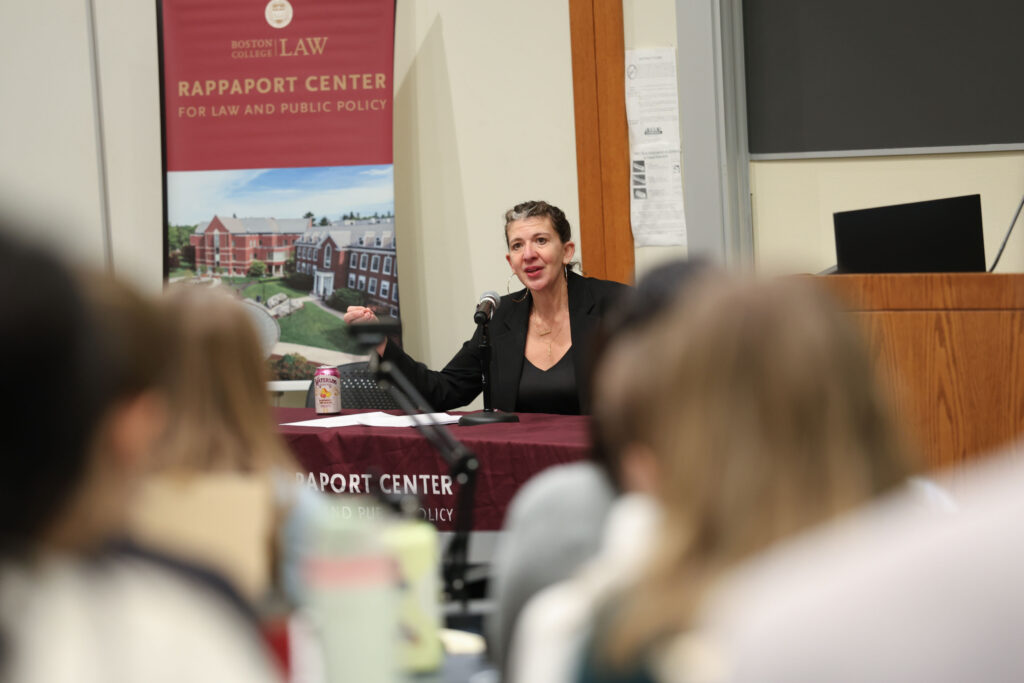
Danielle Sered, one of the most influential thinkers and practitioners in the restorative justice and violence intervention fields, spent several days at BC Law School in February, exploring the role of criminal justice in building and sustaining a multiracial democracy.
In her opening address as a senior fellow with the Rappaport Center for Law and Public Policy, Sered argued that while criminal justice may initially seem ancillary to the central dimensions of a functioning civil society, less necessary to democracy than voting rights or free speech, in actuality criminalization is the mechanism through which repressive governments control people and culture. “The criminal justice system is where other movements end up when they lose,” Sered explained.
Beyond deploying the criminal legal apparatus—law enforcement, courts, carceral institutions—to marginalize or punish those with whom they disagree, Sered observed that repressive regimes seek also to control narratives about who is dangerous, who is in danger, who should do the protecting, and how far they can go in the name of safety. Counterfactual, fear-mongering, and racist, these narratives are often weaponized against black and brown people. However, no one who protests against the dominant regime is immune. “We saw this with Renee Good,” Sered said. “We saw it with Alex Pretti.” She emphasized that changing the narrative is something everyone can—and must—do. “We must insist on the humanity and the rights of everyone,” she said.
The next day, Sered put her words into action at the Massachusetts Correctional Institute-Norfolk. The author of Until We Reckon: Violence, Mass Incarceration, and a Road to Repair was accompanied by members of the Supreme Judicial Court’s Restorative Justice Committee, law students, and several community members, including former prosecutors and survivors of violent crime. In small circles facilitated by leaders of the restorative justice work at Norfolk—many of whom are serving life sentences—the visitors and their hosts reflected on themes of accountability and justice, including what it may mean to, in Sered’s terms, “do sorry”—that is, to take genuine responsibility for harm and to engage in the hard work of repair.
For over 25 years, the Rappaport Center has supported emerging leaders in state and local law and public policy. However, this visit by Sered to MCI-Norfolk was the first time that the Center has brought its senior fellow and students away from lecture halls to connect with the leaders and other impacted people in a carceral setting.
That spirit of thinking outside the box or classroom extended to Sered’s final public event. Moderated by Amanda Teo, Rappaport’s executive director, the panel included Jessica Tang, president of the Massachusetts chapter of American Federated Teachers (AFT), and J.J. Straight, national campaigns director for reproductive rights at the ACLU.
In her panel introduction, Rappaport’s faculty director Patricia McCoy addressed the idea of disruption, a term she defined as working outside the system to effectuate change. “Disruption can transcend the political,” she said.
Sered took up the theme, emphasizing that the reality behind our systems is culture. “The rule of law isn’t more than culture. Laws are agreements we make with each other,” she explained. “If those agreements aren’t being held by the broader culture, they’re not worth the paper they’re written on.” The panel acknowledged that the goal is not to return to the status quo, but to propel forward. “Our democracy was not working for everybody in the first place already,” Tang said.
As Sered sees it, this is the moment when America decides whether to become the multiracial democracy it has claimed to be but has never truly been. “Are we fighting to go back or are we fighting to go forward?” Sered asked.
“Fascism isn’t new to American soil, but this is a moment of enormous escalation,” Sered said. She described this moment as both “extremely frustrating” and “extremely energizing.” Referencing recent incidents in Minneapolis, Sered said, “It’s frustrating because Black people in America will tell you, those videos look very familiar. Those behaviors are very familiar. Policing in America looks like that for Black Americans.” Sered challenged listeners to consider why we feel outrage at these incidents now. “Is that intolerable to us because we don’t think anybody should be treated that way, or because we thought the agreement was that ‘good white people’ wouldn’t be shot in the face, and that agreement has been broken?”
Tang acknowledged that not everybody will agree that we are facing an authoritarian threat. The point isn’t whether the victims of ICE attacks were criminals; “the point is we have due process and a rule of law, and that’s what’s being ignored.” With the country’s usual checks and balances not working as federal authorities ignore court orders, the only solution, according to Tang, is the people, who have to speak up and take action. “You do not obey in advance,” Tang cautioned. This is why lawsuits still matter. “In order to stop the harms that are happening, we have to [use legal process to] slow them down.”
It’s not only lawsuits that slow these harms down, though. “Disruption takes many forms for us, from lawsuit to the classroom level,” Tang said. Straight agreed, noting that her job as a non-lawyer at the ACLU is to complement legal disruption with organizing people: mutual aid is one of the most powerful tools, because it allows people to come together and confirm their shared experience, to support one another, and to push back.
The conversation ended on a hopeful note, with all three panelists confident that the fight ahead is winnable, though not necessarily in expected ways. “None of those [methods] is about what any political party is doing,” Sered said. “It’s about how we decide to be with one another.”
“This nation has only ever been a question,” Sered concluded. “If we do it really, truly together, we get to shape the answer.”