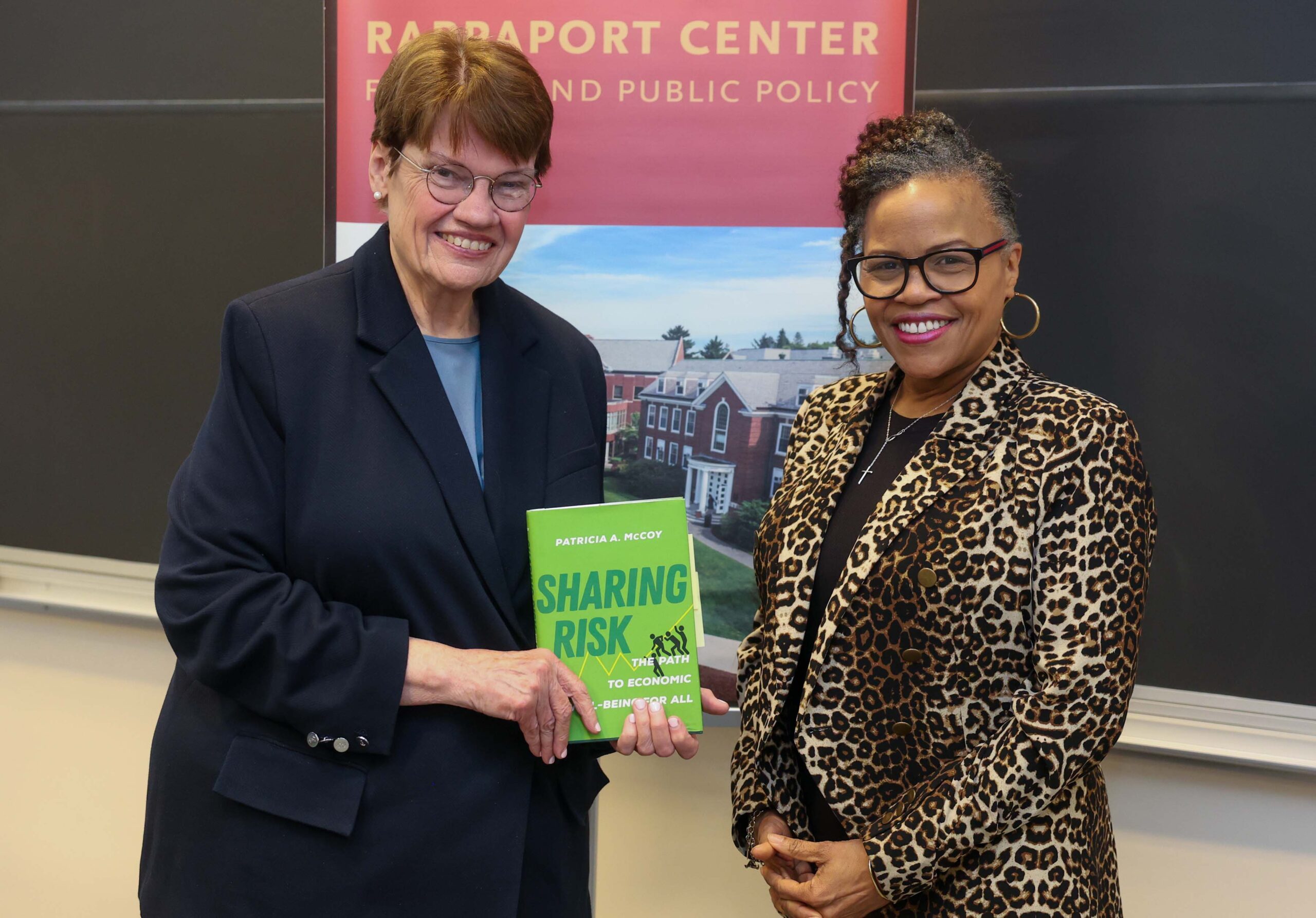







“We’ve made a decision in this country about who to subsidize and it’s the richest people. And that’s a story about power,” asserted Professor Patricia McCoy in a fireside chat on her new book, Sharing Risk: The Path to Economic Well-Being for All. Her interlocutor, Kim Janey, former Mayor of Boston and CEO of Economic Mobility Pathways (EMPath), remarked, “there’s a narrative of who is worthy of a helping hand and who is looking for a handout.”
McCoy was inspired to write Sharing Risk after learning that “half of American families, the bottom 50 percent, doesn’t have enough income to cover their basic needs.” This reality is one that McCoy sees as remediable if the federal government were to offer social insurance, a risk-sharing program which would raise the minimum wage, provide robust unemployment insurance, and targeted support for college, retirement, and health insurance.
Janey takes a two-pronged approach to economic mobility, prioritizing both case-by-case attention and greater systemic reform. EMPath utilizes a 1:1 coaching approach that “centers [the individual] as the driver, as the person who knows what is best for them.” Equally important to Janey is research and policy change, as “these issues can all be traced back to policy decisions.”
While tax subsidies through 401ks and 529 college saving plans incentivize high earners to earn more, many government policies place low-income families into a Catch-22 that exposes them to acute economic precarity. Janey observed the tough choices families make to keep their government benefits, in some cases declining a new job opportunity because it would render them ineligible for housing or childcare subsidies. McCoy pointed to research suggesting that the welfare system sends mixed messages, telling recipients “if you work, you will be disqualified” while failing to provide working families with sufficient funds to live on. McCoy called upon the federal government to implement social insurance policies to relieve American families of such difficult choices and economic burdens.
State and local governments play a role, too. Janey maintained that municipalities have power to affect affordability in their cities and states, citing the Boston Living Wage Ordinance implemented by Mayor Walsh, as an example, which requires eligible employees who are contracted by the city to be paid “an hourly wage that is enough for a family of four to live at or above the federal poverty level.”
The event, “Towards Economic Well-Being: A Fireside Chat on Patricia McCoy’s Sharing Risk” took place at Boston College Law School on Wednesday, February 25, was hosted by the Rappaport Center for Law and Public Policy, and moderated by Amanda Teo, Executive Director of the Rappaport Center.
Photographs by Reba Saldanha and Kasra Raffi ’28