






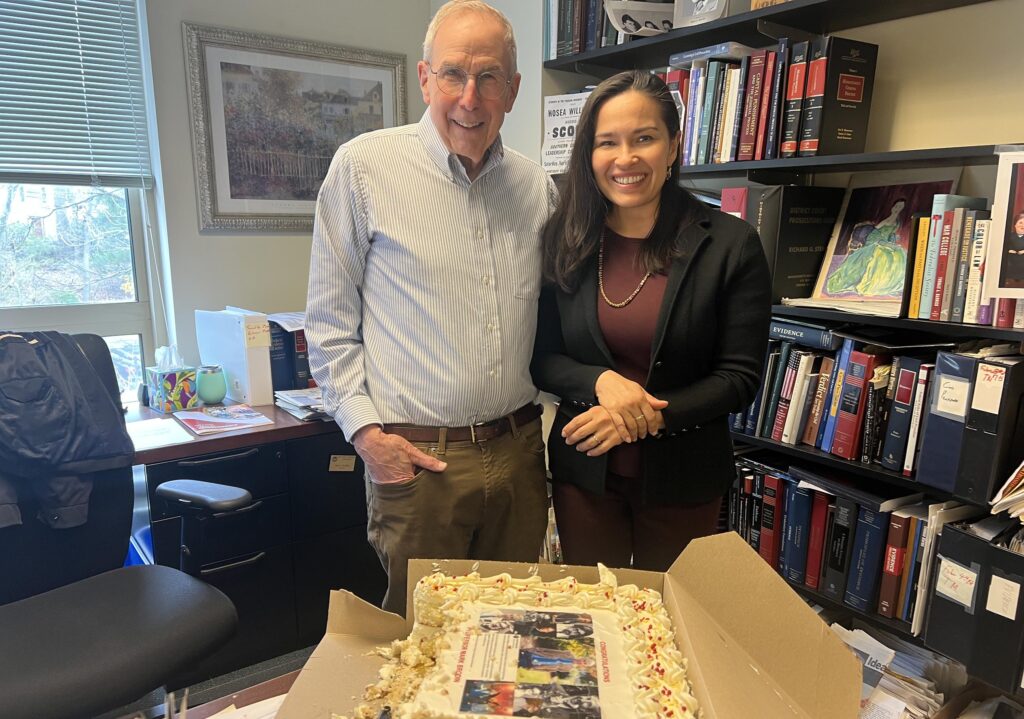
Professor Mark Brodin held his final class on April 22, retiring after over four decades of teaching at BC Law. Brodin is a Michael & Helen Lee Distinguished Scholar and former Associate Dean for Academic Affairs, and his expertise lies in issues surrounding civil procedure, employment discrimination, and litigation.
After graduating from Columbia Law School, Brodin clerked for the United States District Judge Joseph L. Tauro from 1972 to 1974 as his first clerk. He later worked as an employment discrimination attorney with the Lawyers’ Committee for Civil Rights (LCCR) under the Boston Bar Association from 1974 to 1980. In this role, Brodin focused on issues of employment discrimination, housing discrimination, sexual harassment, First Amendment violations, and police misconduct.
It was after his time with the LCCR that Brodin made the switch to teaching, a decision that felt right to him: “I loved it from the start. I just took to it,” he said in an interview with BC Law Magazine last April. Brodin started out as a professor at New England School of Law, until he got a call from Dean Dick Huber who asked if he would come teach Civil Procedure at BC Law. Brodin was so popular amongst the BC Law students that they eventually created a petition to get him to work full time at the school, which proved successful.
After nearly 40 years at BC Law, clearly this decision paid off. Brodin has won numerous teaching awards over the years: the Law Students Association named Brodin BC Law’s 2002-2003 Faculty Member of the Year, and the Black Law Students Association awarded him the Ruth Arlene Howe Award in both 2005 and 2006, and the Anthony P. Farley Excellence in Training Award in 2009.
When asked about his success in the classroom, he attributed it to his ability to engage with students. “I talk about teaching as a conversation. It’s not a monologue,” he told BC Law Magazine. In this spirit, Brodin hopes to be remembered for his commitment to creating an effective learning environment, and for his deep care for all of his students and their futures.
Brodin has taught all over the world, having appointments as a visiting scholar at the Radzyner School of Law’s Interdisciplinary Center in Herzliya, Israel, and at Trinity Law School in Dublin, Ireland. He has been a visiting professor at Boston University School of Law, Northeastern University School of Law, and Tufts University’s Fletcher School of Law and Diplomacy.
He is the author of numerous often-cited law review articles, such as “The Murder of Black Males in a World of Non-Accountability: The Surreal Trial of George Zimmerman for the Killing of Trayvon Martin”, and “The Legacy of Trayvon Martin—Neighborhood Watches, Vigilantes, Race, and Our Law of Self-Defense”. He is also co-author of Handbook of Massachusetts Evidence (with Michael Avery), Criminal Procedure: The Constitution & Police (with Robert Bloom), and Civil Procedure: Doctrine, Practice and Context (with Subrin, Minow, Main and Lahav). His book William P. Homans Jr.: A Life in Court (Vandeplas Publishing), traces the life of the iconic criminal defense and civil liberties lawyer. Brodin’s present scholarship focuses on current political regimes in the United States, particularly topics of Constitutional law and procedure.
An important part of Brodin’s legacy at BC Law will be his longstanding friendship with Professor Bob Bloom. Once called the “Civil Procedure Twins”, the two have become a well-known pair, sharing casebooks and friendly competition. With Bloom also retiring this year, BC Law will feel the loss of this dynamic duo’s enduring presence on campus.
As for the future of BC Law, Brodin expressed his optimism that the school has always been focused on creating lawyers who are ethical and invested in social justice: “I hope we will preserve this environment for years to come.”
———————————————————
On the day of Brodin’s last class, thoughtful comments from colleagues poured in. Here are some of those responses:
Maureen Van Neste: We couldn’t ask for a more generous colleague or a more inspiring example of a lawyer and a teacher. It has been such a privilege to share the third floor of East Wing with you. The building will not feel the same without your daily presence. I hope you’ll enjoy this much-deserved time with your family in retirement.
Mary Holper: Congrats, Mark, on an amazing run here at BC law. You will be missed and I’m sorry I missed the party to teach my last class!
Lisa Alexander: Our East Wing hall and the Law School in general will not be the same. You have been a great colleague and dedicated to the good fight and to your students; you will be missed by all, especially by your East Wing colleagues, who have treasured your consistent, steadfast presence.
Filippa Anzalone: From the time I met you at [Northeastern University Law School] where you used to win the best teacher award as a visitor no less], I knew that there was something very special about you and the intention you bring to your teaching and mentorship of students. You will be sorely missed.
Frank Garcia: Thanks so much, Mark. You are the model of a good colleague and I feel lucky to have been yours, and to have learned from your example what it means to invest in your students, colleagues and community. You set a high bar for the rest of us, and you will be missed.