






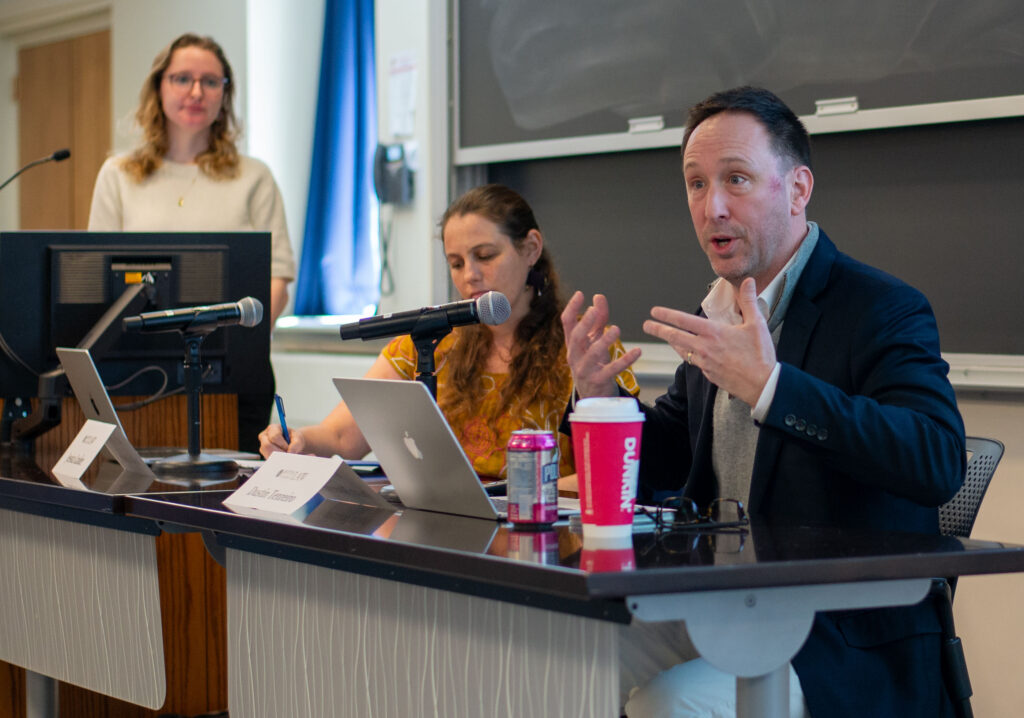
What does 1930s Nazi Germany have in common with 21st century America? During the 26th Annual Owen M. Kupferschmid Lecture presented by the Holocaust and Human Rights Project (HHRP), Jessica Lander, 2023 Massachusetts history teacher of the year, and Dustin Tenreiro, associate program director of Facing History & Ourselves, drew parallels between the tragedies of the past with the current rise of fascism and demonization of immigrants.
Tenreiro began with a brief history lesson, distinguishing between “the universal and the particular,” a distinction that can “help folks from making oversimplified comparisons between events,” he explained. “It’s important to avoid facile comparisons, but it can also be useful to think about the fragility of democracy in a universal sense.” Tenreiro also emphasized that today, we have the benefit of hindsight. He continued to explore this universal fragility of democracy, as well as the impact of ideology, and the range of human behavior.
The consolidation of power in Germany was driven by ideology, through three main methods: targeting education and the youth, spreading propaganda, and extensive legislation. Tenreiro pointed to the over 1,500 laws, policies, and decrees that benefited Aryans and discriminated against those deemed “the undesirables.” The laws permitted the government to sterilize without consent, restricted Jewish people from state employment, and culminated in the Nuremberg legislation, requiring all citizens to have “German” blood. Those who did not couldn’t get visas to leave the country and found themselves trapped in Germany and persecuted with no right to vote.
“It didn’t need to go this way,” Tenreiro said. “Political actors and voters made these outcomes. People’s actions matter.” He stressed that the growing culture shift and harsh legislation happened pre-war, not just through a gradual consolidation of power, but through a lack of significant resistance. “Most chose not to take action,” Tenreiro said. “If enough folks would have stood up, maybe things would have gone differently.”
Tenreiro also touched on the rising culture of fear, a point Lander drew on in her parallels between history and today. “Let’s talk about the fear,” Lander began. “It’s dangerous for our kids to go to school. When immigration agents are seen on the streets, attendance drops 40 to 50 percent.” Lander outlined America’s current reality, one where kids are afraid to go to school and afraid to see police and resource officers, the very people who are supposed to protect them. It’s a reality where adults are scared to come in for medical treatment or to show up to court, where pregnant women delay care or choose a home birth because it’s too dangerous to go to the hospital. “People are scared to go about the daily aspects of their lives,” Lander summarized. “We are seeing a stripping of rights.”
Lander pointed to attacks on birthright citizenship, the banning of not just books but words themselves, and how protected spaces that have been historically off limits to immigration officers are now fair game. “We have the hindsight of Germany that hopefully offers us lessons,” Lander said. “I’m terrified, as an educator, of what I see now.”
One lesson is that small actions can lead to the protection of democracy. As Tenriro put it, “Ultimately the road to genocide began with the deterioration of democracy, and the small steps marginalizing ‘the other’ and targeting them through legislative and social ostracism.” We can learn from the ways the pre-war resistance did try to fight back against the growing Nazi regime. “Parents standing up for what was being taught in school,” Tenreiro said. “Questioning new ideologies, not saluting, not questioning someone new in town who you don’t know.”
The panelists fielded questions from the audience, highlighting community programs that are stepping up to care for those in need, and encouraging the attendees that if we take action, we can learn from the past and not merely repeat it.
Photograph by Kasra Raffi ’28