






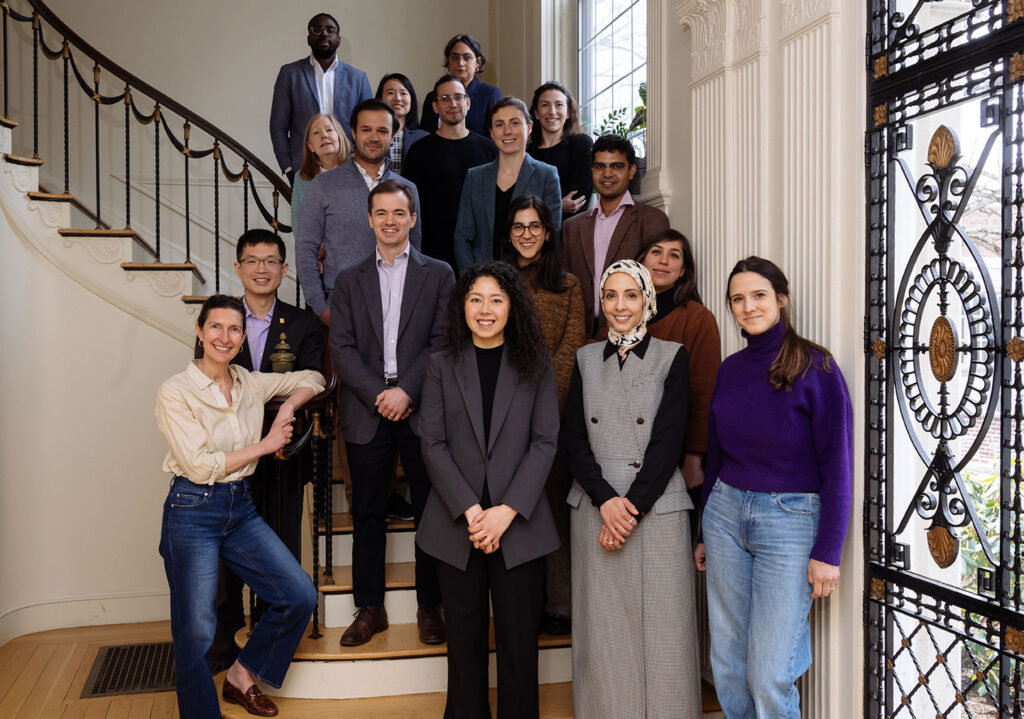
Boston College Law School once again convened a dynamic gathering of emerging legal scholars for its annual Junior Faculty Roundtable, held this year on March 27 at Barat House. Building on a tradition of lively intellectual exchange, the roundtable brought together early-career faculty from BC Law and institutions across the country for a full day of rigorous discussion, collaborative critique, and scholarly engagement.
This year’s roundtable assembled 15 rising scholars to workshop developing ideas and receive feedback from peers and senior faculty. Participants presented works in progress spanning financial regulation, constitutional theory, family law, artificial intelligence, and climate governance, with each session structured to encourage sustained dialogue and interdisciplinary insight. The day began with opening remarks from Dean Odette Lienau and Associate Dean Paulo Barrozo, who underscored the importance of cultivating an intellectual community at early stages of academic careers. The program then unfolded across five sessions, pairing presenters with designated commentators to support detailed engagement with each paper.
Session I explored questions at the intersection of law, markets, and expression, including Raúl Carrillo’s work on financial systems and Sabine Tsuruda’s examination of workers’ speech. Session II turned to family law and reproductive justice, while Session III engaged foundational issues in constitutional law and private law theory. Later sessions expanded to climate governance, policing, and international dispute resolution, reflecting the breadth of contemporary legal scholarship. Across these discussions, a common theme emerged: How do legal frameworks respond to rapid social, technological, and institutional change?
A highlight of the roundtable was the participation of Boston College Law’s junior faculty, including Raúl Carrillo, Caroline Cox, Marco Basile, and Rebecca Horwitz-Willis, Mitchell Johnston, and Shelly Simana, whose work reflects the school’s ever-expanding intellectual footprint.
Professor Mitchell Johnston’s paper, “Algorithms ≤ Humans,” examines how artificial intelligence challenges foundational assumptions embedded in legal doctrine. His work reflects how the law is calibrated to human behavior, including human imperfection, and that algorithmic systems can disrupt this balance in ways that call for careful, context specific regulation. Johnson’s scholarship reframes debates about AI governance by focusing on the structural role that human limitations play in legal design alongside questions of efficiency and accuracy. “One of the hardest parts of developing new scholarship is sharing early and incomplete ideas with others,” he said about the roundtable. “A special thing about our community is that you know that whenever you share early work you will get honest and constructive feedback that makes the work better. The atmosphere at the roundtable is exactly the same. People are presenting work at all different stages of the scholarly process and getting helpful suggestions about how to move forward and make the ideas the best they can be.”
Professor Shelly Simana’s paper, “Genetic Continuity: Beyond Procreation and Parenthood,” introduces a framework for understanding reproductive interests in the law that expands existing categories. She identifies genetic continuity as a distinct interest that captures the desire to sustain genetic connections across generations. Her work examines both the importance and the limits of this interest and offers a structured approach to how law should recognize and regulate it in contexts ranging from assisted reproduction to emerging genetic technologies. “I’m very grateful to Boston College Law School for the support it has given me in developing this piece,” Simana said. “The Law School made it possible for me to have the time and resources to work on it, including the opportunity to work with an excellent research assistant. I also had the chance to present an earlier version at a summer faculty workshop, and I benefited greatly from the careful engagement and thoughtful comments I received there.”
Throughout the day, the roundtable’s format pairing presenters with engaged commentators and opening the floor to broader discussion proved central to its success. Participants refined their arguments while also forming new intellectual connections, often identifying unexpected areas of overlap across fields. The event concluded with a plenary discussion on knowledge production in early academic careers, reinforcing the roundtable’s dual purpose: advancing individual projects and strengthening a community of scholars. Conversations continued beyond the formal sessions and carried into dinner and future collaboration.
By creating space for sustained, critical engagement at a formative stage of scholarly development, Boston College Law’s Junior Faculty Roundtable continues to serve as a catalyst for innovative legal thought and as a reflection of the institution’s commitment to supporting its junior faculty.
Photograph by Andres Leiva ’26
Full list of Junior Faculty Roundtable participants:
Raúl Carrillo, Boston College. Money, Time & Space.
Jeffery Y. Zhang, University of Michigan (co-author: Jeremy C. Kress). Enforcing the Community Reinvestment Act.
Sabine Tsuruda, University of Toronto. Contracting for Expression: Workers’ Speech and the First Amendment.
Shelly Simana, Boston College. Genetic Continuity: Beyond Procreation and Parenthood.
Laura Savarese, Michigan State University. Coercion and Abdication in the Voluntary Foster Care Regime.
Akshat Agarwal, Boston College. Against Children’s Interests: Parents as Facts.
Rebecca Horwitz-Willis, Boston College. Making and Unmaking Education Rights.
Marco Basile, Boston College. Old Textualism, New Juristocracy.
Mitchell Johnston, Boston College. Algorithms ≤ Humans.
Caroline Cox, Boston College. Climate Change & the Big State Opportunity.
Aisha I. Saad, Georgetown University. Subrogation as Climate Governance.
Amelia Wirts, University of Washington. How Social Schemas Affect Police Legitimacy.
Weijia Rao, Boston University (co-author Niccolò Ridi), Voices of Reform: Analyzing the Dynamics of ISDS Reform Negotiations through Audio Recordings.
Aliza Hochman Bloom, Northeastern University. Policing Supervision.
Daniel Fryer, University of Michigan. Policing the Privileged.