



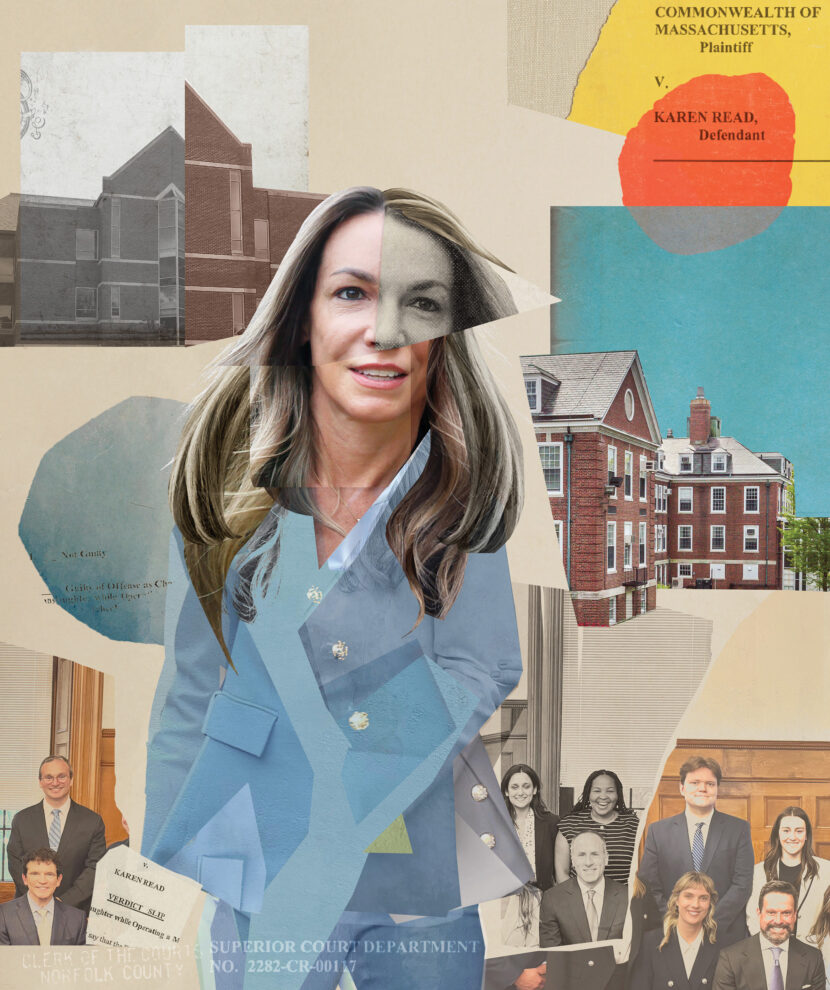





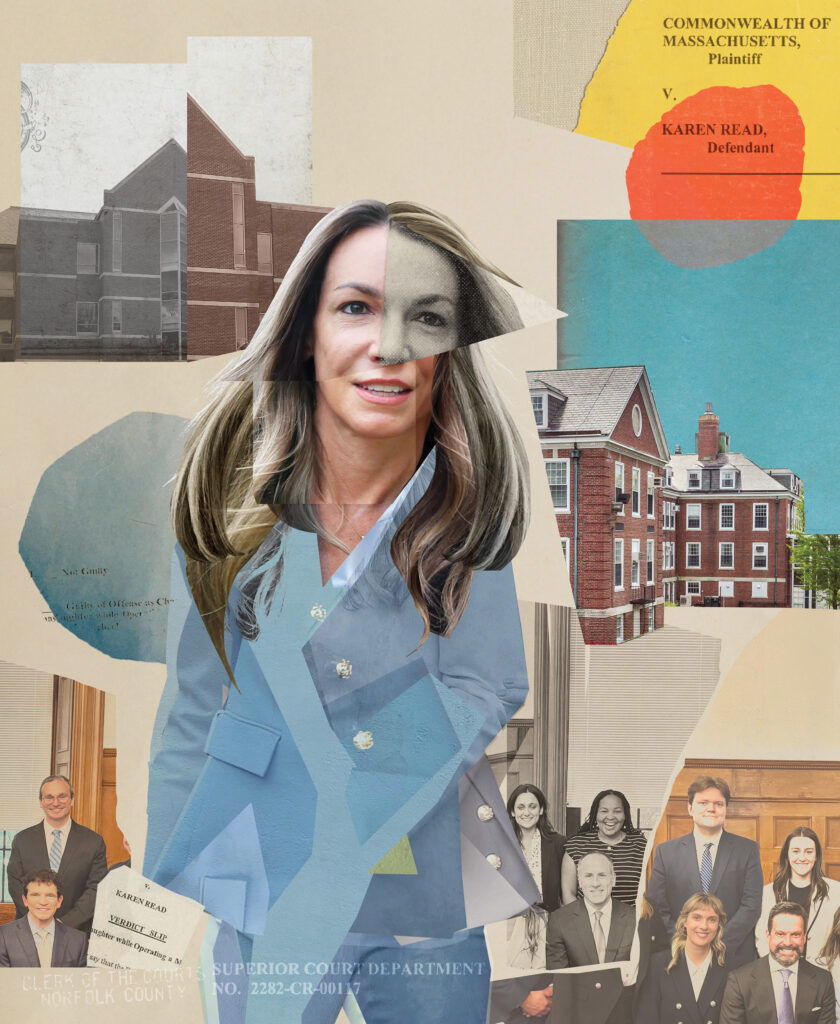
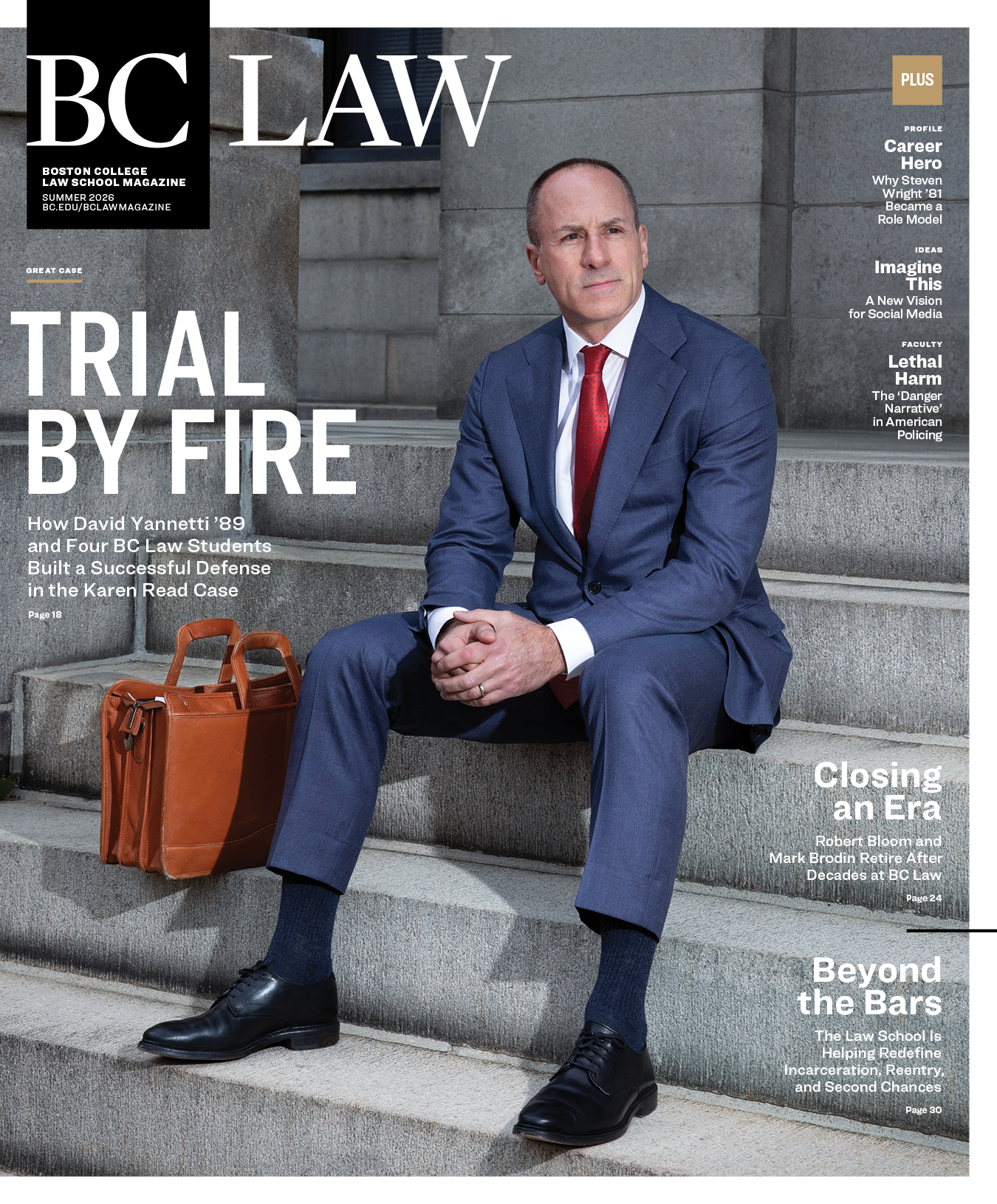
In early 2022, in one of the most sensational cases in recent memory, Karen Read, an adjunct college instructor, was charged with killing her boyfriend, John O’Keefe, with whom she had been feuding, by backing into him with her SUV on the snow-covered lawn of their friend Brian Albert. Read’s defense team proposed an alternate version of events: that inside Albert’s Canton, Massachusetts, house, O’Keefe was mauled by a German shepherd and beaten to death by Albert and others, who then dumped the victim’s corpse in the yard. Common to both stories were the fact that O’Keefe’s death followed a night of heavy drinking by him, Read, and Albert; and the fact that both Albert and O’Keefe were Boston police officers.
After the first contentious case against Read ended in a mistrial, a new one got underway. For four Boston College Law School students who were brought in to assist her defense team, it offered legal lessons of a lifetime.
The jury in Read’s 2024 trial deadlocked on all counts, including second degree murder and manslaughter. Hoping to avoid a similar outcome or even worse in the second trial, scheduled for spring 2025, the three-lawyer defense team made what they saw as essential changes.
To the lawyers, the first trial, with its plethora of physical evidence and the deluge of motions being pumped out by the prosecution, was “like drinking from a fire hose,” recalls defense lawyer and Boston College Law School alum David Yannetti ’89. So, for the second trial, they added a lawyer with a science background, the New York City-based Robert Alessi, to handle expert witnesses. They also decided to bring on interns for emergency research and motion drafting.
“In a trial so long and dense with tons of testimony, you need to keep in mind your theory of the case and make sure you don’t go too heavy on the science at the beginning and end…. Presentations can be long, and you don’t ever want to lose your jury.”
BC Law’s Sophie Johnson ’26
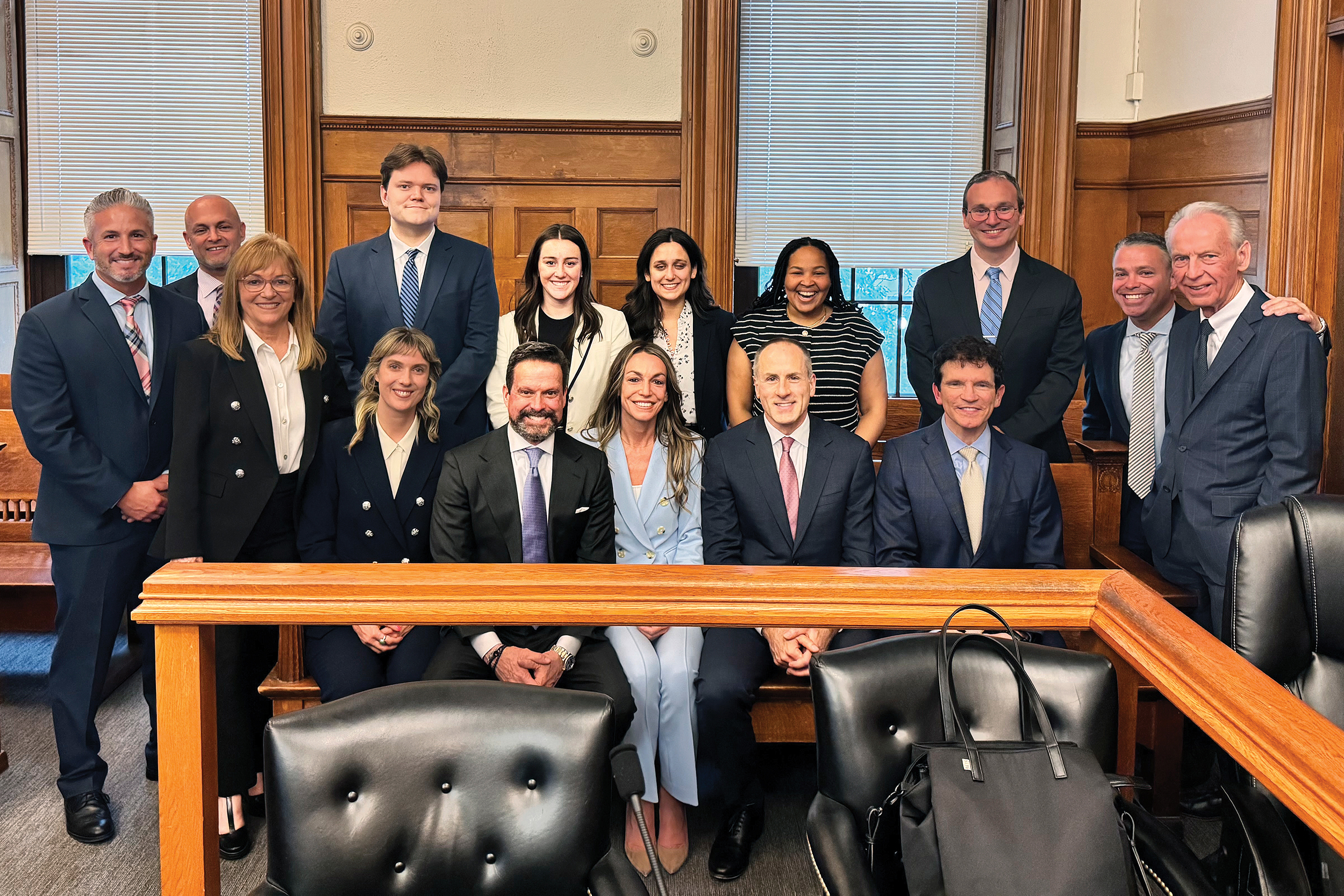
Based on brief Zoom interviews, resumes, and writing samples, the lawyers chose four interns from BC Law, along with two from Harvard Law School. Between pretrial motions and the trial itself, the internships demanded a nine-month commitment. In return, the BC Law interns—3Ls Abby Rosovsky, Evan Wolk, and Lee Moore, and 2L Sophie Johnson—got to test their legal chops in a forum where it mattered, discovered things about trial practice they couldn’t have picked up in a classroom, and had a chance to work with, and learn from, world-class litigators. The internship also dramatically altered one intern’s career plans, while landing him a job with one of the country’s top criminal defense law firms.
Lurid and with elements of an intricate police procedural, the case drew enormous media coverage and gave rise to a corps of Read supporters who mounted daily demonstrations outside the Norfolk County courthouse during both trials. Explains Yannetti: “People have long suspected that if you were part of the good old boy network, if you were connected, then you were treated differently from John Q. Citizen….Members of the public could easily put themselves in [Read’s] shoes.”
Says Professor Mark Brodin, Yannetti’s evidence instructor from law school days, Read’s supporters “viewed her as the victim of at best an overzealous prosecution and at worst a frame-up…and not without some basis.”
On top of its purported pro-Albert bias, according to Yannetti and the Los Angeles lawyer Alan Jackson, also a member of the defense team, the police investigation was exceptionally sloppy. Investigators never applied for a warrant to search Albert’s house, the lawyers say. They interviewed some witnesses in groups and failed to record witness interviews. They put biological evidence in a Solo cup borrowed from a neighbor instead of an evidence container, didn’t keep a crime scene log or establish a chain of custody for the physical evidence, threw the victim’s clothing into a bag along with items from the crime scene, almost assuring cross-contamination.
Through the fall and winter of 2024-2025, when motions in limine for the retrial were being heard almost weekly, the interns mostly worked remotely, researching and writing. Several interns recall their pleasure at seeing motions they penned filed by the legal team with minimal or no edits, an outcome Professor Mary Ann Chirba credits to the rigorous training in legal writing provided by the law school.
With the trial date approaching, the interns spent more time in court and at the Boston hotel where all four lawyers—Yannetti, Alessi, Jackson, and Jackson’s law partner Elizabeth Little—had holed up for the duration. With litigation heating up, some interns moved into the hotel themselves, sharing meals with the defendant and the legal team, and often working late into the night.
As the interns proved their mettle, they came to be relied on for a wide range of duties. Some services they rendered:
Vetting prospective jurors. “I was asked to review juror questionnaires, not a thing law students get to do,” says Abby Rosovsky ’25. “In terms of strategy, I got to see how the lawyers picked up on things like prospective jurors’ demographics and employment history.”
Note-taking in court and reading trial transcripts to tease out inconsistencies. “The idea,” explains Rosovsky, “is to make sure nothing slips through the cracks. I learned what to flag in things the state said, things we would want to check and double-check.”
Providing emotional support for Read. One difference between law school and a real-life trial is “being in a client-facing role,” observes Sophie Johnson ’26. “Yes, there’s a legal side to this, but the human component is also crucial when you’re dealing with someone in a high-stress situation.” During the trial, she says, she came to admire the defendant, from whom she learned “how to go through life when life throws crazy wrenches into your plans.” The two became close, as did Read and intern Evan Wolk ’25, who says he was impressed by Read’s all-out involvement in every aspect of the case, right down to the editing and proofreading of motions. Damon Seligson, who attended the trial from time to time as a lawyer for Read’s parents, says the interns’ presence in court, at the hotel, and riding back and forth between the two locations “added a sense of community for Karen, her family, and the lawyers. The interns served a dual role, and I know that Karen was, and is, immensely fond of them and found their presence and support to be an enormous benefit to her.”
Four BC Law students got to test their legal chops in a forum where it mattered, discovered things about trial practice they couldn’t have picked up in a classroom, and had a chance to work with, and learn from, world-class litigators.
Acting as a sounding board for the lawyers. Wolk and other interns sat in on dry runs of opening and closing arguments and were invited to offer their suggestions and comments. Alan Jackson says Wolk, with his “deep understanding of the flow and storytelling” was “integral in helping prepare the closing argument.” Because the argument had to fit into an hour and fifteen minutes, concision and focus were essential, and Jackson says he took to heart Wolk’s suggestions for what to include and what to leave out, out of the “reams and reams of evidence, attorney’s notes, trial testimony, and prior testimony” that the case had generated. Wolk himself says that through his work on the case he learned that closing arguments should stress, above all, that “the prosecution bears the burden of proof, and it’s a very high burden. To take away someone’s liberty, [the state] has to do everything right. So [the defense] needs to question everything they do, especially in a case like this one that was so rich in reasonable doubt.” Adds Sophie Johnson, who also sat in on the practice runs: “In a trial so long and dense with tons of testimony, you need to keep in mind your theory of the case and make sure you don’t go too heavy on the science at the beginning and end…. Presentations can be long, and you don’t ever want to lose your jury.”
Overseeing audiovisual displays. In Read’s first trial, the legal team used an AV specialist to organize and show the visual exhibits. In the second trial, as a cost-saving measure, the job went to Wolk. In addition to the savings, Yannetti says, they found “it was a benefit to have someone with a legal background in that position, someone who could stay with us in a way a non-lawyer could not have done”—who could anticipate which visuals the lawyers would need at any given moment during a witness examination and get it on the screen without delay. “After all,” explains Wolk, “a trial is a display for the jury, so you want [your AV displays] to be smooth.”
Moving to amend the verdict slip. The verdict slip in Read’s first trial was “an enormous debacle,” says Jackson. “The wording was very confusing,” adds Yannetti, “It offered multiple ways to arrive at ‘guilty’ and not enough ways to arrive at ‘not guilty.’” For the second trial, and on his own initiative, intern Lee Moore—valedictorian, by the way, of the Law School’s class of 2025—wrote a motion to adopt what the defense team came to see as a clearer and fairer verdict slip. While the motion was denied, the judge later included Moore’s ideas in instructions to the jury. “This was incredibly, incredibly, incredibly important,” says Jackson. “No matter what we did at trial, if we had the verdict slip wrong, we would have lost.”
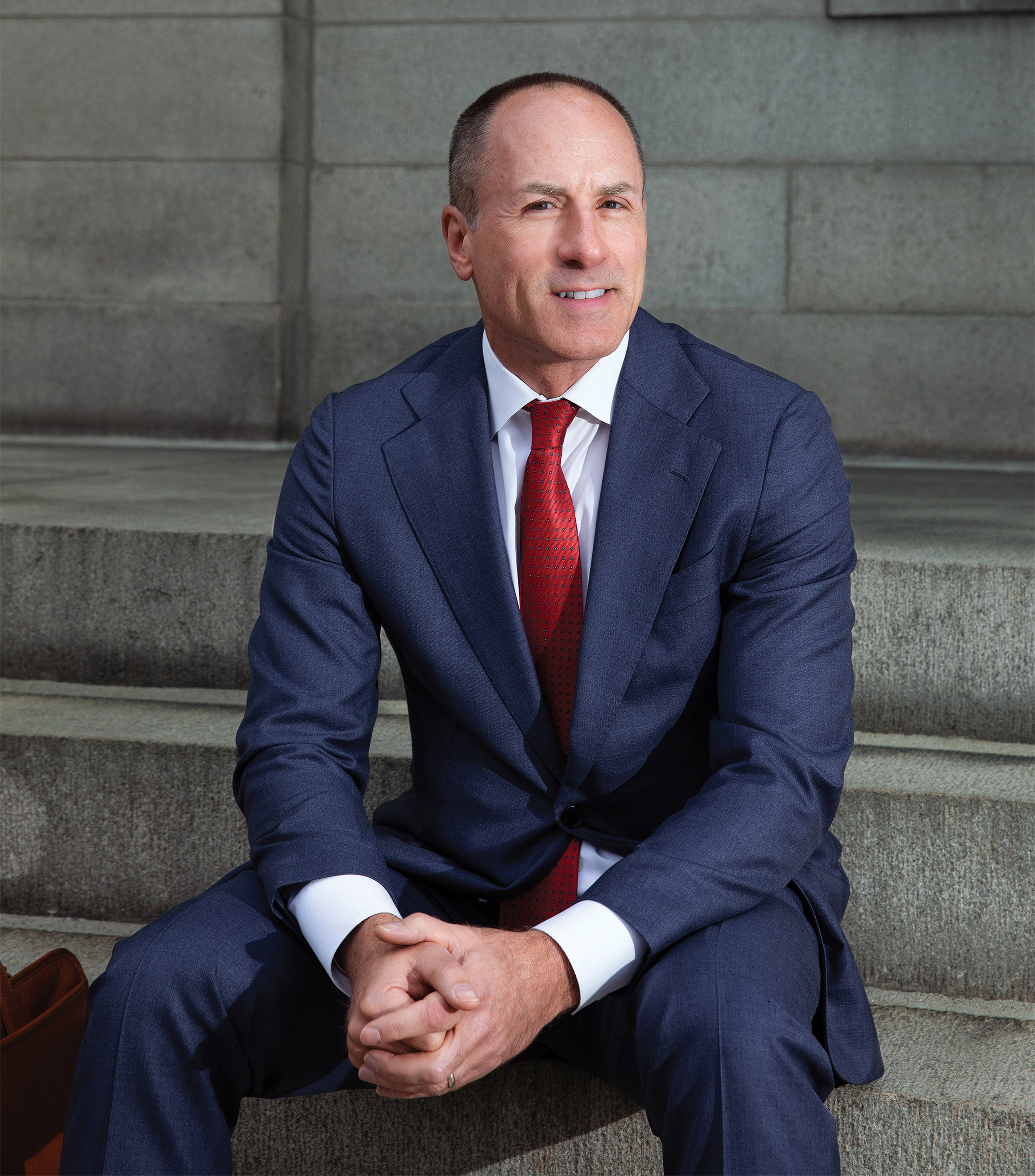
The first trial, with its plethora of physical evidence and the deluge of motions being pumped out by the prosecution, was “like drinking from a fire hose.”
Defense Attorney David Yannetti ’89
As news junkies almost everywhere know, Karen Read’s second jury delivered not guilty verdicts on every charge except for OUI, for which Read served one year of probation. Was justice done? “Justice definitely was done. I could not be more confident,” says Wolk. “It’s a complicated question,” says Johnson.
What about the defense’s narrative of what happened that night in 2022? How compelling did the interns find it? “What drew me to the case to begin with,” says Johnson, “was the feeling that in the first trial Ms. Read’s defense had to affirmatively prove her innocence. My personal theory of what happened is not relevant at all.”
Rosovsky echoes the point almost word for word: “I don’t think my personal view was relevant….The burden was on the state, so a lot of the work we did was [based] on that legal principle. We’re not detectives, we’re lawyers, and we did our job.”
Aside from freedom for Karen Read, bragging rights for the defense team, and the experiential learning enjoyed by the interns, the trial resulted in a dream job for one intern. Evan Wolk was offered, and accepted, a position with Alan Jackson’s law firm in Los Angeles. He had already accepted, and looked forward to, employment at a big Boston firm, where he would have worked on mergers and acquisitions. On the other hand, he says, “I always wanted to be a litigator because I imagined that’s what being a lawyer was about… I went into the internship with no expectation of [changing plans], but I loved the work so much it became difficult to imagine never doing that again.” (Jackson says his pitch to Wolk took the form of a simple question: “Do you like sunshine?”)
Nowadays, Wolk works closely with Jackson—“going through discovery, writing motions, and coming up with litigation strategies in all the cases we’ve got,” Jackson says. “He was with me nonstop in my last trial, which lasted for a month. He can read something, and it’s there—he just remembers it. He can pull out law, a report, a transcript. He’s going to be an extremely powerful lawyer once he starts litigation.”
As to Read’s retrial and its outcome, Jackson says, “I do not believe we could have made it through the trial without the interns, to meet the juggernaut that was the Commonwealth and the multiple motions they filed every day.” The interns, he says, “were very, very well-trained lawyers-to-be, prepared and ready for anything we could throw at them. It was the most sophisticated, most nuanced defense I’ve ever mounted, and they were right there with me.”
“I don’t think my personal view was relevant….The burden was on the state, so a lot of the work we did was [based] on that legal principle. We’re not detectives, we’re lawyers, and we did our job.”
BC Law’s Abby Rosovsky ’25

Beyond the Verdict
Sophie Johnson ’26, who received her JD in May, will be starting this fall as an assistant United States attorney in the US Attorney’s Office for the District of Columbia.
Abby Rosovsky ’25 is an associate in the corporate department of Proskauer Rose’s Boston office.
Lee Moore ’25 is an associate at the Boston office of Goodwin Procter, working on a wide range of civil matters.
Evan Wolk ’25 is an associate at the Los Angeles criminal defense law firm Werksman Jackson & Quinn, where he works closely with Alan Jackson.
Karen Read photograph by Jessica Rinaldi/The Boston Globe via Getty Images