



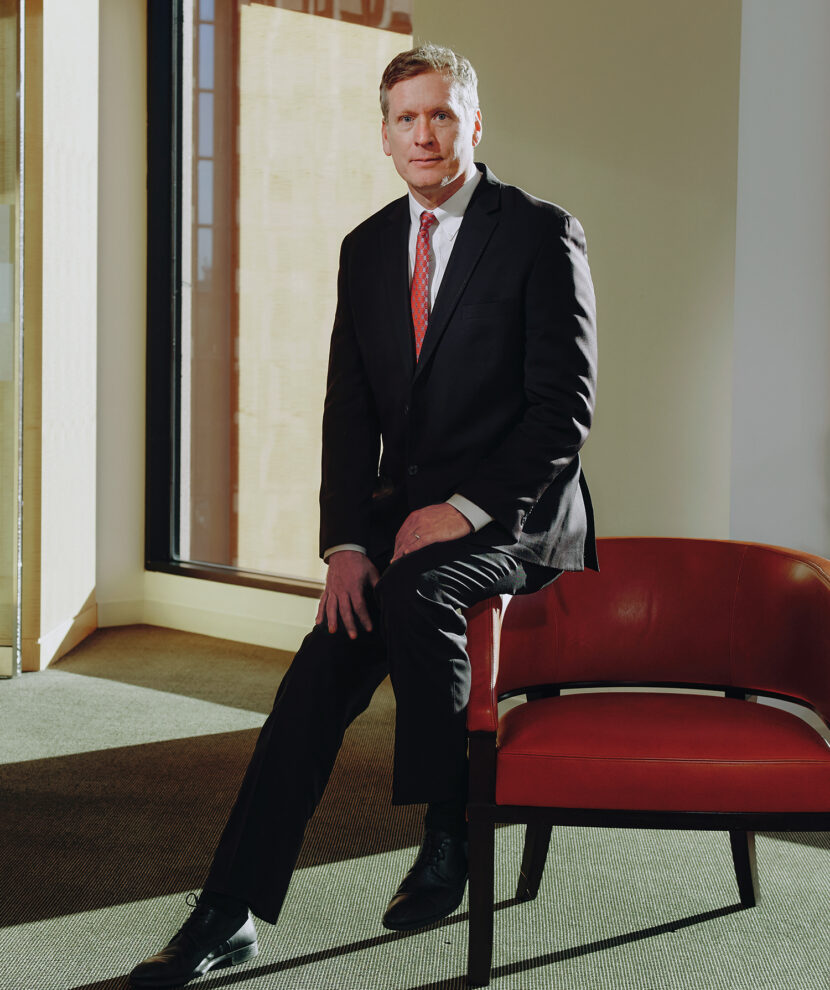





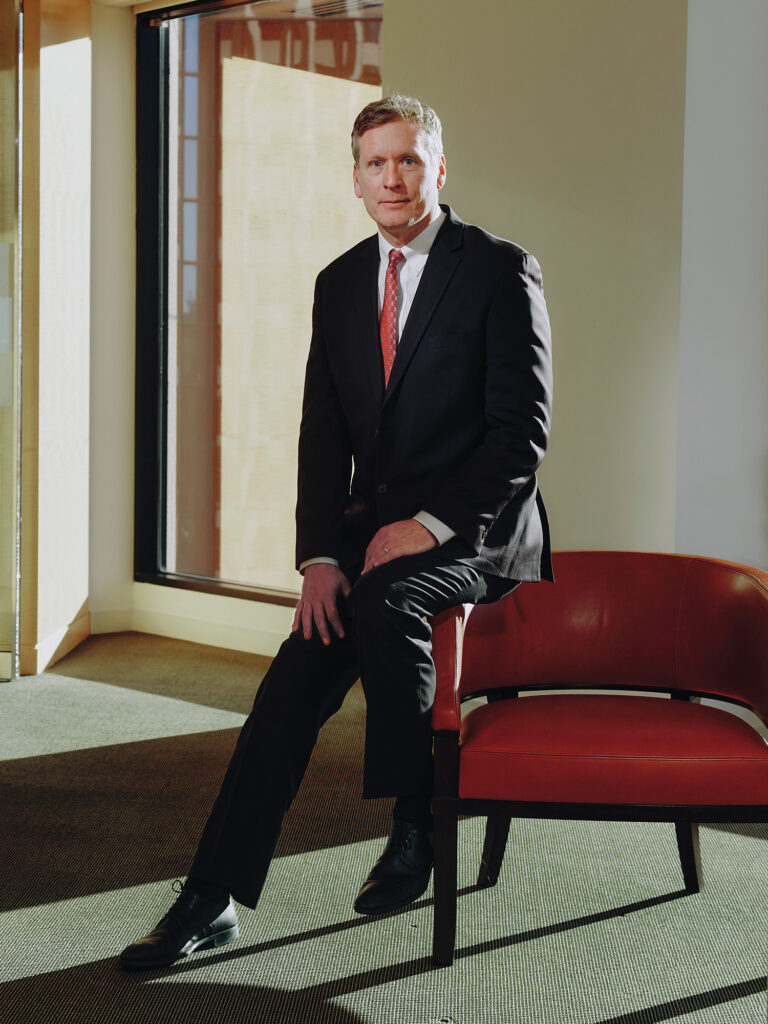
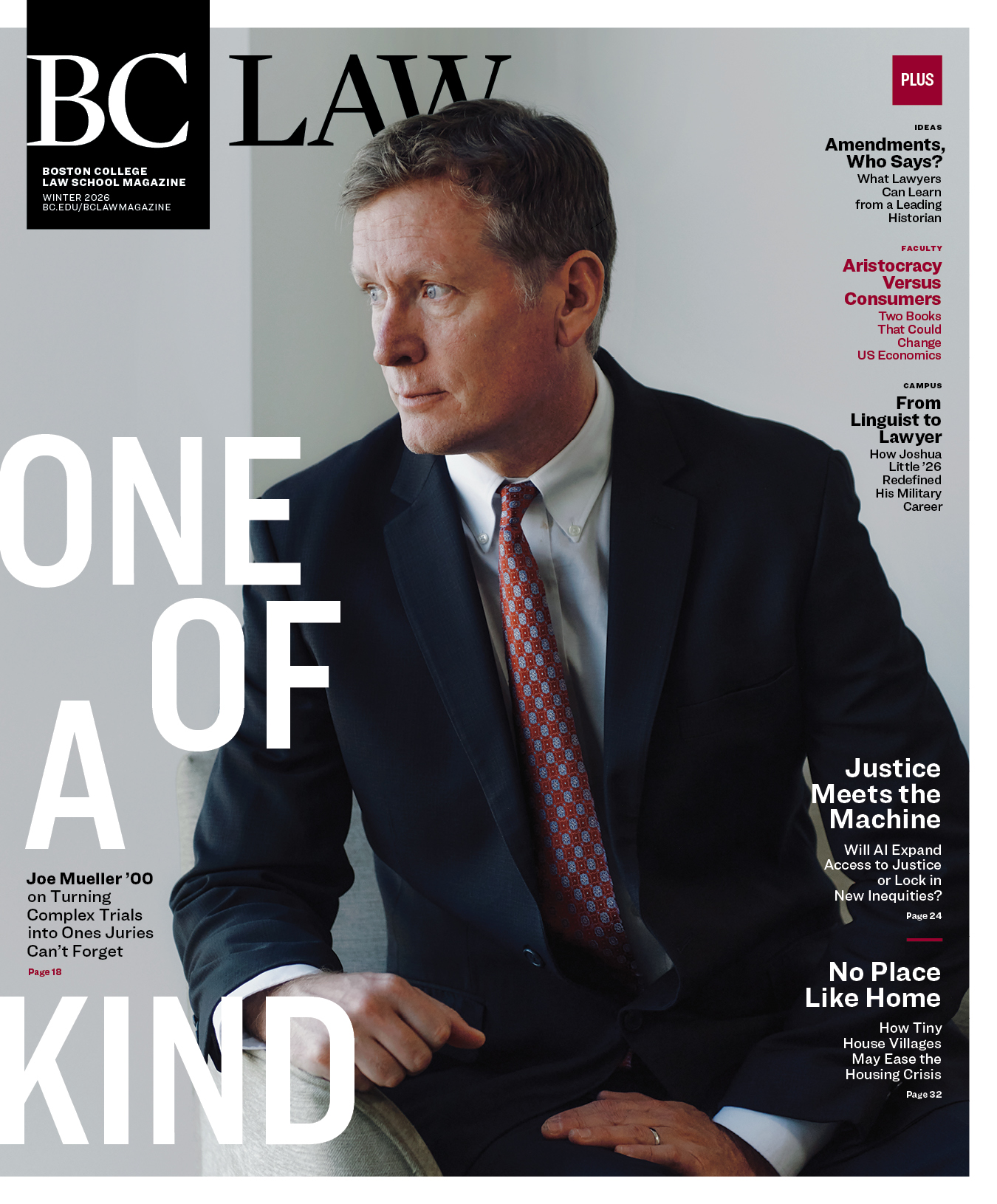
Joseph J. Mueller ’00 brought a dollhouse to federal court.
The thing was a diorama about the size of a breakfast table, two “stories” high, and because it was too big for the security X-ray machine, needed the pre-approval of court marshals to bring inside the building.
It took two people to carry it into the courtroom during Mueller’s cross-examination of a private equity hedge fund executive. The purpose of the dollhouse was to show the jury that the hedge fund was in control of two other companies.
On the diorama’s top floor was a representation of the hedge fund’s headquarters, complete with the company’s logo and little plastic, 3D-printed employees at computers. Embedded in each employee was an unlit LED bulb. While questioning the executive, Mueller noted that the company’s logo was blue. “So,” he said, I’m going to light these folks up in blue.”
On the floor below were two rooms. Figurines representing the five board directors of one company sat at a circular conference table in one room, and in the other room sat the three board directors of the other company. As the cross-examination continued, Mueller established that the majority of little people in each boardroom were employees of the hedge fund. He flipped the switch, and, behold! Before the jury was an organizational structure almost entirely awash in hedge fund-logo blue—indelibly driving home the point that the hedge fund was totally in control. The jury returned a verdict for Mueller’s client in only an hour.
“We could have done the whole thing without any visual at all,” Mueller says. “I could have just asked questions, but I thought, I really want to make this come to life.”
Mueller’s deployment of creative props and visual aids—known as trial demonstratives—and use of extended analogies is a trademark of his courtroom style. “My objective is to make every trial as engaging as possible for both juries and judges. Now, I don’t want the presentation to come across as a magic show, involving sleight of hand. Instead, I want jurors and judges to see that I’m trying to convey the facts, the truth, in a vivid way.”
Mueller has honed his style since graduating BC Law summa cum laude in 2000. In 2004, he joined the firm of WilmerHale, where he focuses on high-stakes, high-tech intellectual property matters, and co-leads the firm’s overall trial practice. In 2024, Mueller was inducted into the invitation-only American College of Trial Lawyers, a recognition reserved only for the country’s foremost litigators. He was the youngest in-court lawyer representing Apple in the 2012 so-called “patent trial of the century.”
“[Joe] is extraordinary with juries. He just radiates trustworthiness, and in large part that’s because he really is a person of real integrity.”
William F. Lee, former WillmerHale managing partner
Since just 2020, Mueller has first-chaired 13 trials, eight involving billion-dollar-plus stakes, and three involving hundreds of millions. In 2022, Mueller led four separate billion-dollar cases in four different intellectual property disciplines: patents, trade secrets, trademarks, and licensing—a rare achievement. Known for his optimism, setbacks don’t ruffle him: Mueller says, “Where we have had even large verdicts go against us, we have a great track record of eventually reversing those later, whether it’s in post-trial motion practice or on appeal.”
If there’s a secret to Mueller’s success, there’s a good case to be made that it’s this: Joe Mueller is a teacher at heart. In fact, while an undergraduate at Harvard, he participated in a program that involved teaching a semester of high school history classes, and for 20 years he has been an adjunct professor at BC Law, imparting the basics of litigation practice while encouraging aspiring trial lawyers to develop their own courtroom voices.
“The entire trial process, especially in jury trials and even in bench trials, is teaching the fact-finder your position,” says Thomas Lee, leader of Impact Trial Consulting, which creates custom demonstratives and other visual aids for litigators. In addition to the dollhouse, Lee once built Mueller a gigantic, to-scale, take-apart iPhone. Lee says, “Joe just knows how to break things down and then teach it to pretty much anyone.”
Mueller has a knack for dreaming up the right demonstrative for the occasion—and it needn’t be elaborate. In a trial where his client was accused of not operating in good faith in responding to a contract proposal, the demonstrative he chose was a simple analog clock. He had the clock displayed on a TV monitor with the hands set to the time that the company had emailed the contract proposal to his client. He then proceeded to cross-examine a company executive.
“And I said, ‘let’s start the clock,’ and the clock starts ticking,” Mueller recounts. As the jury looked on, Mueller began reviewing the actual contract, ostentatiously skipping some pages and keeping up a brisk pace. Six minutes later, at exactly the time that the executive’s company filed suit, a buzzer went off. About half the document remained unread. Not to put too fine a point on it, Mueller said to the executive, “There wasn’t even time to read the contract.”
“The judge was having such a hard time keeping a straight face,” Mueller says. “It really made vivid that the allegation that my client hadn’t responded fairly—when they had not even had the chance to read the proposal before the lawsuit was filed—was pretty silly.”

Creatively bringing judges and juries to case-clinching “aha” moments—and ensuring that those revelations stick throughout a trial—requires real mastery. To reach the highest echelons of trial practice, Mueller has been a committed student of his craft. “He has spent his career absorbing and picking up different pieces of styles from older generations of lawyers that he and I have both had the chance to work with,” says WilmerHale partner Sarah Frazier. “He’s one of those people who, if he’s up against a competitor who he’s really impressed by, I know he’s gone and pulled transcripts of the other attorney’s opening arguments, closing arguments, cross-examinations, and just combed over them to see what he can learn,” she says. He finds “the different pieces of what he sees out there that he thinks work well and meshes them with his own personality to come up with a style that is uniquely his.”
Wherever there’s a lesson to be had, Mueller learns it. For example, after a major, high-stakes trial in Texas, Mueller lingered on the steps of the courthouse with the jury foreman and one of the witnesses. “The foreman said to the witness that he knew that she was a good person when she was talking on the stand about having adopted children,” Mueller says. From that point forward, the foreman told them, he held a favorable view not only of this witness, but also of the people she worked with. “It really taught me the lesson that it’s important to make personal connections in trials,” Mueller says. “We were defending a large institution; we wanted to show that real people work there, good people who were trying to do the right thing at every turn. It was a good example of, for me, that the personal aspect of trials is absolutely crucial.”
Mueller’s promise was noticed early in his legal career by federal district court judge Patti Saris, for whom Mueller worked. It was she who told her friend William F. Lee, a legendary trial lawyer and former managing partner of WilmerHale, that he needed to take her young, talented law clerk to lunch. “He was everything that Judge Saris said,” Lee recalls now. “[Joe] is extraordinary with juries. He just radiates trustworthiness, and in large part that’s because he really is a person of real integrity.”
Mueller’s deployment of creative props and visual aids—known as trial demonstratives—and use of extended analogies is a trademark of his courtroom style. “My objective is to make every trial as engaging as possible for both juries and judges,” he says.
“The first time I worked with Joe on a case, it was apparent that he wanted nothing more than to be as good a trial lawyer as he could possibly be,” says James L. Quarles III, who served as an assistant special prosecutor on the Watergate Special Prosecutor Force and on Robert Mueller’s (no relation) special counsel team investigating Russian interference in the 2016 presidential election. “He won the trust of very large clients very early in his career. And those are clients who know. They are very, very astute consumers of legal services.” The independent legal ranking service Chambers and Partners has placed Mueller in their highest tier for intellectual property matters, and Benchmark Litigation, a research organization, named him the country’s Intellectual Property Litigator of the Year in 2025.
When he’s not in the courtroom, Mueller, as co-chair with Hallie Levin of WilmerHale’s trial practice, is responsible for training colleagues throughout the firm, veterans and novices alike, in the art and craft of litigating with an eye toward trial.
“We realized years ago that we have this incredible repository of trial talent, but it’s not all in one place. It’s not even in one department,” Mueller explains. “So we created this trial practice that spans the firm, and people from any department can affiliate with the trial practice.” Hundreds of lawyers and support staff participate. “We get together regularly to build knowledge and experience across the firm and also to build a sort of integration to get people to know each other and to realize the capabilities that allow for cross-staffing of cases, and allow for cross-staffing of marketing pitches,” he says. The trial practice maintains databases and repositories of high-quality cross-examination outlines, opening statements, and the like, and also information about different courts and trial resources. Every other year, Mueller and Levin run a multi-day “trial academy,” where partners preside as judges for mock trials staffed by younger lawyers.
Harry Hanson ’15, a newly elevated partner at WilmerHale, is a graduate of Mueller and Levin’s trial academy, and has taught with Mueller at BC Law. He says that trial academy “was an unbelievable opportunity to practice on your feet as a relatively junior lawyer at the firm and to learn from Joe and other people who have immense trial experience.” The firm-wide nature of WilmerHale’s trial practice means, Hanson says, that “you’re learning not just from other patent litigators. You’re learning from people who practice criminal law and people who practice antitrust law. The idea is that we can all learn from each other.”
In highly technical trials where billions of dollars are at stake, Mueller may be the guy in front of the jury, but everything he says and does in the courtroom stands on months of preparation by a team of dozens of lawyers and staff. “I believe in strategic integration and having everyone part of a holistic strategy,” Mueller says. “We’ll have dozens of people working behind the scenes on just a huge variety of tasks, working on briefs, working on preparing witnesses, working on cross-examination outlines,” Mueller says. “It’s a real production.” At the end of every court day, Mueller convenes his team into a “war room” to prepare for the next day. “I think it’s enormously important to have every member of the team feel equally invested in the case and equally attuned to the strategy,” he says. “That way, everyone has a better idea of where their piece of the puzzle fits with the other pieces, which is crucial for cases like this.”
Mueller also holds awards for his pro bono work. In two cases of which he says he is particularly proud, one ended disciplinary practices in an Alabama school district that were expelling students without due process. In the other case, he and his team won a court order requiring a Virginia city to pay for school-building renovations to accommodate people with disabilities—but his team had to pivot when the order was reversed on appeal. The team presented the situation at a town meeting, gained public support, and the remediation money was ultimately appropriated through the political process.
The skills that make Mueller a great teacher—to sense what’s hard to understand, to distill complexity into lay-accessible narratives, to set up unforgettable break-through moments, to lead with competence, sincerity, kindness, and respect—also make him an outstanding litigator. “I couldn’t be prouder of him if he was my own son,” says his WilmerHale mentor William Lee, who hired him so many years ago.
“We always try in our cases to conduct ourselves with professionalism and, of course, ethics and courtesy,” Mueller says. “I think it is possible to be very tough and substantively to pursue trial goals in a very robust and energetic way, and still be courteous and still be gracious.” Once, after the parties settled a case in Texas, the judge invited the lawyers for a debrief with the jurors. “The judge asked the jurors if they had any impressions, and one of the jurors said, ‘I have to tell you, this case really restored my faith in the legal system,’” Mueller recalls. “I thought that was wonderful.”