






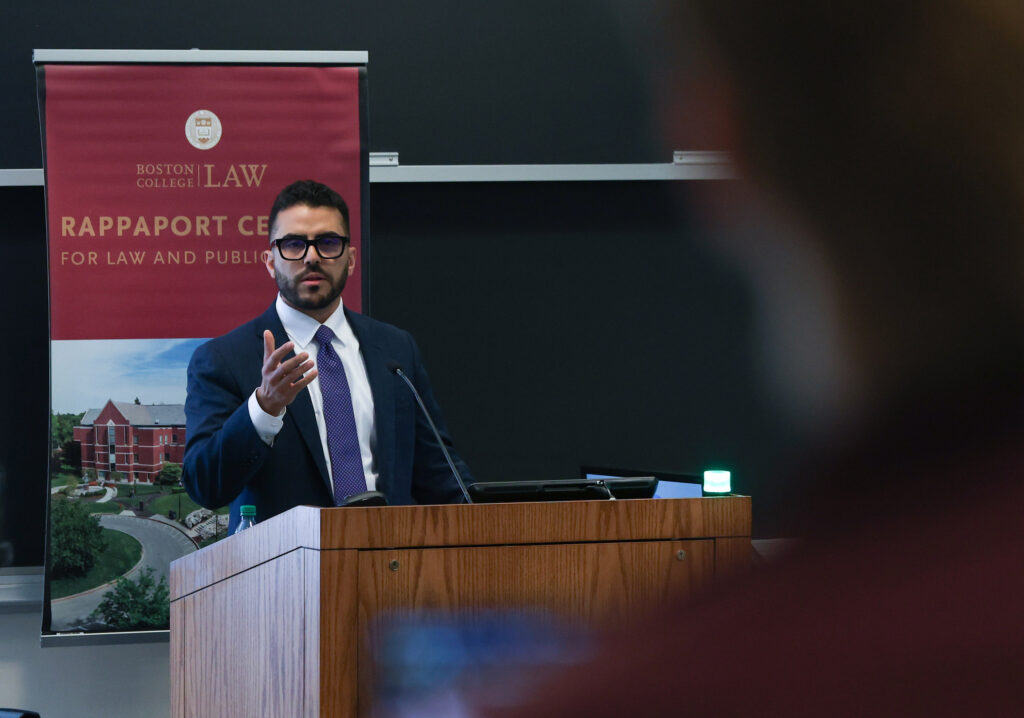
“When systems mediate power more directly than institutions do, legitimacy begins to erode,” asserted Alex Peña ’18, Rappaport spring senior fellow and Boston College Law School alumnus.
Since his graduation from BC Law in 2018, Peña has held several professional roles in public and private sectors. Currently serving as the Partnership for New York City’s executive vice president, Peña works to facilitate collaboration between business leaders and government, with congestion pricing as one of his primary initiatives.
On April 14, Peña addressed the Law School community on governing in an age of distrust. “The central problem of this moment is not simply that institutions have become weaker or less trusted. It’s that for millions of Americans, authority is now experienced less through institutions themselves, and more through the systems that stand between institutions and the public,” he said.
Systems have obscured our understanding of where power and authority reside, according to Peña. While institutions are locatable bodies in the executive branch, Congress, and the courts, systems are the rules, processes, technologies, and data flows that determine how information moves, how access is granted or denied, and how decisions are experienced in everyday practice, he noted. He described systems as the machinery by which there is often no clear face attached to the decision, no clear place to challenge it, and no real door to knock on. The consequence, as Peña understands, is a dissolution of legitimacy and public trust.
We are at a moment in which lawyers are well-positioned to lead. Peña calls upon lawyers to reengineer the encounter and shorten the distance between the institution and the person it serves, until the institution is no longer something people are told to trust, but something that they can actually experience.
During his residency as senior fellow, Peña, a “renaissance man” in the words of Professor Patricia McCoy, faculty director of the Rappaport Center for Law and Public Policy, also led a panel on a separate topic—aviation. In “Flying Cars, Drones, and the Future of Law,” Peña introduced a diverse panel of lawyers and policy innovators co-engineering the next generation of transportation.
Lauren Haertlein, deputy general counsel at Joby Aviation, described working with federal and state governments to create or update regulations around new entrance vehicles such as “eVTOLs”—electric vertical take-off and landing aircrafts. These emerging technologies have required a reevaluation of existing regulations. Desie Gibson, director of policy at Merlin Labs, which develops autonomous piloting software, explained that the Federal Aviation Administration (FAA) relies on the same basic framework for regulating these innovative aircraft entrants.
Even though the FAA has primary responsibility in this space, state governments play an essential role. Robin Grace, chief of advanced air mobility integration and strategy at MassDOT, noted the importance of public perception to the adoption of advanced aviation. She explains the importance of “skirt[ing] the fine line between enabling these operations and making sure we understand the risk continuum.” Paige Scott Reed, partner at PrinceLobel and key player in the establishment of MassAutonomy—a nonprofit dedicated to advancing next-generation aviation in Massachusetts—added that through experiential learning and transparency, local governments can pave the way for new technologies to gain public trust and investment.
New aviation technology has the potential for felt public impact. Gibson encouraged audience members to consider the practical applications advanced aviation technology may have on the ways in which we respond to disaster. In the aftermath of Hurricane Andrew in August 1992, Gibson shared that her family had to wait many days for essential relief supplies. She asked, “What if that was done autonomously?” encouraging the audience to consider the diverse applications of new entrance technology.
In concluding the panel, Peña urged audience members to consider the multitude of access points available in the regulation of new entrance technology.
During his homecoming to BC Law, Alex Peña showcased the opportunities students have available to them in working across the public and private sectors.
Photograph by Reba Saldanha