






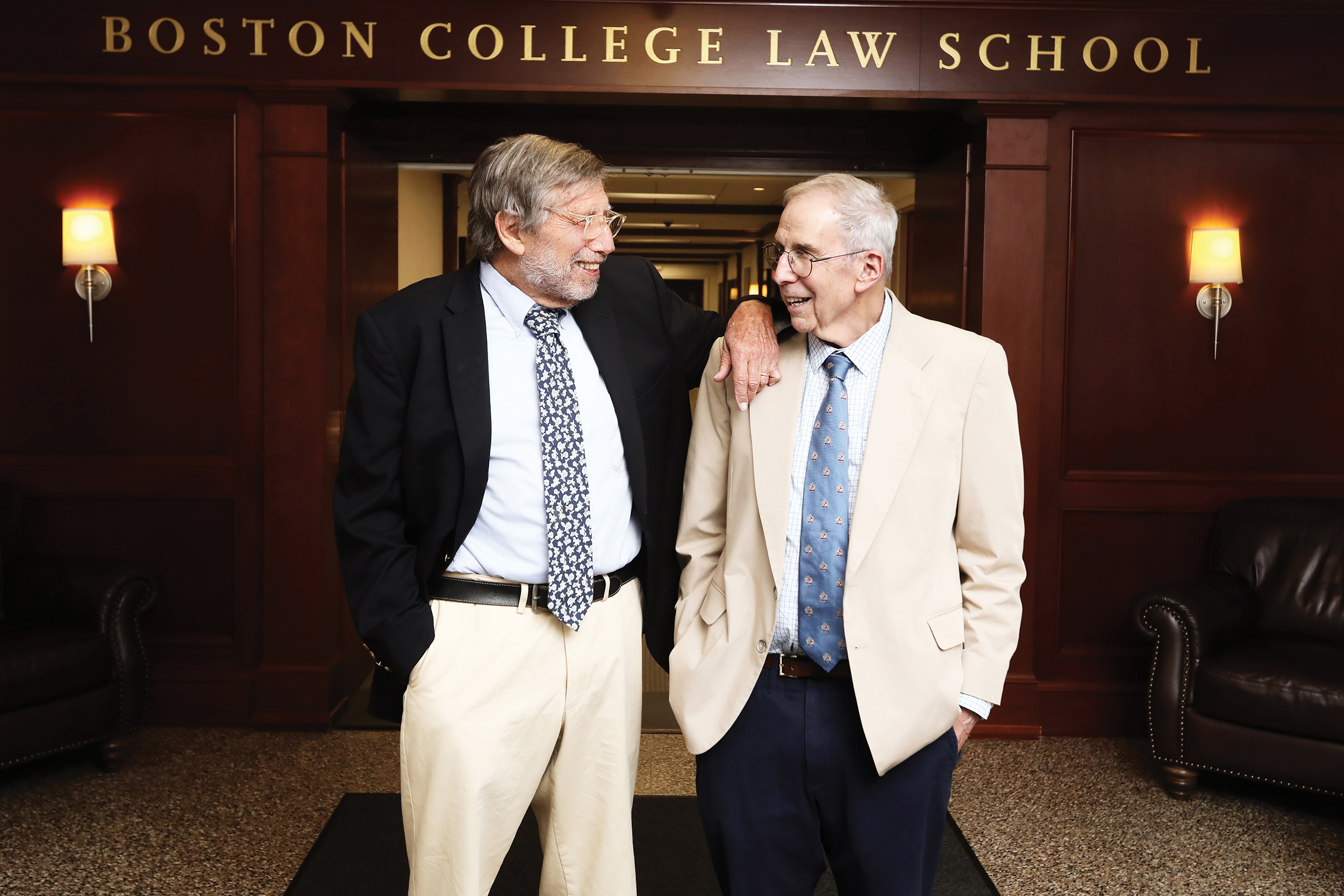
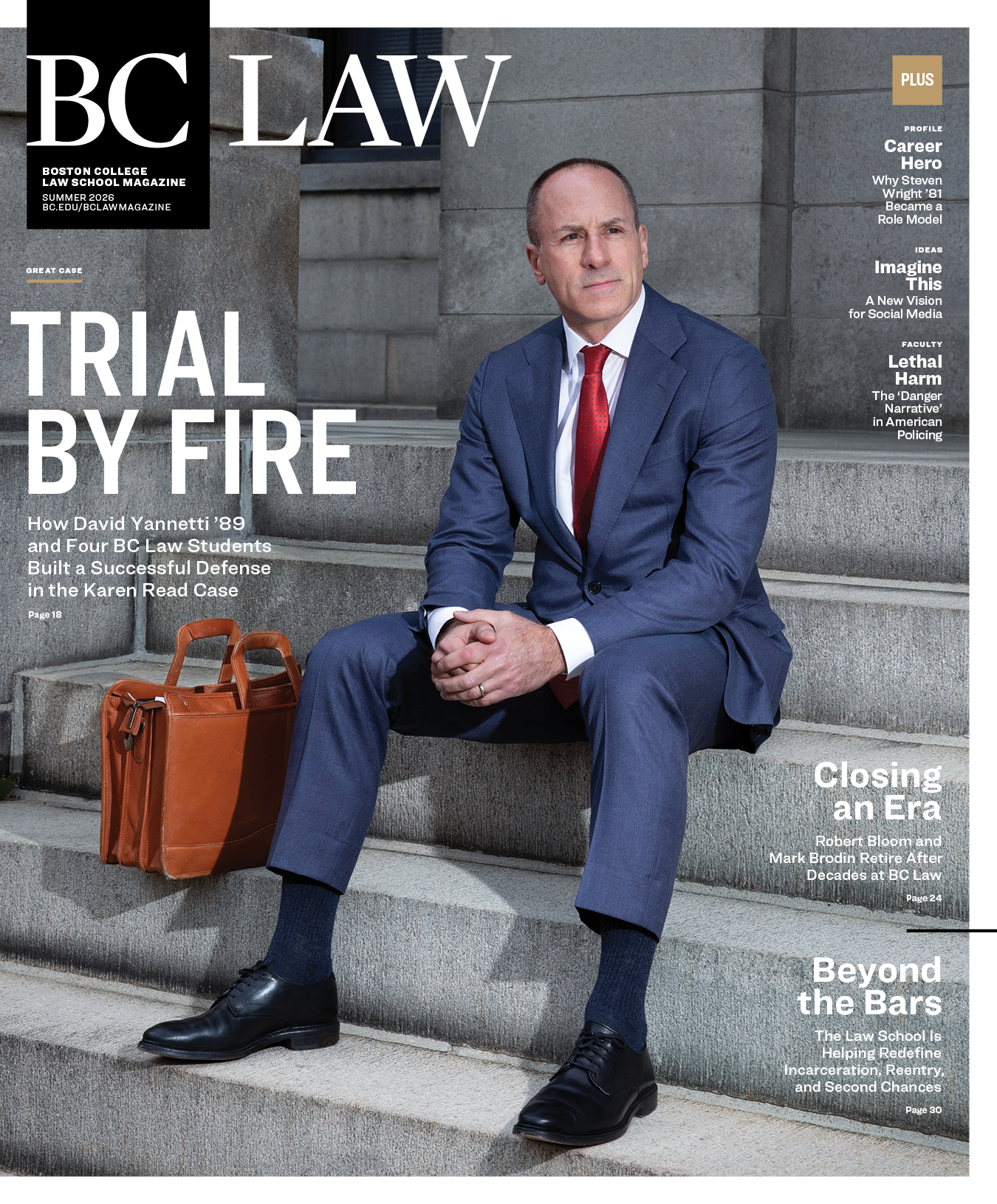
Fondly called the “Civil Procedure Twins,” Professors Robert Bloom ’71 and Mark Brodin taught alongside one another, produced scholarship together, and shaped the way generations of BC Law students understand the law. For decades, their names were synonymous with the first-year experience. This spring, they both retired from the school to which they have given so much of their lives, closing a chapter nearly half a century in the making.
The two came to teaching through parallel paths rooted in civil rights. “I became a civil rights attorney because I found discrimination abhorrent,” said Bloom, a BC Law alumnus, who began his legal career in Savannah, Georgia, as its schools were navigating the first year of a court-ordered integration plan. Eventually, he returned to Massachusetts to work for the legal services organization, Cambridge Sun. While there, he received a call from BC Law’s dean at the time, Richard Huber, who remembered him fondly from his student days, and informed him of an opening at Boston College Law School’s Legal Assistance Bureau. “I went through the interviewing process and eventually got the gig, so it wasn’t exactly planned…,” Bloom noted about his transition to teaching. At the time, he planned to stay at BC Law for a few years. That was more than 50 years ago.
Brodin’s path was equally purposeful. He was raised by parents who valued activism, and had an uncle who was involved in the Civil Rights Movement. However, law was not the only calling in his early years. An accomplished drummer, he was asked in college to join a group that eventually became Sha Na Na. He passed. Instead, he chose to attend Columbia Law School, where he graduated with honors, and joined United States District Judge Joseph L. Tauro as his first law clerk. “In an alternate life, I could have ended up with greased hair, jumping up and down on stage to doo-wop music!” he once exclaimed. He then spent six years working at the Lawyers’ Committee for Civil Rights under the Boston Bar Association, litigating employment discrimination, housing discrimination, police misconduct, and First Amendment cases. “It was grand fun,” he recalled.
“In an alternate life, I could have ended up with greased hair, jumping up and down on stage to doo-wop music!” said Brodin, once a drummer for the band that became Sha Na Na. Instead, he spent six years working at the Lawyers’ Committee for Civil Rights under the Boston Bar Association.
It was there that Bloom and Brodin crossed paths. Brodin oversaw two interns from BC Law’s clinical program, which Bloom managed. When Brodin had a 20-day employment discrimination trial against a police department, Bloom appeared in the gallery, took notes, and offered feedback. “And we just became friends,” Bloom said. During this time, Bloom urged Brodin to consider teaching, advice that Brodin took when a position opened at New England School of Law. In what Brodin considers a small miracle, he noted, “I think I was the only lawyer who went into teaching who got a raise in salaries.”
Eventually, Dean Huber invited Brodin to teach a Civil Procedure course at BC Law. As Bloom recalls about his longtime colleague and friend, “…the students loved him so much that they wrote a letter to the administration begging to have him stay here.” However, as Brodin recounted, “What I didn’t know is that, in order to have me as a visiting professor, Huber had to promise my old school that he wouldn’t raid me. So, I couldn’t come to BC right away. After the following year, Huber called me and asked me to come to BC for good, and I was just delighted.”

This marked the beginning of an era, as Bloom and Brodin became fixtures in the classrooms. Bloom, who described Civil Procedure as “not that dissimilar to getting a root canal,” focused on making the course enjoyable. “I like to have fun,” he said. On the first day of class each semester, he asked students to fill out index cards. “…to read about different things that I can share with the class that will interest these specific students,” he said. During the holidays, he held an annual ugly sweater contest. At the end of a particularly memorable semester, a class gifted him a large stuffed giraffe, which took up permanent residence in his office until his retirement. In 2020, he established the endowed Bloom Emergency Aid Fund to support students in times of crisis, after years of handing them his credit card.
Bloom also served as a mentor to students. Each year, he would allow a student to co-author an article with him for independent study credit, which led to many students’ works being published in scholarly journals. He served as the first faculty advisor to the Public Interest Law Foundation, chaired the Admissions Committee, and was a persistent advocate for diversity at the school. Over the years, he received the Emil Slizewski Teacher of the Year Award, and Faculty Member of the Year awards from both the Black Law Students Association and the Public Interest Law Foundation.
Brodin also developed a signature approach in the classroom, understanding it to be a conversation rather than a performance. “If we’re a monologue, I’d be bored to tears,” he said. He abandoned cold-calling in favor of a panel system after recognizing how much anxiety it caused, preferring a room where students felt safe enough to think out loud. His favorite case to teach was Erie Railroad v. Tompkins, not for its doctrinal complexity alone, but for the human story embedded in it. “If you connect the concept with a story, people might remember it more,” he said. Students clearly agreed with his teaching approach. Over the years, he received Faculty Member of the Year Award from the Law Student Association and was a two-time recipient of the Black Law Students Association’s Faculty Member of the Year Award.
During his tenure, Brodin became the Michael and Helen Lee Distinguished Scholar and Associate Dean for Academic Affairs, held visiting appointments at law institutions in Israel and Ireland, and served as a visiting professor at Boston University School of Law, Northeastern University School of Law, and Tufts University’s Fletcher School of Law and Diplomacy. For brief periods, he served as an appellate attorney with the Massachusetts Defenders Committee, now the Committee for Public Counsel Services, and as a special assistant district attorney in Norfolk.
Brodin produced extensive scholarship in the fields of employment discrimination, constitutional criminal procedure, civil procedure, evidence, scientific and forensic evidence, and litigation, including widely cited law review articles on race and accountability. He co-authored the Handbook of Massachusetts Evidence and Civil Procedure: Doctrine, Practice and Context, and wrote a biography of the legendary civil liberties lawyer William P. Homans Jr., while serving as Editorial Consultant to the six-volume Weinstein’s Federal Evidence treatise and overseeing its triannual update.
Bob Bloom, who described civil procedure as “not that dissimilar to getting a root canal,” focused on making the course enjoyable. “I like to have fun,” he said.
Bloom drew a direct line between his civil rights work and his scholarship as a national authority on criminal informants and a leading voice on Fourth Amendment jurisprudence, regularly testifying as an expert in jailhouse informant cases across the country. At one point, he became a court appointed master to rule on discovery motions in civil cases. His scholarly interests included the constitutional limits of policing, the persistence of racial disparities in police stops, and the evolving challenges of digital privacy under the Fourth Amendment. He authored Searches, Seizures, and Warrants: A Reference Guide to the United States Constitution and Ratting: The Use and Abuse of Informants in the American Justice System, while contributing to volumes of Moore’s Federal Practice. He also wrote casebooks, including Cases on Criminal Procedure. His shared casebook with Brodin, Criminal Procedure: The Constitution and the Police, now in its tenth edition, is a testament to the camaraderie that defined their decades at BC Law.
After years of shared scholarship, teaching, and service, it was fitting that their retirements coincided. Bloom delivered his final lecture on Terry v. Ohio, echoing the same sentiments that first drove him to civil rights law. In tribute to Bloom’s last class, Brodin offered these words: “Bob Bloom is what BCLS is all about: a consummate educator, total commitment to students, and outsized social conscience. I am so proud to call Bob a close friend, co-author, and colleague for over 40 years. His departure will leave an unfillable hole in our school.”
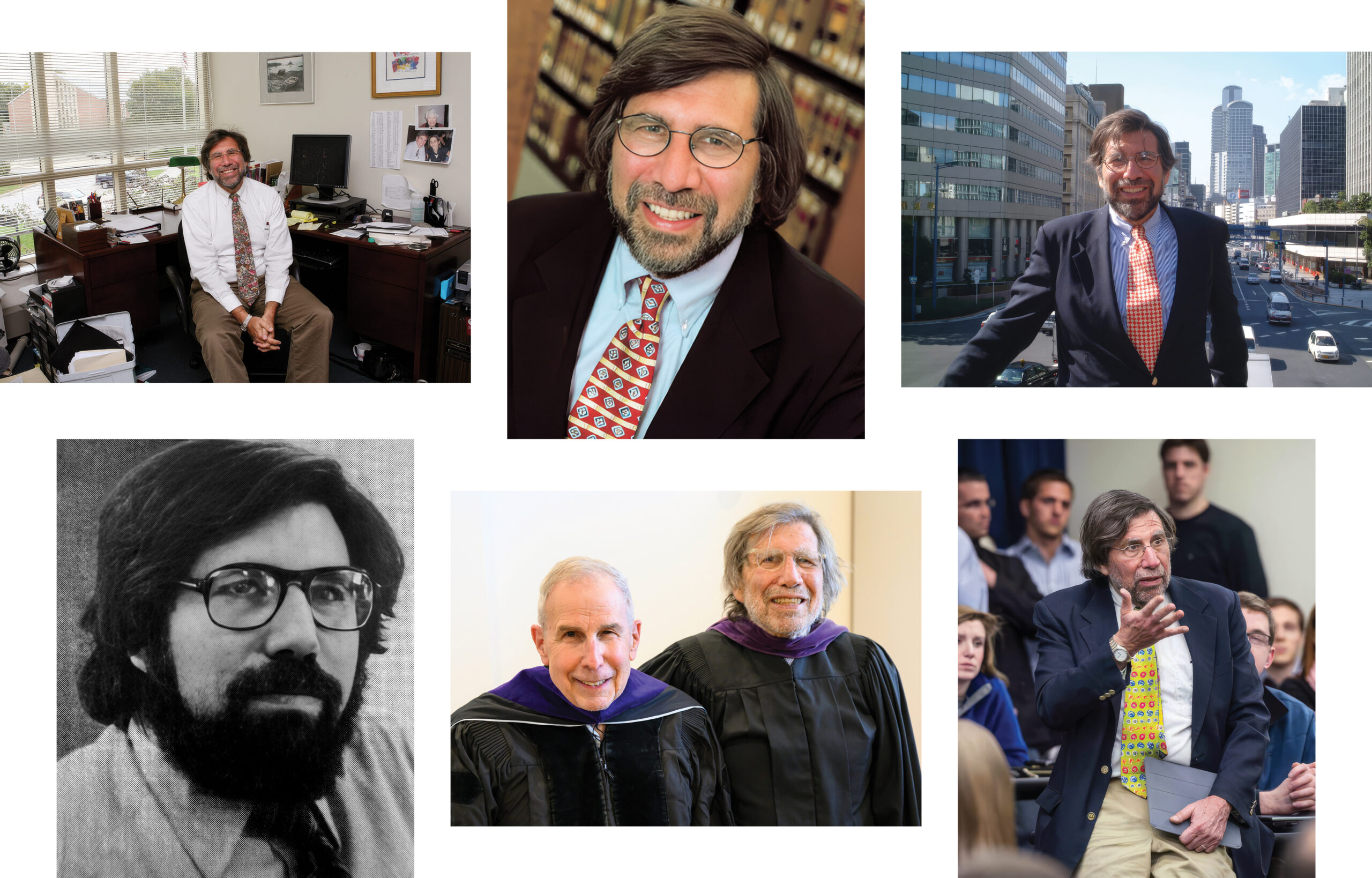
On Brodin’s last class, colleagues sent warm tributes to him. “You have been a great colleague and dedicated to the good fight and to your students,” wrote Professor Lisa Alexander. “From the time I met you at Northeastern—where you used to win the best teacher award as a visitor, no less—I knew there was something very special about you,” added Professor Filippa Anzalone. Professor Frank Garcia called him “a model of a good colleague,” who set a high bar for investing in students and community alike.
“Bob Bloom and Mark Brodin embody what it means to be a BC Law faculty member—rigorous scholars, devoted teachers, and tireless advocates for their students,” said Odette Lienau, the Marianne D. Short, Esq., Dean at BC Law. “The impact they have left on this community, on the countless students and colleagues whose lives they touched over the years, is immeasurable. We are deeply grateful for everything they have given to BC Law and to the legal profession.”
Reflecting on their legacies, Brodin said, “I hope we will preserve this environment for years to come.” Bloom offered a similar sentiment: “Boston College Law School is known as a place that trains good lawyers. And to be a good lawyer, you have to be smart, you have to care, and you have to have some sort of moral conscience… So, to the extent there’s a legacy, I hope it’s that I trained good people that know something about lawyering.”
What Bloom and Brodin leave behind is not easily replaced. They built a partnership rooted in friendship, mutual respect, and a shared belief that the law, done right, is a force for good. Their teaching influenced the way thousands of students think about law, justice, and what it means to do both well. BC Law is better for having them, and better still for having them together.