






For Boston College Law School’s newest students, the first year of law school now comes with an additional responsibility: preparing for a Big Law recruiting process that can begin almost as soon as classes do.
That changing timeline, with some law firms accepting 1L applications as early as October 1, 2026 for summer 2028 positions, prompted the Office of Career Services to take a new approach this year, bringing the centennial Class of 2029 together September 18 for the inaugural Big Law Summit, a half-day program designed to give students a clearer picture of the recruiting process and what it requires of them.
“The biggest challenge is that the new recruiting timeline offers the CSO very little time to get everybody up to speed,” Assistant Dean for Career Services Sarah Bookbinder said. “Students don’t just need a resume. Being prepared requires understanding what Big Law is, deciding if you want to start your career on this path, and determining what practice you want to apply for.”
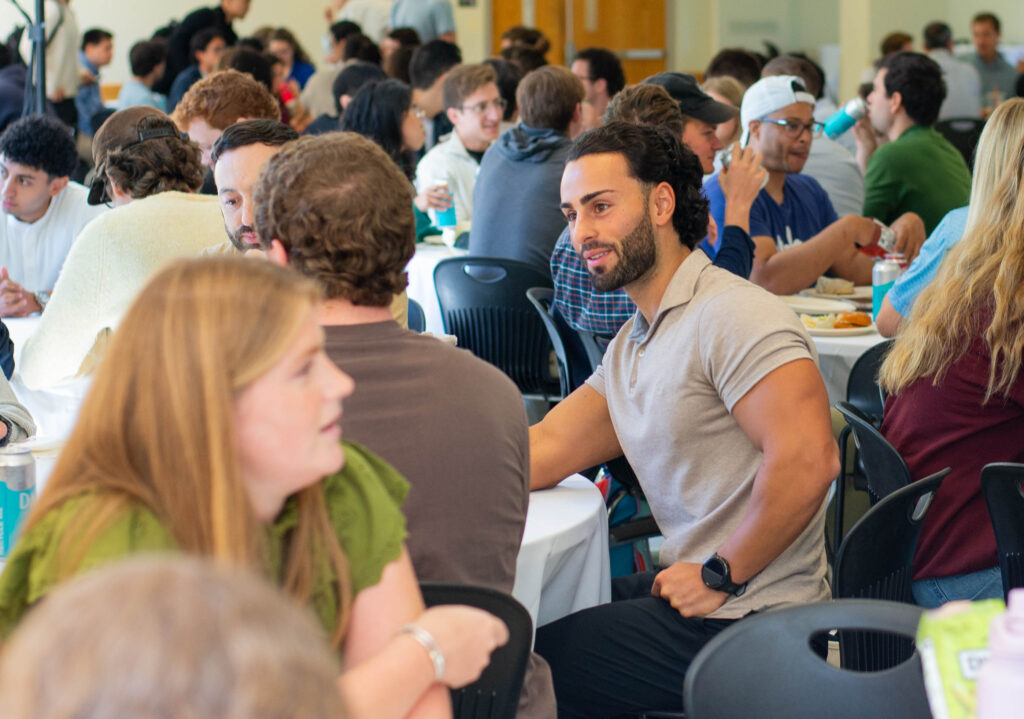
The Summit brought together Career Services staff, second-year students who participated in recruiting last year, and law firm recruiting professionals. The morning included a presentation from Bookbinder on the mechanics of Big Law recruiting, followed by panels featuring 2Ls discussing their recent experiences. The program concluded with a lunch panel featuring law firm recruiting professionals, including BC Law alumnus Daniel Vatanaviggun ’94 of Troutman Pepper Locke’s New York office.
For Vatanaviggun, who has more than 20 years of experience in legal talent recruiting, the early timeline has fundamentally changed what students must take on during their first year.
“1L year has now become a two-fold set of responsibilities running along parallel tracks,” Vatanaviggun said. “Not only are students tasked with a new way of learning and thinking…they now too must be increasingly aware of developing ‘commercial intelligence,’ with a clearer understanding of the role they will soon play as summer and junior associate ‘apprentices’ within the profession.”
In recent years, firms across the country have begun recruiting substantially earlier, with more and more opening application portals in the fall of 1L year. That compressed timeline leaves students less time to learn about the profession, prepare application materials, and decide whether and where they want to apply.
“The goal at this point is to help everybody get as informed as possible, as quickly as possible,” Bookbinder said.
The accelerated process also raises questions of access. Bookbinder said the earlier timeline can advantage students who enter law school with existing knowledge of the legal profession or connections to lawyers. In response, Career Services has moved resources earlier, including collecting and editing student résumés before orientation and creating a website with information about Big Law, firm research, and career decision-making.
“We want everybody to have access to opportunities, and confidence to apply, at the same level,” she explained.
The Summit was another part of that effort to expand access, giving students the opportunity to hear useful information firsthand rather than relying solely on emails and written materials. It also gave 1Ls a chance to learn from students who had recently navigated the process themselves.
“One of the best things about being at BC Law is that we have the most amazing community, career services team, and upperclassmen that will do everything to support us, explore those options, and find our way,” Allison Vuono ’28, a second-year student and panelist at the Summit, said.
Vuono, who will join Fried Frank in Washington, DC, next summer, said she also hoped the Summit would remind 1Ls that they do not have to have everything figured out right away. “I hope the 1Ls came away knowing that they’re in a great place, at a happy school, with so many resources and people at BC who are invested in helping them find the opportunities and careers that are right for them.”
Kasra Raffi ’28, who spent this past summer at Kirkland & Ellis in Chicago, was also among the first class to experience the new fall recruiting cycle. Raffi said many of the questions he heard from 1Ls this year, particularly about the recruiting timeline, networking, and balancing the process with grades, were ones his own class had faced.
“I really wanted to show how doable it is,” the second-year student said. “Many students are so nervous about the timeline and I hope they just see the entire 2L class and know that we all made it through, are still here, and happy.”
Rather than dismissing that anxiety, Raffi hopes students would recognize that some stress is a natural part of taking on something that matters to them.
“I won’t tell someone to just not be stressed because it’s inevitable, but that doesn’t have to be a bad thing,” he said. “You’re stressed because you care about it and you’re doing something important that means a lot to you.”
That perspective reflects a larger goal for Career Services as it adapts to an increasingly fast-moving profession: helping students navigate not just the next recruiting cycle, but the choices that shape their careers beyond it.
“There’s a purposefulness in your experience here and I think that that’s important for career advising because our office is not just here to be transactional,” Bookbinder said. “We’re not just trying to get you one job. We’re trying to help you figure out, honestly, your life.”
Photograph by Kasra Raffi