







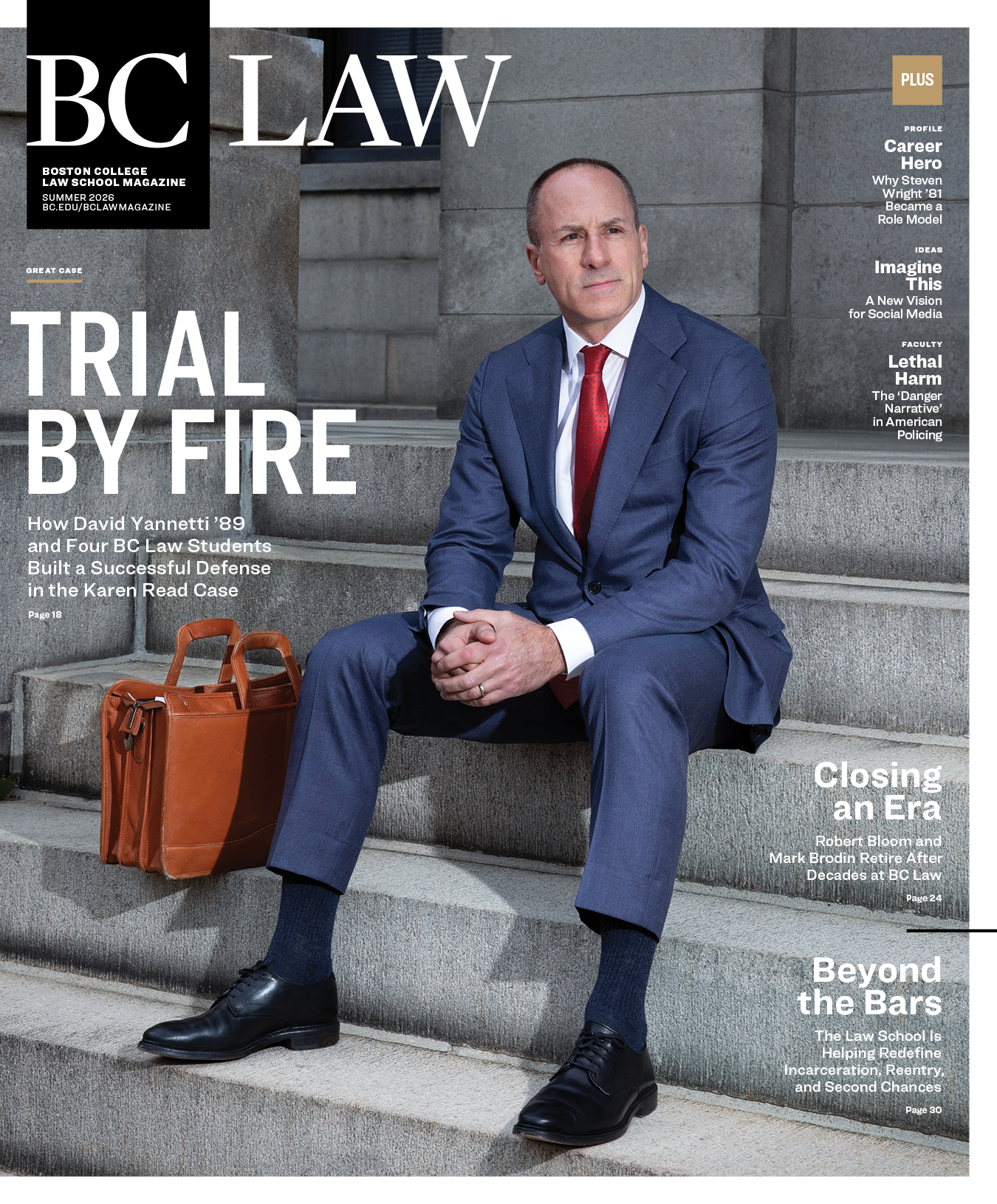
Steven H. Wright ’81 has spent four decades moving between public service, private practice, business, and finance with a consistent sense of purpose and a focus on impact across his roles. This spring, he left the Federal Reserve Bank of Boston after seven years as Senior Vice President and General Counsel to become Chief Legal Officer of First Tech Federal Credit Union. At the beginning of 2026, First Tech merged with Digital Federal Credit Union (DCU), creating a combined $30 billion financial institution, marking the largest merger in credit union history.
“I will always count my time at the Federal Reserve as among the most interesting and fulfilling of my career,” Wright recalled. There, he guided legal strategy during some of the nation’s most consequential financial periods, including the launch of FedNow, an instant payment service—the first new payment service since the check 50 years prior.
He legally guided the billion-dollar Money Market Mutual Funds, as well as the $17 billion Main Street Lending Program during the Covid-19 pandemic financial crisis. The legal team also supported Project Hamilton’s exploration of central bank digital currency. Wright described the period as “seven of the most dynamic years in the financial services industry,” shaped by crisis management, innovation, and economic recovery. Federal Reserve Chair Jerome Powell later credited some of these programs with helping stabilize markets and restore confidence during the economic shock of Covid-19.
Now, Wright is bringing that experience to First Tech, leading its Enterprise Governance & Legal Affairs departments, which encompasses legal, government and legislative affairs, compliance, and regulatory teams. In doing so, he aims to help guide the organization through a period of rapid growth and technological change while expanding access to innovative financial services for its 2 million members, another opportunity to pair financial innovation with a broader public purpose.
Finance, private practice, and public service define Steven Wright’s legal trajectory.
His path to those roles has been far from linear. Wright entered BC Law intending to become a public defender. However, a formative summer at the Legal Aid Society in New York shifted his perspective. “I realized that, unfortunately, by the time people reached that system, there was probably not a lot that I could do to have a meaningful impact,” he reflected. He moved toward the practice of business law and government leadership.
One pivotal moment came years later, when Wright was considering a judgeship in Massachusetts. After seeking advice from US District Judge George Daniels, then counsel to New York City Mayor David Dinkins, Wright received an unexpected opportunity to be interviewed for the deputy counsel position. He drove from Boston to New York the next morning and accepted the role as deputy counsel to the mayor. The deputy counsel experience reinforced a lesson that would shape the rest of his career: Lawyers can do more than interpret the law. They can help leaders solve problems, strengthen institutions, and create opportunities that improve people’s lives. He returned to Boston and co-founded his own firm, Chin, Wright & Branson, with his BC Law classmate Russell Chin ’81.
The move launched a career that placed Wright at the intersection of law, finance, business, and public service. In Boston, he represented residents during the transformation of Orchard Park public housing into Orchard Gardens, a landmark Hope VI redevelopment project that replaced distressed housing with modern townhomes and a new K-8 school through a combination of federal and private investment. He later represented BankBoston and Fleet in more than $250 million in equity investments supporting minority- and women-owned businesses across the country.
He also became the executive partner, managing Holland and Knight’s Boston office—an unexpected elevation. Wright credits mentorship as one of the defining forces in his career. At BC Law, he found an early mentor in Wayne Budd, then a rising Boston attorney who taught corporate law and later became a pioneering figure in the profession, and former Supreme Judicial Court Chief Justice Roderick Ireland. Those connections developed into what Wright described as “a career-long mentorship, sponsorship, and incredible friendships.” He added, “I am eternally grateful for those who poured into me.”
He, too, has remained closely connected to BC Law, as a member of the Dean’s Advisory Board and deeply invested in mentoring Black law students. Asked what he would tell his younger self graduating from BC Law in 1981—and the next generation of students—Wright reflected less on titles or achievements than on purpose and growth. “You’re going to have a better, more varied career experience than you imagined,” Wright encouraged. “Work hard, try to make a difference, and have fun along the way.”