


Rental affordability has only further deteriorated since 2010 New York gubernatorial candidate Jimmy McMillan famously declared, “The rent is too damn high,” according to BC Law Professor Lisa Alexander. High rental prices are a problem currently plaguing Massachusetts, particularly in the greater Boston metropolitan area.
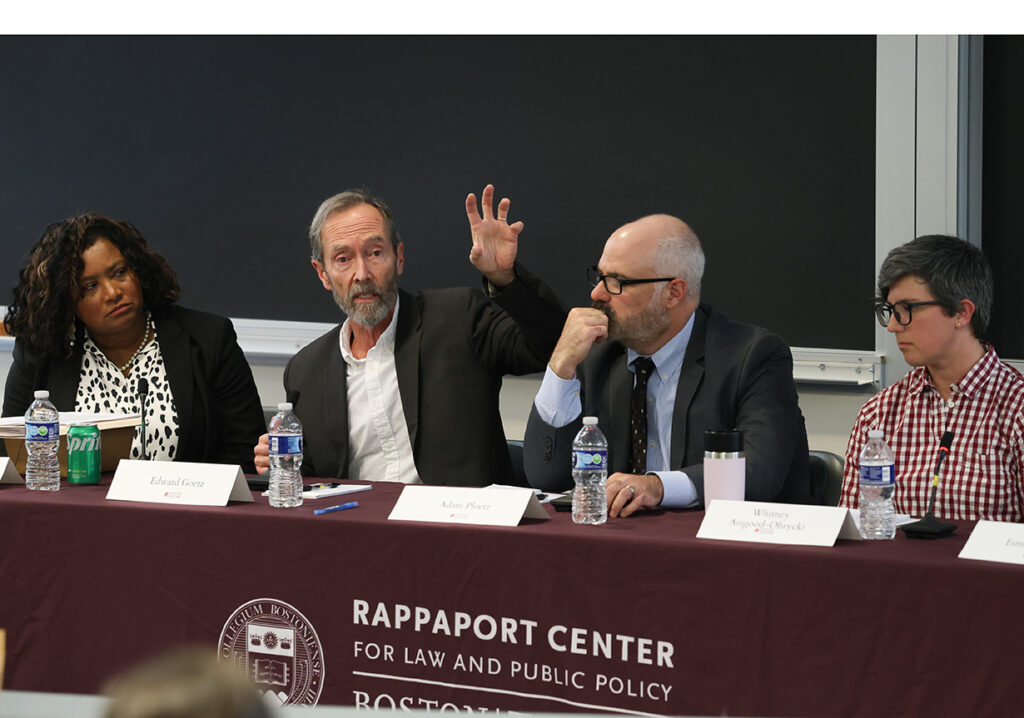
On October 21, BC Law’s Rappaport Center for Law and Public Policy hosted a panel of housing law and policy experts to address these issues and break down various potential strategies to promote affordable rental prices.
Professor Patricia McCoy, faculty director of the Rappaport Center, noted that Boston’s average rental cost rose to $3,400 this year. Almost half of Boston renting households spend more than 30 percent of their income on housing, and roughly a quarter spend over 50 percent.
Adam Ploetz, manager of housing and neighborhood development at the Metropolitan Area Planning Council, analyzed the pros and cons of inclusionary zoning and explained how pro forma models study its feasibility in various areas. Ploetz detailed several problems associated with inclusionary zoning, but he asserted there should be no full-scale retreat from the policy because it does help build affordable units.
“Inclusionary zoning policies need to be well balanced,” Ploetz said. “If the policy asks for too much affordability, then a developer will not build. If the policy doesn’t ask for enough, then the municipality is not going to get all the benefits it could get out of a specific project. The goal of a financial analysis is to maximize community benefit while maintaining development feasibility.”
Whitney Airgood-Obrycki, a senior research associate at the Harvard Joint Center for Housing Studies, discussed ongoing housing programs in Cambridge, including revolving loan fund programs. Because there is a shortage of available federal and state rental subsidies, Airgood-Obrycki said revolving funds are a way to grow the pie of affordable housing resources.
Rent control is another method employed to address affordable housing needs. Ed Goetz, a professor in the University of Minnesota’s Humphrey School of Public Affairs, asserted that the impacts of rent control vary because the programs and local housing markets vary. Empirical studies suggest rent control does depress rent growth and does not negatively affect housing production, but it can have a mixed impact on housing quality.
Despite often hyperbolic reactions to rent control policies, “more than 200 jurisdictions across the country have rent stabilization or rent control, and so far, the apocalypse has not visited any of those cities,” Goetz said.
Though the conversation surrounding affordable housing often focuses on building new units, preserving existing affordable housing can be easier and cheaper, according to Esme Caramello, co-faculty director at Harvard’s Legal Aid Bureau.
“We need creative financing options to make these community land trusts survive and be able to purchase these properties and take them off the market,” Caramello said. “And also, you have to get the landlord to the table, the owner to the table. … This is where the [Tenant Opportunity to Purchase Act] comes in.”
Near the panel’s conclusion, one attendee asked how law students can utilize their skills and become involved in the affordable housing conversation. Caramello said there are many ways to get involved in housing law, from eviction defense to government work to zoning enforcement. A lawyer’s deep knowledge of housing policy can make the difference between an effective policy and one that falls flat, she said.
Photograph by Reba Saldanha