


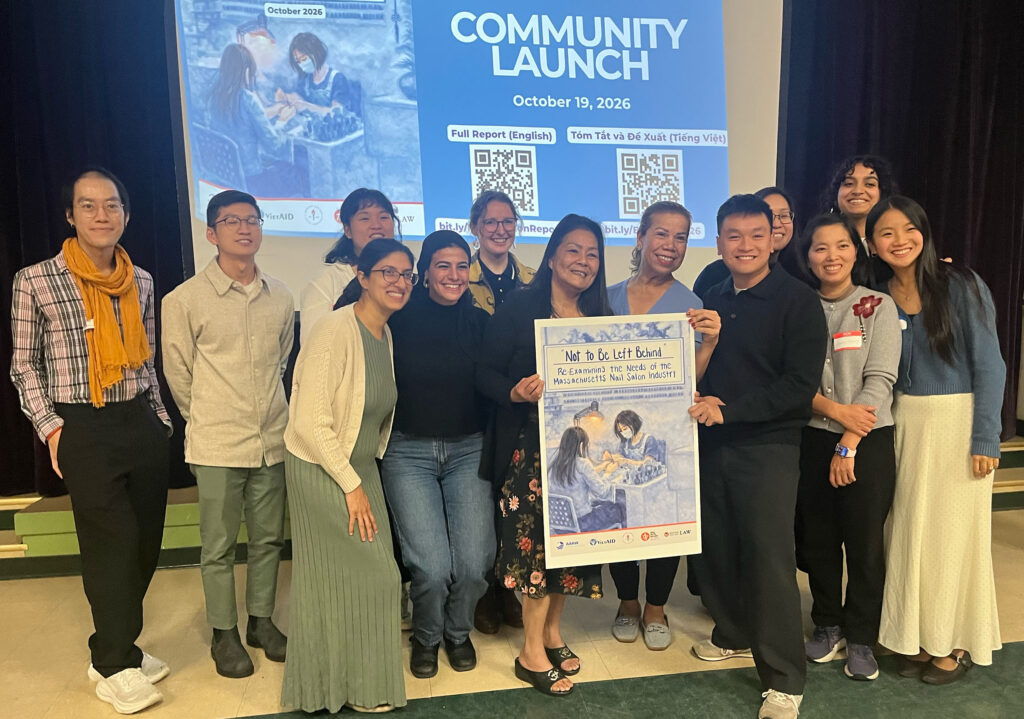
A yearlong research effort by Boston College Law School’s Civil Rights Clinic is bringing greater attention to the challenges facing Massachusetts’ nail salon industry, with a new report documenting the experiences of workers and owners across the Commonwealth.
Released Oct. 19, “Not to Be Left Behind: Re-Examining the Needs of the Massachusetts Nail Salon Industry” was developed in collaboration with the Vietnamese American Initiative for Development, Greater Boston Legal Services’ Asian Outreach Center, the Asian American Resource Workshop, and the Asian Pacific Islanders Civic Action Network. The study draws on surveys of 95 workers and 47 salon owners, alongside focus groups conducted across the state.
The findings reveal persistent financial instability and workplace risks in an industry that provides an important livelihood for immigrant women and families. Nearly 79 percent of surveyed workers reported earning $40,000 or less annually, while 80 percent said they had experienced symptoms such as headaches, dizziness, or nausea while working. Almost one-third reported feeling unsafe at work because of their identity or race.
Four current Civil Rights Clinic students—Samiha Abd-Elazem ’27, Portia Caruso ’27, Catelyn Devlin ’27, and Max German ’27—co-authored the report. Nine former clinic students also helped develop the study, secure Boston College Institutional Review Board approval, and conduct the research, bringing the total student contribution to 13.
“I am incredibly proud of our students for their dedication to this project and their commitment to amplifying the voices of nail salon workers and owners,” said Reena Parikh, director of BC Law’s Civil Rights Clinic. “This report is a wonderful accomplishment that demonstrates the impact of community-engaged advocacy and marks an important step toward advancing protections and support for these vital members of our communities.”
For Caruso, the research changed her understanding of the industry. “When I first joined this project, I only thought of nail salons as places to go for special occasions. After having spent countless hours speaking with nail techs, seeing how hard they work and the pride they take in their art, I’ve realized that this industry is essential—both for workers and their clients.”
The report also describes the economic pressures affecting salon owners, many of whom operate small businesses while navigating rising rents, labor costs, and uncertain customer demand. As the report observes, prices for nail services have barely moved in 15 years while rent and groceries keep rising.
Abd-Elazem emphasized the importance of documenting experiences that are often overlooked. “Nail salons are on practically every corner in Boston but there is not much research on the experiences and working conditions of people in the industry. I am so grateful to have supported this report to uplift their voices and shed light on the challenges that they are facing.”
The report calls for improved income stability, stronger health and safety protections, expanded multilingual resources, and greater worker participation in policy decisions. Its authors emphasize that meaningful change will require investment and collaboration among policymakers, community organizations, salon owners, and customers.
Read the full report here.