


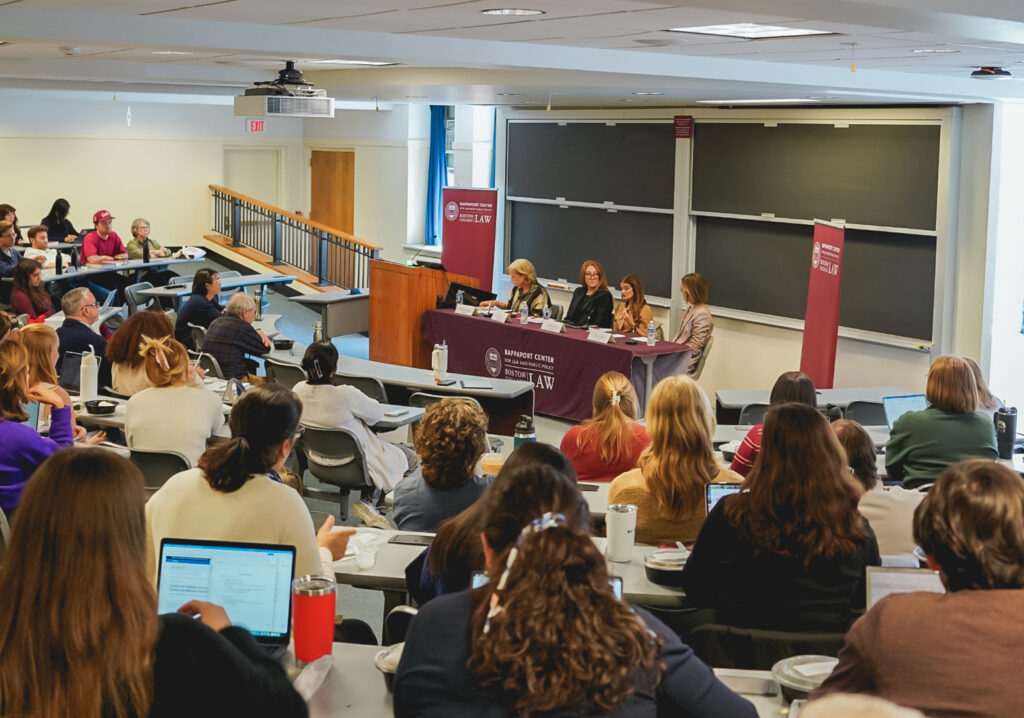
In the wake of the recent Lindsay Clancy and Latarsha Sanders cases, what would it take to build a maternal mental health system that reaches mothers before crisis? Panelists met for a recent Rappaport panel to ask, “Who Cares for Mom? Building a Better Maternal Mental Health System.”
Clancy’s trial brought the failures of the mental health system into stark view for Mary Ann Chirba, professor at BC Law and panel moderator. “Our system is fragmented,” she remarked, citing utilization reviews and other insurance gatekeeping devices, lack of communication between different electronic medical recordkeeping systems, and medical gaslighting as systemic barriers to women accessing care.
To address that fragmentation, Emily Bailey, commissioner for the Department of Mental Health (DMH), aims to build “a continuum” of care that takes a comprehensive view of a mother’s social, mental, and physical health. The goal, she explains, is to move away from just providing “a list of services” to understanding holistically how to meet the gaps or needs of new moms.
The Clancy trial has also been effective at bringing awareness to postpartum psychosis. Dr. Nancy Byatt, psychiatrist and founding medical director of MCPAP for Moms, noted that “mood and anxiety disorders during pregnancy and the postpartum period occur in one in five individuals,” so they’re not uncommon and often have a negative outcome, sometimes associated with maternal suicide and infanticide.
These outcomes are the result of a lack of access to evidence-based treatment. Dr. Byatt cited a study she conducted that found “even after women screened positive for depression, less than a quarter of those individuals were able to access even an initial mental health appointment.”
To fill the gap, Dr. Byatt founded MCPAP for Moms. The original MCPAP, funded by the DMH, was designed to enable pediatric clinicians to consult child psychiatrists for questions relating to adolescent mental health. MCPAP for Moms operates on a similar model, offering providers—often pediatricians who screen new moms for postpartum health issues when they accompany their newborns to appointments – specialized support to serve the mental health needs of pregnant and postpartum patients.
Any effective change to policy also requires storytelling, Dr. Byatt remarked. That narrative-building and organizing is at the center of Jessie Colbert’s work as the coordinator for the Massachusetts Mind the Gap Coalition. Originally supported through Postpartum Support International, Mind the Gap organizes a coalition of community-based organizations, nonprofits, providers, and impacted people in an effort to improve maternal mental health.
Mind the Gap was at the forefront of ensuring the inclusion of parts of the Moms Matter Act (MMA) in the Massachusetts’ omnibus maternal health law, which, among other things, funded grants for community-based programs that support perinatal mental health. Mind the Gap also was critical in the efforts to put into place universal screening, ensuring that both in the maternity and pediatric care settings, new mothers had a touch point with a provider around their mental health. Mind the Gap is now working on a bill that would allow perinatal mental health conditions to be considered in criminal cases, for example, as a mitigating factor in sentencing.
While Massachusetts is doing great work in the mental healthcare space, “everything is getting worse,” Chirba stated, citing a $1 trillion cut to Medicaid, a new requirement that individuals redemonstrate Medicaid eligibility every six months, and an expiration to Affordable Care Act subsidies. These cuts will only make the challenges to accessing care “more pronounced,” according to Chirba, thus heightening the need for further collaboration between government, coalitions, and providers.
The Clancy trial spotlighted the fragmentation of the maternal health care system. Panelists hope that the rise in national attention on the issue will bring forth a more functional and interconnected healthcare system.
Photograph by Reba Saldanha