






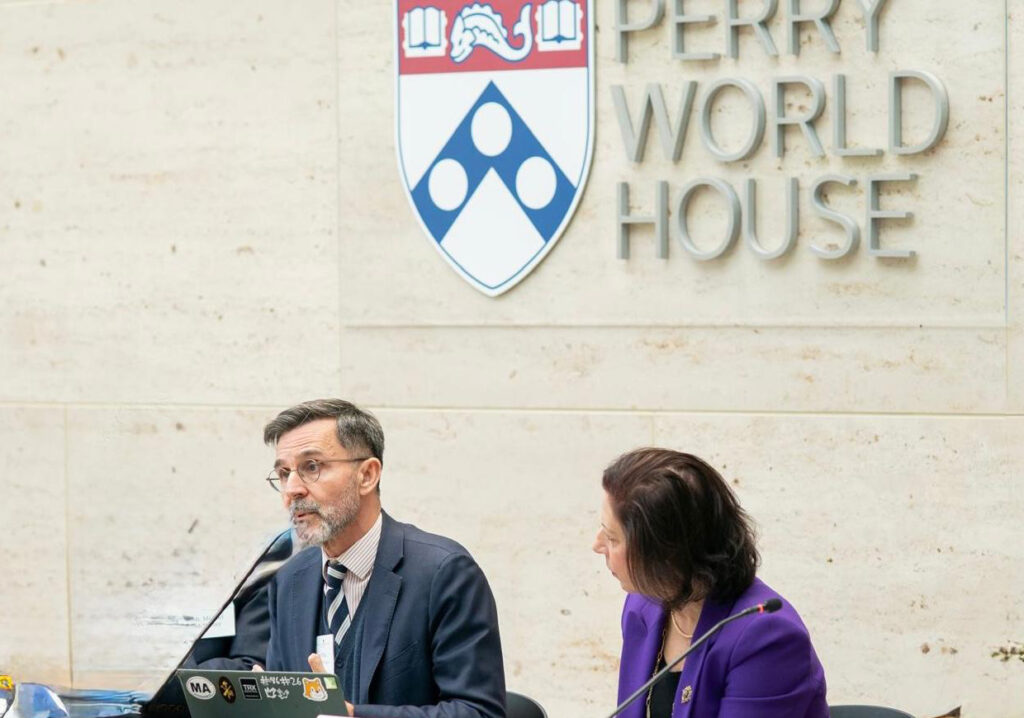
Andres B. Muñoz-Mosquera has spent much of his career working where international law moves from principle to practice: inside international institutions, courtrooms, negotiations, and military operations. Now, as Boston College Law School’s inaugural Distinguished Scholar in Residence, he is bringing that experience to BC Law’s classrooms and intellectual community.
Muñoz-Mosquera, who has held the honorific title of Distinguished Scholar in Residence since January 2026, is also an adjunct professor at BC Law and a visiting scholar with Boston College’s Clough Center for the Study of Constitutional Democracy. For him, the appointment brings together “three dimensions of my professional life that have rarely been separated: the study of international law, the practice of law within international institutions…and the teaching of future lawyers in the AI era.”
Those dimensions have intersected throughout a career that has taken Muñoz-Mosquera across international institutions, military operations, negotiations, and courts. He spent more than two decades in the Office of Legal Affairs at NATO’s Supreme Headquarters Allied Powers Europe, serving first as deputy director and, from 2014 to 2025, as director. His work has ranged from advising on NATO operations and negotiating international agreements to handling major court cases arising from operations in the Balkans and Afghanistan.
His experience in the Balkans began earlier and on the ground. During a deployment to Bosnia and Herzegovina, Muñoz-Mosquera took part in negotiations over anti-sniping agreements and exchanges of prisoners and remains in Sarajevo. He later worked as a counterintelligence officer with a US-led Allied Military Intelligence Battalion, identifying and collecting evidence of war crimes in support of the International Criminal Tribunal for the Former Yugoslavia. Across his career, he has also worked on rule-of-law issues in the Balkans and Middle East and negotiated and concluded more than 800 international agreements.
That breadth of experience shapes what Muñoz-Mosquera hopes to bring to BC Law. After years of advising on the legal dimensions of institutional decision-making, international courts, and military operations, he wants to bring “that practical perspective into the classroom and into the intellectual life of BC Law.” That perspective is grounded in his understanding of how international law operates beyond the classroom. “International law is not an abstract body of rules existing somewhere beyond or in between national legal systems,” Muñoz-Mosquera explains. Rather, its meaning takes shape through institutions, governments, courts, businesses, and individuals who must interpret and apply the law “under conditions of uncertainty and pressure.”
For Muñoz-Mosquera, that reality changes what it means to prepare students for careers in international law. Future lawyers must understand the institutions in which legal principles are interpreted and put into practice, as well as the role lawyers themselves can play in protecting the rule of law. “Law schools therefore have a responsibility not simply to teach students what the rules are,” Muñoz-Mosquera notes, “but to prepare them to understand how international institutions and relations work.”
Muñoz-Mosquera sees another challenge for legal education in the growing role of artificial intelligence. As technology changes how lawyers find, analyze, and produce information, he hopes to develop teaching approaches that shift the emphasis “from information retrieval to judgment, from doctrinal reproduction to critical evaluation,” and from individual written work toward the broader range of competencies lawyers need in practice.
In bringing the lessons of his international career to a new generation of BC Law students, Muñoz-Mosquera hopes to prepare future lawyers for a profession being reshaped by technology while cultivating the human judgment and responsibility required to put international law into practice.