






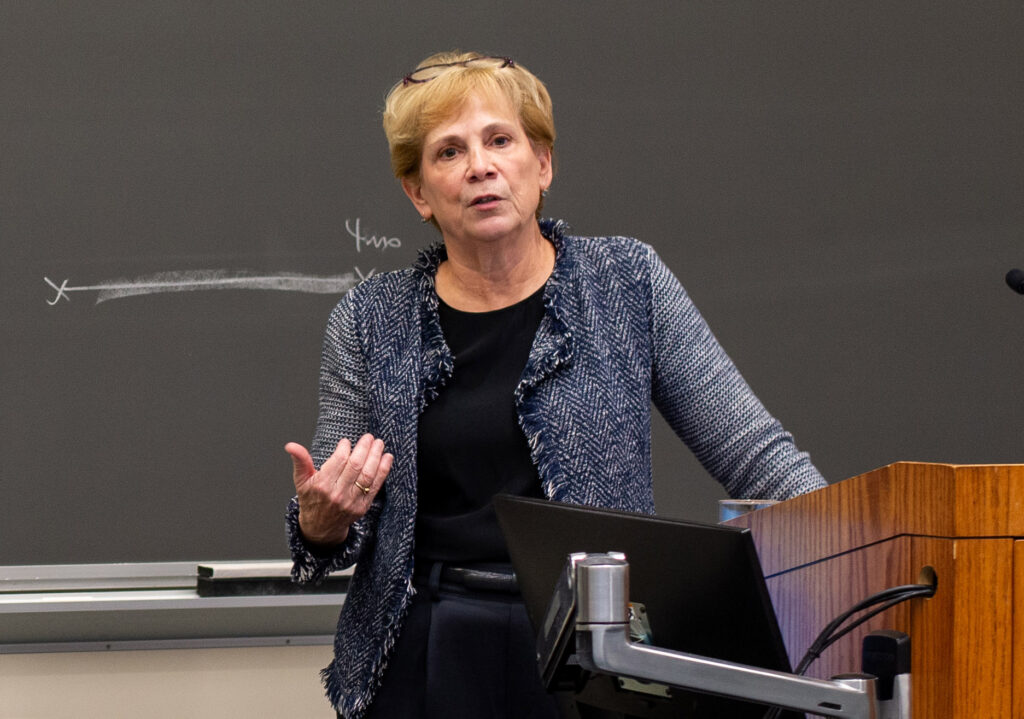
Nadine Pellegrini, a former federal prosecutor who served on the trial team in United States v. Tsarnaev, spoke to Boston College Law School students on October 13 about the investigation and prosecution of the 2013 Boston Marathon bombing. The event was hosted by the BC Law Criminal Law Society and moderated by Dan Boucher ’28, who worked as Pellegrini’s paralegal for two years before law school.
The 2013 bombing near the marathon finish line killed three people and injured hundreds. A federal jury convicted Dzhokhar Tsarnaev on all 30 counts in 2015. Pellegrini delivered the government’s opening statement in the penalty phase, which ended in a death sentence.
In the courtroom, Pellegrini had a history of building her cases around the victims and the lives they lost. She was chief of the Major Crimes Unit when the bombs exploded, and she said her years of work with victims earned her a seat on the trial team. In her talk, she walked students through the FBI-led investigation, in which agents rebuilt the crime scene from thousands of photographs. One analyst, she recounted, spotted a man in a white hat dip his shoulder, as if setting down a backpack. After long debate, investigators released photos of two suspects. No one came forward. The answers, she explained, came with the killing of an MIT police officer and the shootout in Watertown.
Turning to the survivors, Pellegrini described how the office brought in veterans of the Oklahoma City bombing case to help. She said she met with each victim and asked what they wanted, including the death penalty, though she noted that the final decision belonged to the US Attorney General.
Pellegrini traced her path to criminal law back to the University of North Carolina at Chapel Hill, where, she said, studying journalism gave her a nose for facts and a need to string them into a compelling story. She recalled that, as a student at Albany Law School, observing interviews for assistant district attorney jobs first drew her toward prosecution. She later started at the Monroe County District Attorney’s Office in New York and rose to chief of the Violent Felony Offense Bureau.
She credited one rule for what followed: early in her career, she “never said no.” That openness, she told students, carried her to the Massachusetts Attorney General’s Office, where she led special prosecutions, and then to the US Attorney’s Office in Boston, where she served as chief of the Major Crimes Unit and later chief of the National Security Unit before retiring.
A common commitment to protecting life connected the threads of Pellegrini’s career. Concerned about wildlife trafficking, she earned a master’s degree from the Tufts University Cummings School of Veterinary Medicine Center for Animals and Public Policy. This education, she said, would ground her policy arguments in science. She later taught animal law at BC Law.
Pellegrini closed by reflecting on her penalty-phase opening statement, in which she asked jurors to understand not only how the victims died but how they lived: the three people killed at the finish line and MIT police officer Sean Collier, who was killed during the manhunt that followed.
For the students in the room, the conversation was instructive about a professional pathway some of them might pursue.
Photograph by Kasra Raffi