


A Supreme Court ruling expanding presidential authority over independent federal agencies has reignited a longstanding constitutional debate over the limits of executive power and the future of agency independence.
That debate took center stage at a recent BC Law panel examining the Supreme Court’s decision in Trump v. Slaughter, which expanded presidential authority to remove the heads of independent federal agencies, overturning a nearly century-old precedent.
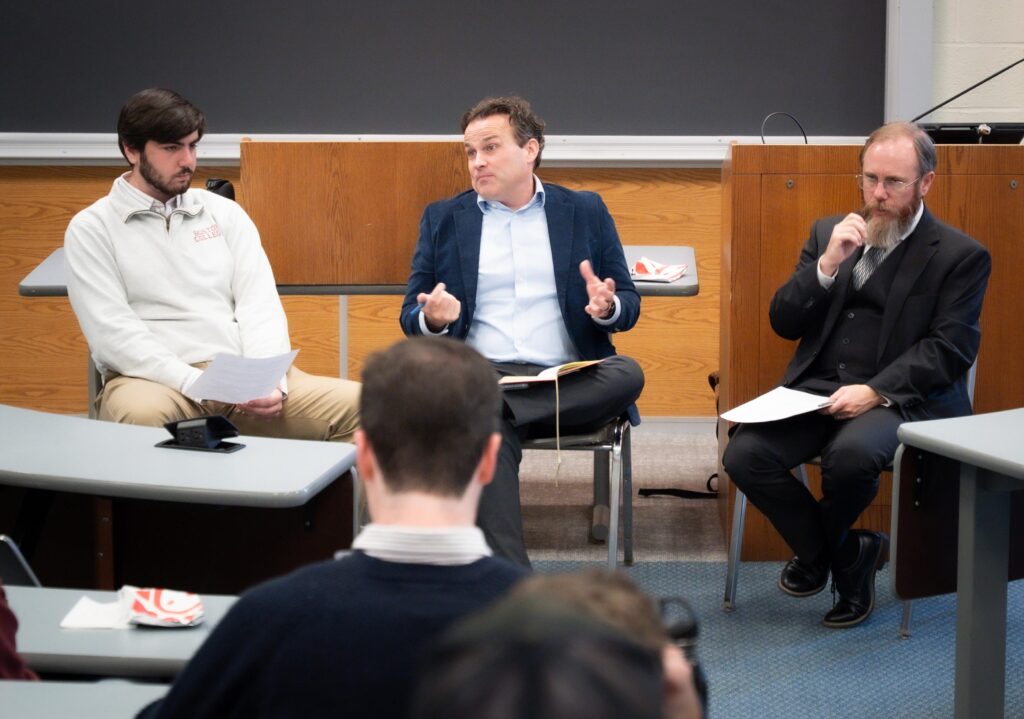
Hosted by the BC Law Federalist Society, the discussion featured University of Michigan Law Professor Christopher Walker and BC Law Professor Daniel Lyons, who examined the constitutional foundations of presidential power, the future of agency independence, and the implications of the Court’s ruling for the federal government.
How Much Control Should the President Have over Federal Agencies?
Walker opened the discussion by introducing the unitary executive theory, which holds that the Constitution vests executive power in the president and requires presidential control over officials exercising that authority.
He distinguished among three interpretations of that control: the power to remove agency officials, the power to direct their decisions, and the power to exercise an agency’s executive authority directly. Much of the discussion focused on the first interpretation, which was central to the Supreme Court’s decision in Trump v. Slaughter.
For decades, Congress relied on the Supreme Court’s 1935 decision in Humphrey’s Executor v. United States to protect leaders of certain independent agencies from dismissal without cause. In Slaughter, however, the Court overturned that precedent to the extent it permitted restrictions on removing officials who exercise executive power, expanding presidential control over agencies such as the Federal Trade Commission.
While Walker supported the Court’s recognition of broad presidential removal authority over agency leaders, he argued that such power need not extend to lower-level officials. In his view, the Constitution permits Congress to protect career civil servants from political interference, provided agency heads retain final decision-making authority.
Can Government Expertise Survive Greater Presidential Control?
Lyons questioned whether expanding presidential removal authority could undermine the independence of career civil servants and other lower-level government officials, whose expertise is essential to the operation of federal agencies.
“There’s a tremendous amount of value in having dispassionate experts in our agencies that are deciding these issues and making recommendations,” Lyons said.
The debate, Lyons explained, reflected two competing principles: political accountability and administrative expertise. While presidential oversight ensures that agencies remain responsive to elected leadership, insulating government officials from political pressure allows them to develop and exercise specialized knowledge.
Walker argued that the two principles need not be mutually exclusive. In his view, Congress can preserve employment protections for lower-level officials while allowing the president to shape an agency’s direction through the removal of its leader, provided that that leader retains final decision-making authority.
However, Lyons questioned whether the Supreme Court’s reasoning would ultimately preserve that distinction. Although Walker pointed to earlier decisions supporting protections for lower-level officials, Lyons argued that Slaughter could open the door to future challenges involving inferior officers and career civil servants.
Why Should the Federal Reserve Be Different?
The discussion turned to the Federal Reserve, whose independence presents a particularly difficult question for the Supreme Court’s expanding interpretation of presidential removal authority.
The Fed’s power to influence interest rates, and consequently the broader American economy, has long provided a rationale for insulating its leadership from direct political interference. Lyons questioned whether the Supreme Court could embrace broad presidential removal authority while preserving special protections for the central bank.
“Why is the Fed special?” Lyons asked. “Because it would be a disaster if Trump could, like, raise interest rates or I fire you. Everybody recognizes that that’s like the death of the Western economy, right?”
Walker acknowledged that the Fed’s monetary-policy responsibilities may justify special constitutional treatment. However, he argued that the institution’s extensive financial-regulatory authority complicates that distinction, since those responsibilities more closely resemble the executive functions performed by other federal agencies.
The panelists also considered whether the Supreme Court had avoided confronting that distinction directly.
“I view it much more as they dodged the Fed,” Walker said.
Walker pointed to Trump’s attempted removal of Federal Reserve Governor Lisa Cook, which the president justified on an asserted “for cause” basis. Because the dispute concerned whether sufficient cause existed for her removal, Walker suggested that the Court could address it without definitively deciding whether the president may dismiss Fed officials over political or policy disagreements.
How Far Will the Supreme Court Go?
The panelists concluded by considering how far the Supreme Court might extend its interpretation of presidential removal authority.
Walker identified Article I courts, including the US Tax Court and the Court of Federal Claims, as a potential “next battleground.” Unlike traditional Article III courts, whose judges enjoy constitutional protections against removal, these specialized courts operate under different statutory arrangements.
“At the end of the day, it’s checking the IRS and what the IRS is doing, and the president does not have final decision-making authority over the tax court,” Walker said.
Walker suggested that the authority exercised by these courts, particularly their ability to review the actions of federal agencies, could make their independence the subject of future constitutional challenges.
Lyons, meanwhile, suggested that the Court’s future direction may depend on whether subsequent administrations continue testing the limits of presidential authority. A president who operates within the boundaries established by the Court, he argued, may leave fewer opportunities for the justices to further expand removal power.
Walker closed by expressing concern that the erosion of institutional norms may pose a greater threat to agency independence than changes in constitutional doctrine alone. He explained that presidents have historically faced significant political consequences for dismissing senior officials, even when legally entitled to do so.
“So, my worry is more about norms. It’s not about legal stuff. It’s how do we kind of reestablish the norms that we want expertise in government,” Walker said.
Photograph by Delaney Miller ’29