

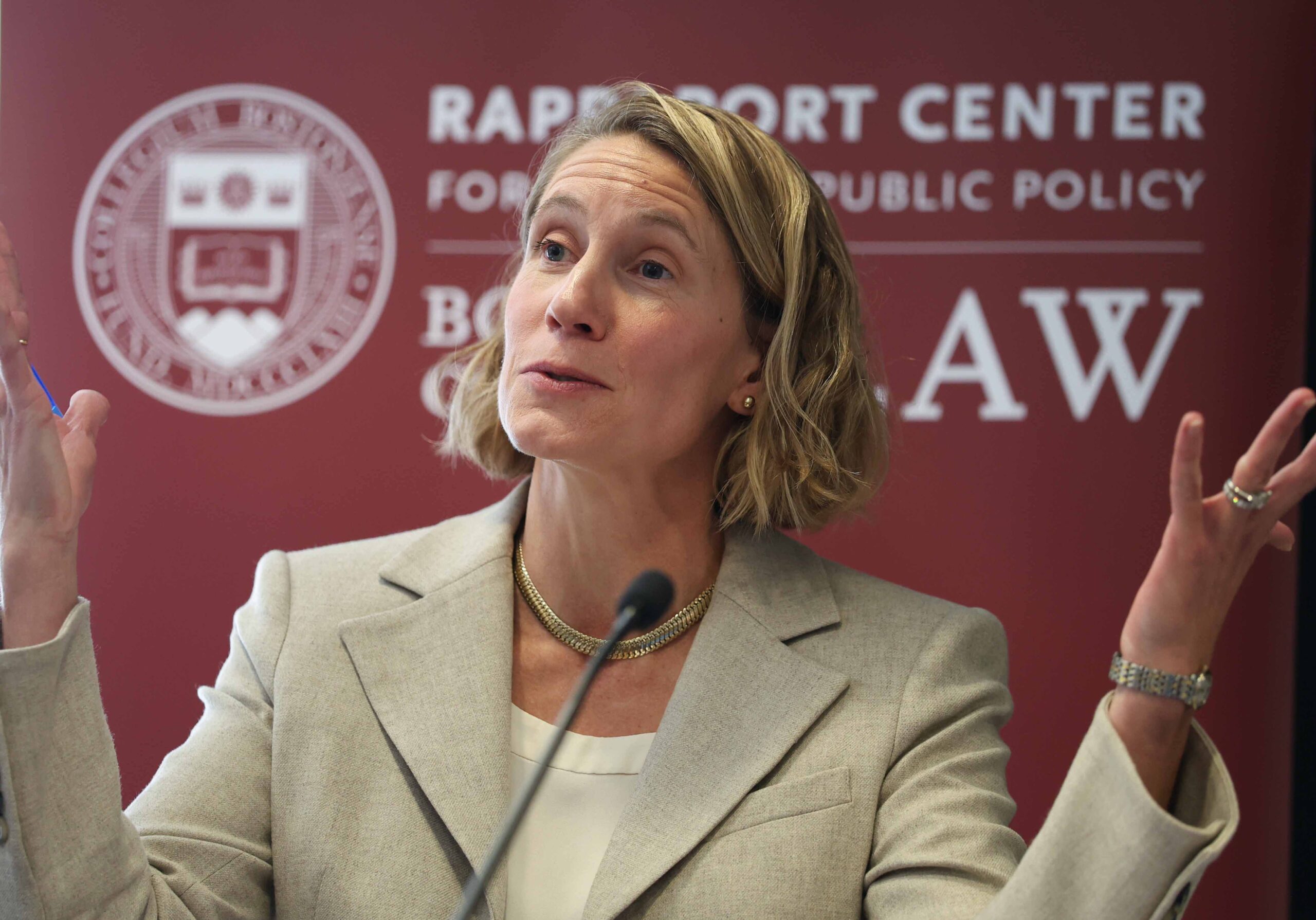
Former Securities and Exchange (SEC) Commissioner Caroline Crenshaw visited BC Law School for three days in November as a Senior Fellow of the Rappaport Center for Law and Public Policy. Currently a partner at Venable LLP, she kicked off her residency with a community address on campus examining the evolving balance of federal and state authority over US financial markets.
In the campus talk “Where Do We Go from Here?” Crenshaw described how federal and state investor protections sometimes overlap, with regulatory responsibilities divided among different agencies. This allocation of responsibility matters, she said, because different frameworks can provide different levels of protections to investors.
Crenshaw identified an impulse to seek the path of least resistance when it comes to compliance: “A pattern has emerged in which firms look to state law when it offers a lighter regulatory touch, to federal law when it offers a lighter regulatory touch, to a different federal regulator when that framework is more convenient, and to private contracts when the firm would prefer to set the terms of the engagement themselves,” she explained.
Crenshaw stressed that as regulatory protections change, the underlying financial activity and the risks it presents to investors likely remain the same. She also noted that overlapping regulation is not necessarily unneeded regulation.
“[The National Securities Markets Improvement Act of 1996] shows that removing one layer of review may simply leave no one performing a preventative function, and these dynamics have been particularly acute in the markets recently,” she said.
Eliminating a federal protection does not necessarily mean state law will provide an equivalent safeguard, Crenshaw said. Sometimes, that protection simply disappears. A related concern is public protections giving way to private ordering arrangements established through corporate charters, bylaws, and contracts.
“Those arrangements can be useful, particularly when parties have meaningful bargaining power, but public company shareholders generally cannot negotiate the governing documents of companies in which they invest,” Crenshaw said.
Crypto is another area with legal questions surrounding regulatory boundaries, but in this sector, the boundary is between two federal agencies: the SEC and the CFTC. Crenshaw said this determination matters because the SEC and the Commodity Futures Trading Commissioner (CFTC) have different statutory powers.
“The CFTC can pursue fraud and manipulation in commodity spot markets, but it generally lacks comprehensive regulatory authority over those markets comparable to the SEC’s broader ongoing oversight of securities trading platforms and intermediaries,” she said. “So, concluding that a transaction falls outside the securities laws does not necessarily mean another regulator can provide equivalent protections.”
Crenshaw concluded her talk by comparing the US regulatory system to a Jenga tower. You can remove one block and the tower stands, maybe even some others. But some blocks support each other, and you may not know which blocks held the structure together until they’re gone.
“Our securities laws work in much the same way,” she said. “Disclosure requirements, custody, safeguards, regulatory oversight, [and] private rights of action serve different purposes. Some overlap, others reinforce each other. Removing a requirement may reduce costs or complexity, but we need to understand what that requirement was doing in the first place and whether anything meaningful will take its place.”
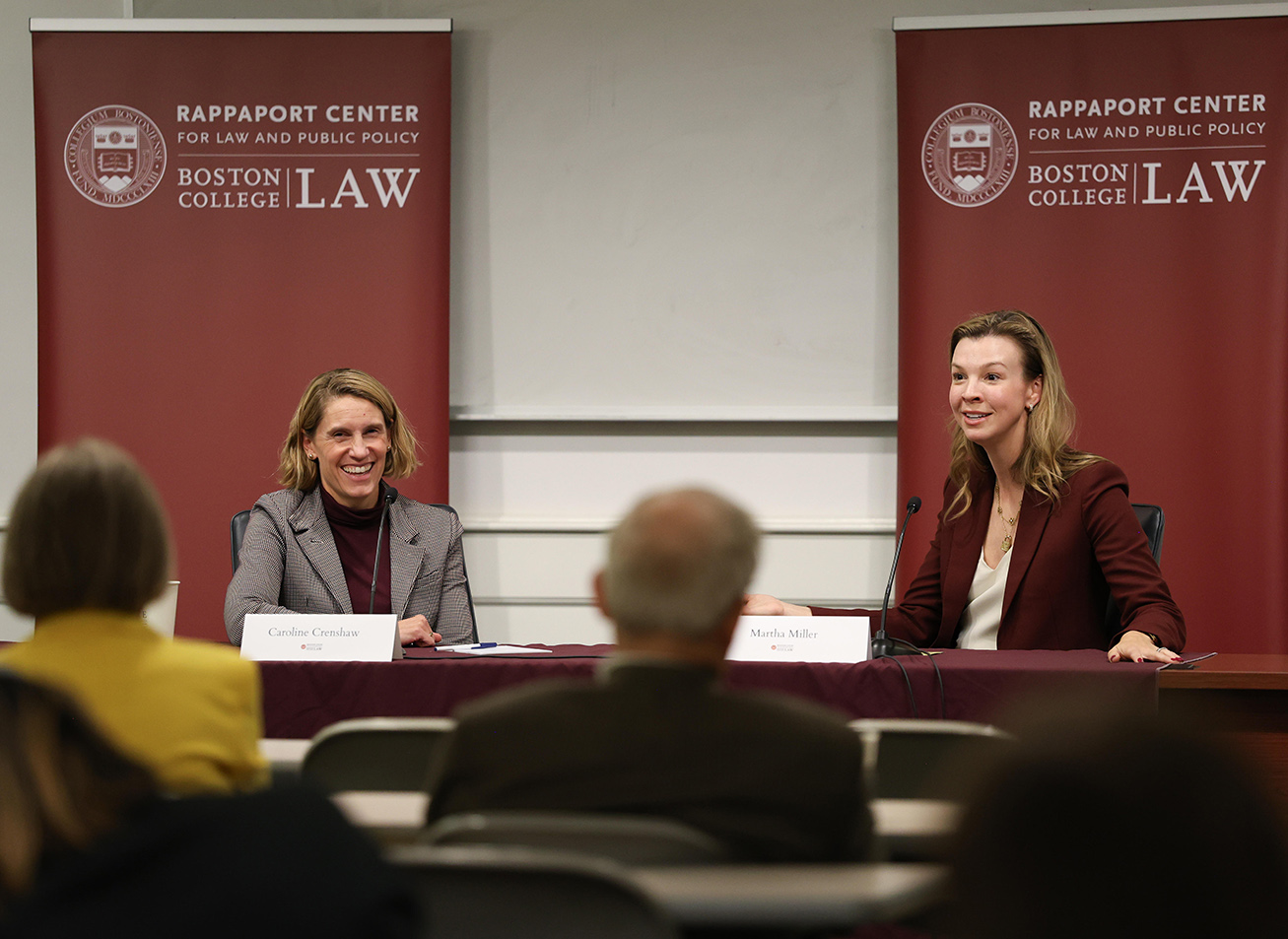
During the second day of her residency, Crenshaw participated in a fireside chat downtown with Martha Miller, senior vice president of policy and regulatory at Fidelity Investments. Introduced by Professor Renée Jones, who also worked at the SEC, Crenshaw and Miller engaged in a lively conversation about Crenshaw’s path to the commissioner position and reflected on the meaningful impact that the SEC’s work has on real people.
As a member of the JAG Corps, for example, Crenshaw would often meet enlisted people whose financial security were impacted by the SEC’s policy decisions. She stressed the importance of the SEC to ensure fair markets, facilitate capital formation, and protect investors. At a reception after the fireside chat, Crenshaw connected with students from law schools across Greater Boston, suggesting that they take seriously their capacity to improve public policy, whether at the SEC or beyond.
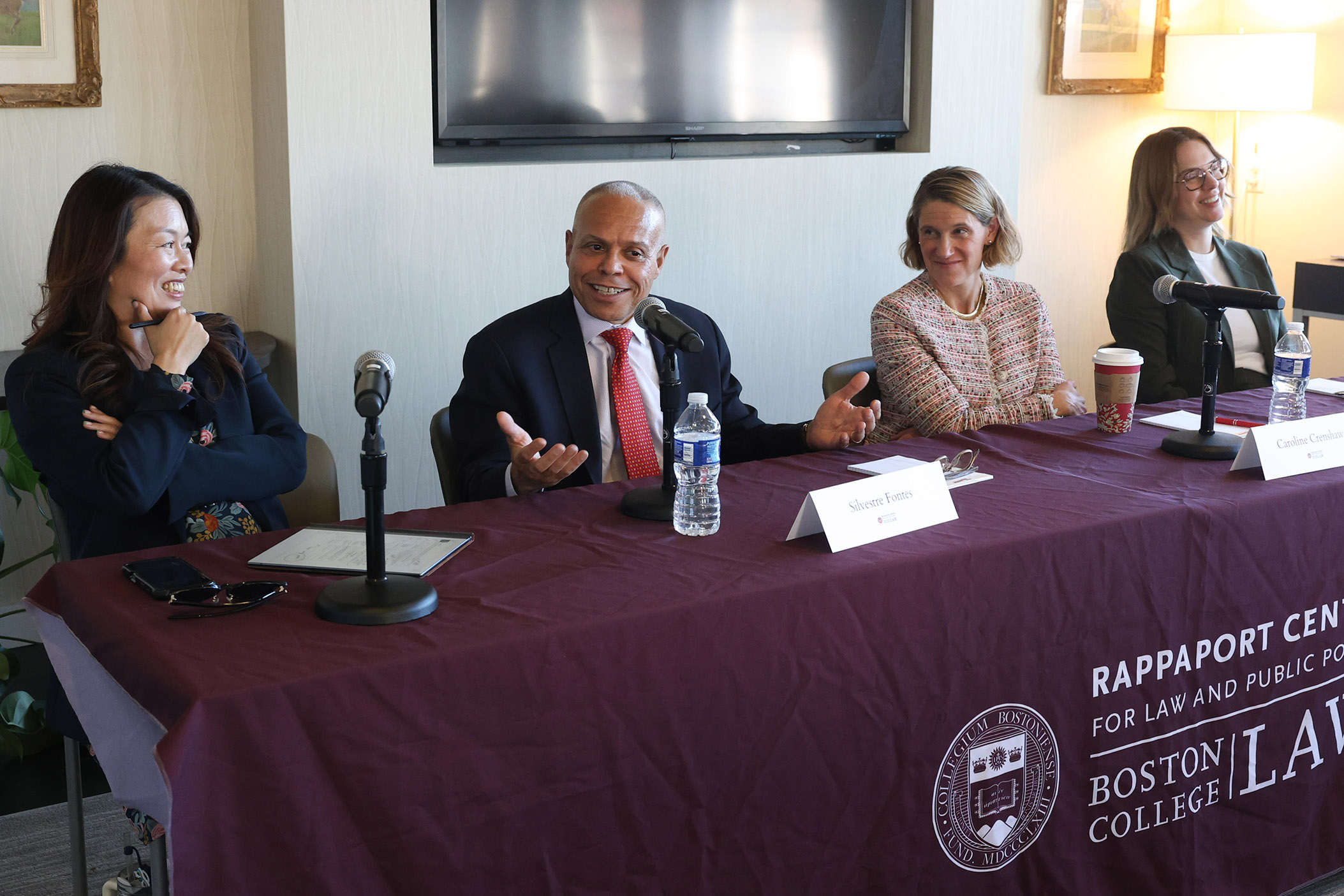
Crenshaw continued this theme on her final day, when she participated in a campus career panel co-sponsored by the Business Law Society, Student Veterans Association, and Women’s Law Coalition. Silvestre Fontes, chief risk and compliance officer at the SEC Boston Regional Office, and Susan Poklemba, a financial services attorney at Venable LLP and former SEC attorney, joined Crenshaw for the discussion. Panelists explored the arc of their careers pivoting between government and private firms, and advised students to be open to the many opportunities that will present themselves along their careers. Law is the story of people’s lives, Crenshaw explained, and all three panelists urged students to see themselves as leaders who will shape the next chapter of that story.