


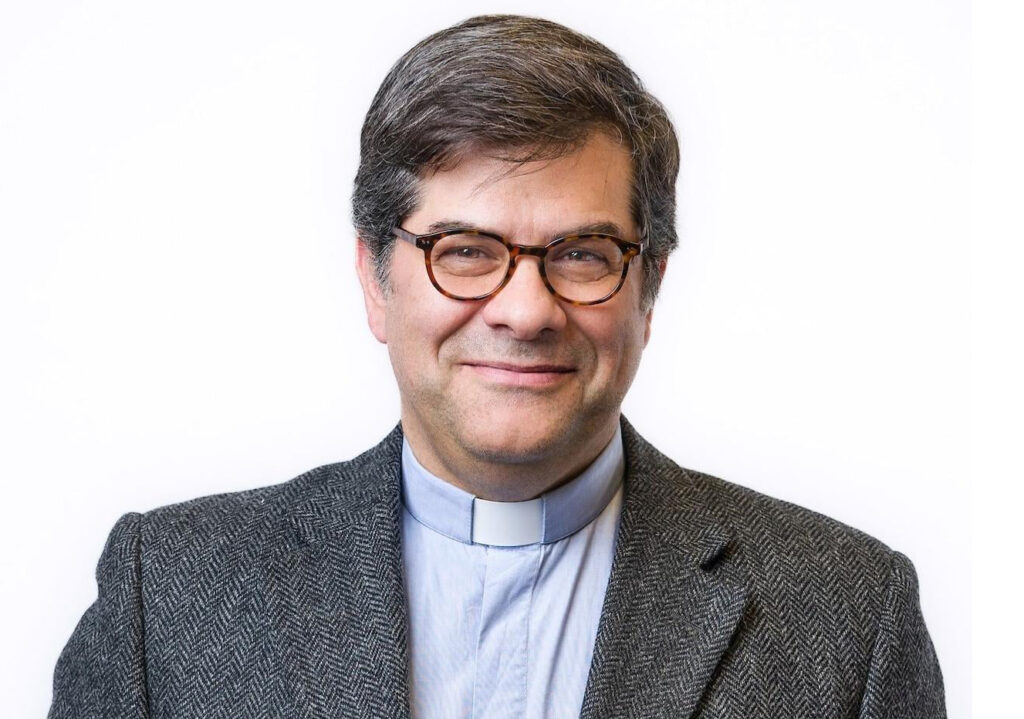
Afonso Seixas-Nunes, SJ, joins Boston College Law School with a scholarly background that spans international humanitarian law, artificial intelligence, human rights, and the ethics of warfare. A Jesuit priest and scholar of international law, Seixas-Nunes has devoted much of his career to examining how emerging military technologies challenge longstanding legal principles, particularly when autonomous weapons make decisions that can have life-or-death consequences.
Born in Porto, Portugal, Seixas-Nunes earned his law degree from Portuguese Catholic University before entering the Society of Jesus. He subsequently studied philosophy and theology, earned a master’s degree in international law and human rights from the London School of Economics, and completed his doctorate in international humanitarian law at the University of Essex. His research led him to a postdoctoral fellowship at the University of Oxford’s Institute for Ethics, Law, and Armed Conflict and later to Saint Louis University School of Law.
His scholarship includes The Legality and Accountability of Autonomous Weapon Systems: A Humanitarian Law Perspective, published by Cambridge University Press, as well as research examining the responsibility of military commanders, designers, and programmers for violations of international humanitarian law involving autonomous systems. His work has also brought him into conversations with military officials and defense experts across Europe and beyond. At BC Law, Seixas-Nunes will bring these interdisciplinary perspectives to courses addressing the laws of armed conflict, human rights, and outer space law. As he begins this new chapter, he reflects on the experiences that shaped his scholarship, the questions that continue to challenge international law, and why the human consequences of technological advancement must remain at the center of the conversation.
Q: You began your career studying law in Portugal, but your path has since taken you through philosophy and theology, international law, and human rights at the London School of Economics, and doctoral work in international humanitarian law at Essex. How did international humanitarian law ultimately become the field that brought those different interests together?
Seixas-Nunes: I studied law in Portugal, and when I finished law school, I was invited to join the faculty. But I joined the Jesuits instead. It was a difficult process deciding between law and religious life, but I thought that was what God wanted, and I was very happy with it. So, in a way, I put law on the shelf. Then, during my theological studies, I received an email from my provincial in Portugal telling me that Pope Benedict had asked the Jesuits for experts in the laws of war, or international humanitarian law, and asking whether I would be available to return to law.
I decided to finish theology first and then pursue a master’s degree because international law develops and changes so quickly. I was actually very scared of returning to law, so I applied to only one school, the London School of Economics. Luckily, or unluckily, I was accepted. At the beginning, I thought that would be it. But I had two amazing professors who convinced me to pursue a PhD. My master’s thesis had examined the legitimacy of American drone strikes in Pakistan. When I applied for my doctorate, my future supervisor suggested that, since so many people were already working on drones, I should explore the question of autonomy.
This was around 2014, when artificial intelligence was becoming a very fashionable subject, but nobody really knew what AI would be able to do. Through my PhD, I began discovering how AI is embedded in almost everything we do and the complexity of deploying autonomous systems on the battlefield. Later, at Oxford, I began working with governments, and that is where the subject became truly multidisciplinary. When lawyers hear the word autonomy, we immediately think about accountability. For robotics experts, autonomy might simply mean that a system does not need human supervision. And if you ask a philosopher what autonomy means, you might get a six-hour discussion. I tried to bring those different perspectives together and find a common language.
But there was also a much more personal reason for pursuing international humanitarian law. When you study the laws of war, you deal with the worst that humanity can do: killing, destruction, and suffering. At one point, reading international criminal cases became very depressing. I remember reading Article 32 of Additional Protocol I, which concerns the right of families to know the fate of their relatives. That same day, I saw news about three American soldiers who had been killed in Afghanistan. Their bodies were returning to the United States with well-deserved military honors. But in the same attack, 12 innocent civilians had also been killed, and they were reduced to numbers.
That was what began motivating me personally. We talk about 12 people killed or 100 people killed, but these are human beings. I decided that I wanted to dedicate my life to those unknown civilians who become numbers, people without faces in the way we talk about war.
Q: In your work, you distinguish between genuinely autonomous systems and weapons that simply operate according to predetermined instructions. Why is a system’s ability to adapt to changing circumstances so central to the legal questions you’re asking?
Seixas-Nunes: This is a question that lawyers, especially lawyers dealing with military affairs, do not always ask. The United States Department of Defense is one of the few that has called attention to adaptability as an important element of autonomous weapons systems. Imagine that I create a robot to go to the common room and bring me a coffee. It has a determined path. We know where the room is, and we know where the coffee machine is. That is what we call a determinate system. But imagine that students are crossing the corridor. Will the robot stop to allow them to pass? Or imagine that someone is already preparing a coffee. Will the robot wait?
When we talk about adaptability, we are talking about unpredictable circumstances in the environment that require a device to adapt in order to accomplish its mission. When you put this concept into the context of a battlefield, everything changes. You might have civilians around a military target. You might have weather conditions that dramatically reduce visibility. These are circumstances that a system needs to respond to. Artificial intelligence, especially newer models that can receive new data and adapt, theoretically offers a great advantage in these situations.
We talk about the three Vs and the three Ds. The three Vs are variety, volume, and velocity, because AI can process a variety and volume of data at a velocity that is impossible for a human operator. The three Ds are dirty, dull, and dangerous missions, particularly missions that would traditionally require human soldiers on the ground. That is why adaptability is at the center of these discussions. It allows systems to respond to circumstances that could not necessarily have been anticipated beforehand.
Q: Another central concern in your scholarship is the so-called accountability gap surrounding autonomous weapons. How has your thinking about that gap evolved as technology and your own work have developed?
Seixas-Nunes: I published my book in 2022, and already some of the paradigms on which I based it are becoming outdated. They are not completely outdated, but AI is developing so quickly that things we once thought impossible are now possible. In artificial intelligence, we sometimes talk about winters and summers. Winters are periods when development slows, and summers are periods when engineers overcome obstacles and technology advances. We have been living in a summer for a long time.
When I first wrote about the accountability gap, I thought it was, in some respects, a false question. In its 1996 advisory opinion on nuclear weapons, the International Court of Justice established that the principles of international humanitarian law apply to weapons of the past, present, and future. States remain responsible for the weapons they deploy. The problem today is the complexity of these systems. When I was writing my PhD, the idea of swarms of drones operating together was almost a dream. Now we are talking about enormous numbers of drones operating simultaneously. That dramatically increases the complexity.
We also have multistate operations. Imagine that intelligence is provided by the United States, the drones are German, and they are operating in Israel. If something goes wrong, how do you determine which state should be responsible for compensation? This becomes especially difficult because machine learning algorithms and neural networks are what we call black box systems. We cannot always understand how the system connects the data it receives to reach a particular outcome.
Another problem is the distinction between malfunctions and errors. Traditionally, a malfunction involves a technical problem with a weapon. But with AI, we also have software errors. These systems can make errors of judgment, much as humans do. They process enormous amounts of information and sometimes arrive at a conclusion that turns out to be wrong. The distinction matters because states may treat malfunctions differently from software errors when determining legal responsibility and compensation. So the question is no longer simply whether someone can be held accountable for an autonomous weapon. It is also how we identify responsibility when these systems are so complex, when multiple states are involved, and when we cannot fully explain why a system acted as it did.
Q: More recently, you’ve turned particular attention to designers and programmers, asking when they might bear responsibility for violations committed by autonomous systems. What led you to look further back in the chain of decisions that precedes a weapon’s deployment?
Seixas-Nunes: Imagine that you want to prepare a fancy dinner for some friends, but you do not have much experience cooking. Of course, you call someone who cooks very well and ask for suggestions. With AI on the battlefield, something similar happens. Military forces are receiving training in AI systems, but one thing is knowing how to use AI in everyday life, and another is understanding the technology operating inside a particular system. When military commanders have questions about how a system operates, they will turn to engineers and AI specialists.
What I think is that these specialists, when advising commanders, are ultimately making an assessment of risk. They are looking at the circumstances, the targets, and the technology, and deciding whether a particular deployment is safe. That assessment of risk needs to be taken into account if violations of international humanitarian law occur. There is a legal concept called dolus eventualis, which concerns situations where someone foresees the possibility of an unlawful outcome and nevertheless accepts the risk. If an operator or programmer recognizes that a system could unlawfully target civilians or destroy civilian objects, the question becomes whether that person’s acceptance of the risk should create legal responsibility. Of course, this would imply a significant change in international criminal jurisprudence. But we are beginning to see courts consider questions of recklessness and the responsibility of corporations for how technologies are designed and used.
Another problem that I think will dramatically change how we perceive law is the role of corporations in the AI world. Normally, we think about states as the owners of military technology. But increasingly, major corporations possess the technology and understand how the hardware and software operate. Look at companies developing artificial intelligence or at what SpaceX has accomplished in outer space. States will face significant difficulties determining who controls these technologies, who understands them, and who should bear responsibility when something goes wrong. I think those will be some of the major legal challenges of the future.
Q: You’ve had opportunities to discuss these questions with scholars and people working in defense and technology, including through engagements with the Dutch and Portuguese ministries of defense. How have those encounters shaped the way you approach these questions as an academic?
Seixas-Nunes: I have had the privilege of working with military and government institutions in several countries, including Denmark, Portugal, the Netherlands, Israel, and the United Kingdom. What you learn is similar to what happens when a law student goes to a law firm. In law school, you learn the legal framework that allows you to build a legal mind. But when you go to a law firm, you encounter real problems, real clients, and real circumstances. It is very nice to write theories in books, but military commanders face practical problems on the battlefield. AI has been raising many questions, particularly with the extensive deployment of drones in the conflict between Russia and Ukraine.
Working with military personnel has radically changed my perception of them. Sometimes we imagine that military operators press a button to initiate an attack as casually as we answer a telephone call. But these people are moral agents. They understand that what they are doing may be lawful and necessary, but they also know that it has a human cost. People will be killed. Property will be destroyed. And even when an operation is legitimate and lawful, those decisions can have a tremendous psychological impact on the people making them.
We know, particularly in the United States, how soldiers struggle with post-traumatic stress disorder. That reflects the moral involvement of people in situations of destruction. What really changed my perception was recognizing how these human beings are called to serve their countries in terrible circumstances and must make decisions that they know will have irreversible consequences. These people are genuinely concerned with getting things right. My respect for the armed forces and military personnel has grown tremendously through these experiences. I am grateful that I study these questions, but I am also grateful that I am not the person who has to make those decisions on the battlefield.
Q: At BC Law, you’ll teach the laws of armed conflict and potentially human rights law, as well as a seminar in outer space law. What connects these subjects in your own thinking and teaching?
Seixas-Nunes: The connection has everything to do with artificial intelligence. Imagine that you are using WhatsApp to communicate with a friend in China. The information might travel through satellites, and increasingly, much of that infrastructure is owned or operated by private corporations. That raises a very important question: What access should these corporations have to our private information? This is not a criticism of any particular company, but we need to ask how we establish boundaries between the information that corporations can access and what belongs to our private lives.
In outer space, this is tremendously difficult because we cannot see the infrastructure or necessarily know who operates it. That connects directly to human rights. Do we still have a meaningful right to private life in a world where technology can collect so much information about us? We see similar problems in everyday life. Think about supermarket loyalty cards. They might contain your name, address, phone number, and purchasing habits. That information can be used to create a profile of you as a consumer, and there have been cases involving companies selling that information to others.
Now consider the laws of war and national security. States need to identify threats, particularly in a world where terrorist attacks can be planned by people living in ordinary communities. That creates pressure for states to conduct surveillance and collect information. But how much information should a state be allowed to collect about you? What information should it be allowed to keep? Should it eventually be required to delete your personal data?
These are questions about national security, human rights, and technology, but they are also connected to outer space because so much of the infrastructure involved operates through satellites. So all three fields come together through the questions that artificial intelligence and emerging technologies raise about privacy, security, and the boundaries of state and corporate power.
Q: Your scholarship often deals with situations in which existing legal principles must be applied to technologies or circumstances their drafters could not have anticipated. How does that uncertainty carry over into the way you teach students to approach unsettled questions of law?
Seixas-Nunes: When I teach seminars, especially on autonomous weapons and cybertechnology, I never tell my students what I think. Sometimes students ask me directly for my opinion, but I refuse to answer because I think these are very personal questions. I want students to make up their own minds about what they think should be possible, what should be forbidden, and where the limits should be. Law develops over time and responds to new challenges. Reaching consensus among states is difficult, but society and academia have an important role in calling attention to areas that need regulation.
AI forces law students to think differently. I remember speaking at a conference where a woman in the audience was very much opposed to artificial intelligence, particularly its use in warfare. She was also surprised to hear a priest speaking about war. I gave her an example, “Imagine that we receive information that a suicide bomber is on a subway platform, and we have an autonomous device capable of stopping the attack. Would you use it?” She said no, as a matter of principle. Then I asked, “What if your daughter were on that platform?” Suddenly, the question became more complicated.
That is where things become difficult because we can think about principles in the abstract, but we also need to ask whether those principles actually protect people. When we establish laws, we are protecting certain values, and we need to commit ourselves to those values. AI forces us to think and rethink what values we want to protect. I think it is a fascinating time to ask what kind of human beings we want to be.
Q: As you begin your time at Boston College, where do you see your research going next?
Seixas-Nunes: I am starting a new project in outer space law. From a technical point of view, it is very difficult because there is so much to understand about what satellites can do and how these technologies operate. Even the technical language is very challenging for me, so it will take some time. I am also thinking, if things go well and with the support of colleagues at Boston College, about creating a symposium next year on the challenges of outer space. I would like it to examine not only privacy, but also technology, warfare, and environmental questions.
There is a great deal of debris in outer space, and some of it enters the atmosphere and affects people on Earth. So when I talk about outer space, I am looking at it from a multidisciplinary perspective. I think outer space will gain enormous importance in the coming years, particularly as military technologies and activities in space continue to develop.
Q: You’re joining another Jesuit institution, now as both a Jesuit priest and a scholar of international humanitarian law. Is there something distinctive about pursuing this work within a Jesuit law school?
Seixas-Nunes: Yes and no. I think our style as Jesuits is not to impose our faith. Boston College is clearly a Catholic institution, but that does not mean we are here to convince students of what they should believe. I think there is a particular Jesuit way of pursuing truth, and I hope our institutions are built to help students find their own truth. That is a challenge for everyone, priests and laypeople alike. We need to ask ourselves what we think about the issues we encounter.
Jesuits have this terrible vice of asking people questions to make them think. One thing that has surprised me about Boston College is that people are not afraid to ask questions. In faculty workshops and meetings, they do not stop asking questions. I think that can only happen in a very vibrant academic environment. Otherwise, people simply focus on their own work without engaging with the questions other scholars are asking. As a new faculty member, I am really thrilled because I see a very inquisitive academic community, and also a very friendly one, which is not always common among lawyers. I am very happy to be here, and I hope that is part of the Jesuit spirit.