


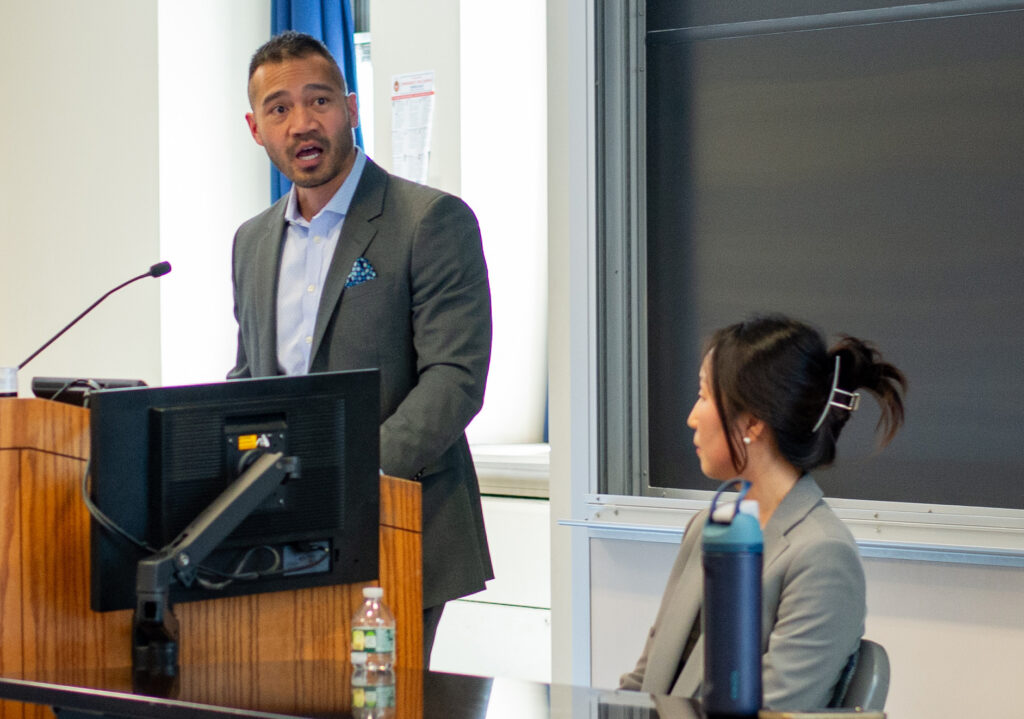
AI is not core to being a lawyer, and it does not change the central qualities that define what it means to be a good lawyer, but it does require managing, according to David Kemp, AI and innovation training manager at Ropes & Gray LLP.
“We don’t believe at Ropes that AI will replace, or can replace, junior lawyers or lawyers at any level,” Kemp said. “We do recognize that it can absorb and do some tasks very well, but someone has to be there to manage it, control it, supervise it, manage its outputs, and so on.”
On November 3, two members of Ropes & Gray’s AI Training Group visited Boston College Law School to speak at an event titled, “Thinking Like a Lawyer in the AI Age.” Kemp and Joanne Hyun ’21, legal AI training manager, discussed how the firm perceives and utilizes AI. The program was part of BC Law’s efforts to offer more workshops, trainings, and discussions around AI tools in law school and the profession, one of the recommendations that came from the School’s AI Task Force preliminary report last year.
Kemp stressed that tool proficiency with AI matters later on, but law students should instead focus on developing sound legal judgment. “A lot of what we’re trying to instill in lawyers and law students is how to think about AI as a tool, not just push the right buttons and type the right things,” Kemp said.
Taking a step back, Kemp asked attendees to think about why lawyers are using AI. He said one clear reason is efficiency, but Ropes & Gray also encourages its attorneys to consider AI for opportunity as well.
“What are we able to do with AI that’s better than what we could do without AI, not just faster?” Kemp asked. “And so by shifting our thinking to what can AI provide in terms of opportunity, we start thinking … maybe we can consider additional strategic options, or maybe we can improve the quality of the precedent research we’re doing.”
Hyun broke down Ropes & Gray’s framework for the responsible use of AI, which requires attorneys to own the thinking, control the AI, and explain the process. Owning the thinking involves attorneys analyzing their tasks, coming to initial judgments so they can later determine if AI output aligns with their expectations. To control the AI, attorneys competently prompt and ground AI tools and verify AI claims against other sources.
“The last part is my favorite … which is to explain the process and have a stigma-free, open conversation with the teams you’re working on, starting with something like, ‘I used AI for filling this table out, I reviewed all the outputs, I verified that it’s there, and that I agree with it,” Hyun said.
Ropes & Gray uses a wide range of AI tools but approves them for designated tasks. Huan walked attendees through how attorneys might specifically employ AI in due diligence review, for example. Kemp said that the firm considers what lawyers really need, rather than just buying or building everything.
“We as a firm are very AI forward, but that doesn’t mean we are just going to throw AI at everything,” Kemp said. “We’re really thinking about what is the best tool for achieving the highest quality client service.”
Kemp and Hyun concluded their talk by giving Boston College Law students advice on how to convey their legal judgment throughout the recruiting process. Kemp said one important aspect is demonstrating a healthy dose of curiosity and skepticism towards AI.
“Show curiosity about its potential, but not an unreserved curiosity.” Kemp said. “Recognize that it does have limitations and maybe share an experience that you had where you checked something that looked right, but found it wasn’t. That demonstrates that you aren’t just brought in by a polished and nice-looking answer.”
Photograph by Kasra Raffi